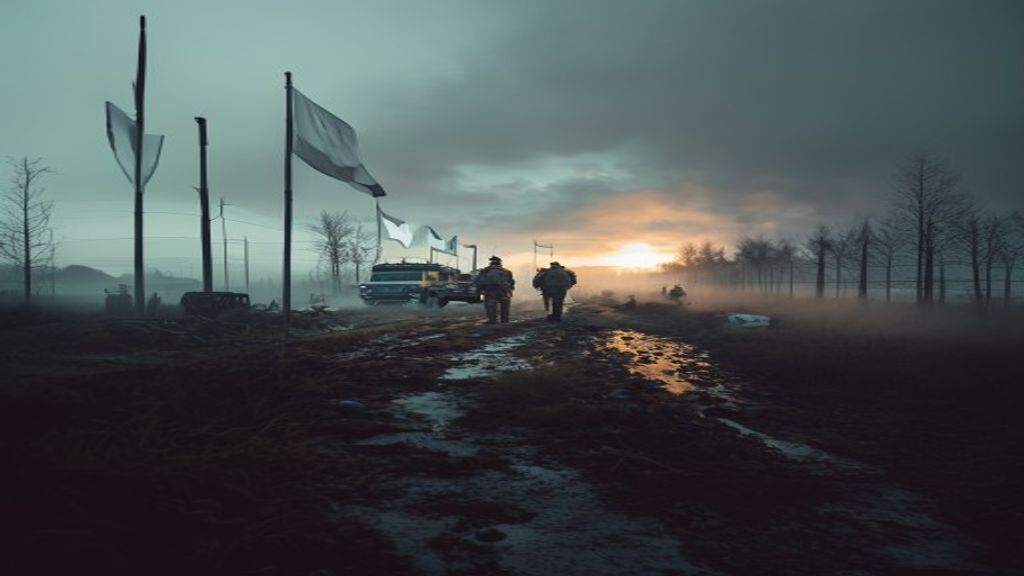

KYIV — Russia and Ukraine have agreed to a United States-brokered three-day ceasefire running from May 9 to May 11, 2026, marking the most significant pause in hostilities since the full-scale invasion began more than four years ago, with both sides set to exchange 1,000 prisoners of war each as part of the landmark arrangement.
The truce coincides with Russia’s Victory Day, an annual commemoration of the Soviet defeat of Nazi Germany in World War II — a holiday of deep symbolic significance for the Kremlin and one that President Vladimir Putin has repeatedly used to frame his war in Ukraine as a continuation of that historic struggle. The agreement came after Moscow had initially announced a narrower two-day unilateral ceasefire for the holiday period before the broader US-mediated deal expanded the scope and duration. President Volodymyr Zelenskyy also ordered Ukrainian forces not to attack Moscow’s Red Square during the Victory Day military parade, a gesture that added a layer of diplomatic goodwill to an otherwise fragile arrangement. The deal involves a full suspension of kinetic military activity on both sides, encompassing ground operations, aerial strikes, and artillery fire along the entire front line.
| Parameter | Details |
|---|---|
| Ceasefire Duration | Three days — May 9 to May 11, 2026 |
| Mediator | United States administration |
| Prisoner Exchange | 1,000 POWs from each side (2,000 total) |
| Key Figures | President Zelenskyy, President Putin, President Trump, Kremlin aide Yuri Ushakov |
| Trigger Event | Russia’s Victory Day commemorations on May 9 |
| Scope | Full suspension of kinetic military activity on both sides |
| Initial Russian Proposal | Two-day unilateral ceasefire (later expanded to three-day bilateral deal) |
Situational Breakdown
The ceasefire agreement emerged from what Kremlin aide Yuri Ushakov described as intensive telephone contacts with the US administration. Russia had initially signalled a more limited gesture — a two-day unilateral pause in fighting to mark the Victory Day holiday — but American diplomatic pressure expanded the framework into a bilateral three-day truce with the significant addition of a prisoner exchange involving 2,000 combatants. The evolution from a unilateral Russian announcement to a negotiated bilateral agreement suggests Washington played a more active brokering role than either side has publicly acknowledged. — Al Jazeera
President Zelenskyy’s decision to order Ukrainian forces not to strike Red Square during the Victory Day parade represents a calculated diplomatic concession. While largely symbolic — Ukraine has rarely targeted central Moscow directly — the order signals Kyiv’s willingness to engage in confidence-building measures, even as its forces continue to hold defensive positions across the eastern and southern front lines. The move also removes a potential provocation that could have given Moscow a pretext to abandon the ceasefire before it began. — Euronews
The prisoner exchange component may prove to be the most consequential element of the deal. With 1,000 prisoners returning to each side, families across both nations will see loved ones come home for the first time in months or years. Previous smaller-scale exchanges have been emotionally charged affairs that briefly united public opinion on both sides around the human cost of the conflict, and this exchange — the largest of the war — is expected to carry even greater weight. — RFE/RL
The American Role: Trump’s Diplomatic Gambit
President Donald Trump framed the ceasefire as evidence of mounting diplomatic momentum toward ending the war entirely. In a post on Truth Social, he suggested that the agreement represented meaningful progress, indicating that all parties were getting closer and closer every day to ending the conflict, and expressing hope that this could mark the beginning of the end.
“We are getting closer and closer every day to ending this war — hopefully this is the beginning of the end.”
Trump’s involvement in mediating between Moscow and Kyiv represents a continuation of his administration’s efforts to position the United States as the indispensable broker in the conflict. The approach mirrors Washington’s broader strategy of leveraging relationships with both parties — a tactic also visible in US Strikes Iranian Military Sites After Warship Attacks in Hormuz, where American military and diplomatic power were deployed simultaneously across multiple theatres. Whether Trump can translate a three-day ceasefire into a lasting peace framework remains the central question hanging over the agreement.
Victory Day: Symbolism and Strategic Calculation
The timing of the ceasefire is no coincidence. Victory Day on May 9 is arguably the most politically significant date on Russia’s national calendar, a day when the Kremlin stages massive military parades through Red Square and Putin delivers speeches connecting the Soviet Union’s World War II sacrifice to Russia’s present-day military posture. By tying the ceasefire to this occasion, the deal allows Putin to project strength at home — a wartime leader magnanimous enough to pause fighting on a day of national triumph — while also creating space for the prisoner exchange to dominate headlines.
For Zelenskyy, accepting a ceasefire framed around a Russian holiday required political courage. Critics within Ukraine may argue that honouring Victory Day lends legitimacy to Moscow’s narrative. However, Kyiv appears to have concluded that the return of 1,000 Ukrainian prisoners of war — soldiers, medics, and civilians held in Russian detention — outweighs the symbolic cost of a temporary pause. As Al Jazeera reported, the exchange represents the single largest repatriation of Ukrainian POWs since the conflict began.
The Prisoner Exchange: Human Stakes Behind the Headlines
The exchange of 2,000 prisoners — 1,000 from each side — will be the most logistically complex humanitarian operation of the war to date. Previous exchanges, often brokered by Turkey or the International Committee of the Red Cross, involved dozens or at most a few hundred prisoners. Scaling to 1,000 per side within a 72-hour window requires extensive coordination on the ground, including designated handover points, medical screening, and transportation infrastructure.
Kremlin aide Yuri Ushakov confirmed that the agreement was reached during direct telephone contacts with the US administration, suggesting that Washington provided both the diplomatic framework and possibly logistical guarantees for the exchange.
“An agreement on the ceasefire was reached during our telephone contacts with the US administration.”
For the families involved, the exchange transcends geopolitics. Mothers in Kharkiv and Rostov alike have spent years not knowing whether their sons and daughters are alive. The scale of this swap — unprecedented in the conflict according to BBC reporting — could reshape public sentiment in both countries and build domestic pressure for a more permanent cessation of hostilities. Humanitarian organisations have long argued that prisoner exchanges are among the most effective trust-building measures available to warring parties, and this exchange may test that thesis at scale.
Fragility of the Truce: What Could Go Wrong
Three-day ceasefires in active war zones are inherently unstable. With hundreds of kilometres of front line, thousands of individual units, and deeply entrenched mistrust on both sides, even a single incident — an accidental artillery discharge, a drone malfunction, a rogue unit — could unravel the agreement within hours. Neither Moscow nor Kyiv has announced independent monitoring mechanisms, and the absence of a neutral verification body raises serious questions about enforcement.
Historical precedent offers limited comfort. Ceasefires in the Donbas region between 2014 and 2022 were routinely violated within hours of taking effect, often by both sides simultaneously. The scale of the current conflict — involving far more troops, longer front lines, and more advanced weaponry — makes compliance even harder to guarantee. As Reuters has noted, both armies have deeply entrenched forward positions that make disengagement difficult even when the political will exists.
Bolotosai Assessment
This ceasefire is significant not because three days of silence will change the military balance — it will not — but because it establishes a framework for negotiated pauses that could be extended or replicated. Three potential outcomes emerge from this moment.
First, the ceasefire holds, the prisoner exchange succeeds, and both sides use the momentum to open broader negotiations. This is the optimistic scenario, and the one Trump will aggressively promote. If 2,000 prisoners return home safely, the political cost of resuming full-scale fighting increases for both leaders. Second, the ceasefire holds but leads nowhere — a humanitarian pause that temporarily reduces suffering without altering the strategic calculus. Both sides rearm, reposition, and resume fighting on May 12. Third, the ceasefire collapses before the exchange is complete, with each side blaming the other for violations, further entrenching the conflict and discrediting future mediation efforts.
What to watch: the first 24 hours will be decisive. If both sides can maintain discipline through Victory Day itself — when nationalist emotions run highest — the remaining 48 hours become significantly more manageable. The prisoner exchange logistics will also serve as a real-time stress test of whether Moscow and Kyiv can coordinate on anything beyond killing each other. The world should pay close attention to whether this is a genuine inflection point or merely a pause before the next escalation.

 By
By

 By
By