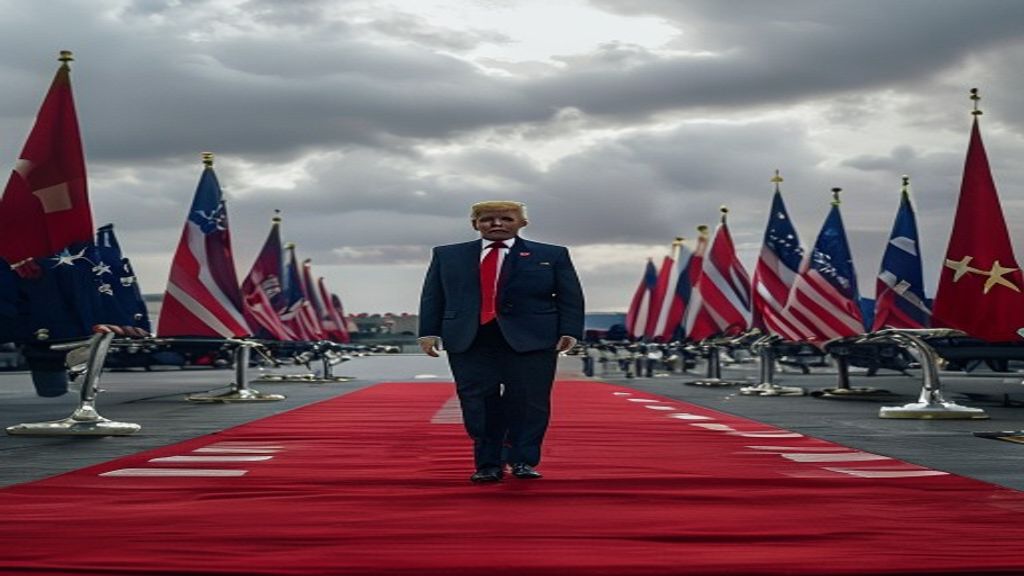

BEIJING — US President Donald Trump touched down in the Chinese capital on Tuesday for a landmark three-day state visit, the first by an American president in nearly nine years, setting the stage for high-stakes summits with President Xi Jinping that could reshape the trajectory of the world’s most consequential bilateral relationship.
The visit arrives at a moment of extraordinary geopolitical turbulence. Trump, accompanied by a powerful delegation of American business titans including Tesla CEO Elon Musk, Apple’s Tim Cook, and Nvidia chief Jensen Huang, is seeking to recalibrate Washington’s economic relationship with Beijing while navigating a thicket of security crises stretching from the Taiwan Strait to the Persian Gulf. The summit sessions with Xi, scheduled for Thursday and Friday, are expected to centre on trade — particularly deals involving US food and aircraft exports — but the agenda extends far deeper into the architecture of 21st-century power.
For both leaders, the political calculus is delicate. Trump faces mounting domestic pressure from inflation driven by surging fuel prices, while Xi is managing a Chinese economy still searching for post-pandemic momentum. The outcomes of this summit will reverberate well beyond Beijing and Washington, with world leaders from Singapore to Brussels closely monitoring every signal on Iran, Taiwan, and the future of global trade.
| Parameter | Details |
|---|---|
| Key Figures | President Donald Trump (US), President Xi Jinping (China) |
| Visit Duration | May 13–15, 2026 (three days) |
| Summit Sessions | Thursday and Friday (May 14–15) |
| Business Delegation | Elon Musk (Tesla), Tim Cook (Apple), Jensen Huang (Nvidia) |
| Core Trade Agenda | US food exports, aircraft deals |
| Security Issues | Taiwan, Iran war, technology restrictions, AI policy |
| Last US Presidential Visit | Nearly nine years ago |
Situational Breakdown
Trump’s arrival in Beijing was carefully choreographed, with Chinese state media broadcasting live coverage of the presidential motorcade moving through the capital’s broad avenues. The symbolism was unmistakable: after years of escalating tariffs, technology bans, and diplomatic frost, both sides are signalling a willingness to explore détente — or at least the appearance of one. Trump himself framed the visit in transactional terms, telling reporters aboard Air Force One that he would discuss trade with Xi “more than anything else” and that he was seeking concrete deals for American food and aircraft exports. — CNBC
The presence of Musk, Cook, and Huang underscores the commercial dimensions of the trip. Each executive represents a sector deeply entangled with Chinese supply chains and markets: Tesla’s Shanghai gigafactory, Apple’s vast manufacturing partnerships, and Nvidia’s dominant position in the AI chip market that Washington has sought to restrict through export controls. Their inclusion in the delegation suggests that the Trump administration views commercial engagement as both a diplomatic lever and a domestic political necessity, particularly as inflation continues to erode the president’s approval ratings. — South China Morning Post
Yet the trade agenda cannot be separated from the security landscape. The US-Iran ceasefire is teetering on collapse, with fuel price spikes rippling through the American economy and intensifying political pressure on Trump to deliver results abroad. Meanwhile, Beijing has its own calculations regarding Iran, Taiwan, and the broader question of whether Washington’s technology restrictions represent a permanent feature of the relationship or a bargaining chip to be traded away. — Al Jazeera
The Trade Equation: Food, Aircraft, and Leverage
At the heart of the summit lies an old-fashioned grand bargain: American agricultural products and Boeing aircraft in exchange for Chinese concessions on market access and, potentially, reduced tensions on other fronts. Trump has long viewed trade deficits as scoreboards, and the US-China imbalance remains one of the largest in global commerce. Securing high-profile export deals would give the president tangible deliverables to present to American farmers and manufacturers ahead of the midterm political cycle.
“I’ll be discussing trade with President Xi more than anything else. We want to sell our food, we want to sell our planes — and China wants to buy them.”
But the economics are layered with strategic complexity. Boeing’s position in the Chinese market has eroded significantly amid years of political tension and competition from China’s domestically produced C919 aircraft. Any aircraft deal would represent not just a commercial transaction but a political statement about the trajectory of the relationship. Similarly, food export agreements would need to navigate a web of sanitary standards, tariff structures, and the ever-present risk that such deals become hostage to future political disputes.
The Shadow Agenda: Taiwan, Iran, and AI
While trade will dominate the public narrative, the most consequential conversations may happen behind closed doors. Taiwan remains the single most dangerous flashpoint in the US-China relationship, with Beijing viewing the island as a core sovereignty issue and Washington maintaining its policy of strategic ambiguity backed by arms sales. Any shift in rhetoric from either leader — even a subtle one — will be parsed by defence analysts and foreign ministries across the Indo-Pacific.
The Iran situation adds another volatile dimension. The US-Iran ceasefire on ‘life support’ creates an urgent backdrop for the summit, as China remains one of Iran’s most important economic partners and a key player in any diplomatic resolution. Trump may seek Beijing’s cooperation in pressuring Tehran, but Xi will extract his own price for any such assistance — likely in the form of relief from technology export controls or concessions on Taiwan policy.
Artificial intelligence policy represents perhaps the newest and most complex item on the agenda. Washington’s restrictions on advanced chip exports to China have become a major irritant in the relationship, and the presence of Jensen Huang — whose Nvidia chips are at the centre of the AI hardware competition — signals that this issue will feature prominently. Both nations recognise that AI governance will define the next era of geopolitical competition, and whether they can find common ground on safety frameworks while competing fiercely on capabilities remains an open question.
The Business Delegation: Corporate Diplomacy in Action
The composition of Trump’s business delegation tells its own story. Elon Musk, whose relationship with the Chinese government has been notably warmer than his interactions with many Western regulators, brings both commercial interests and a complicated political profile. His role in the Trump administration and his extensive business operations in China create a unique nexus of influence that Beijing will seek to leverage.
Tim Cook’s presence reflects Apple’s deep dependence on Chinese manufacturing — a vulnerability that has become increasingly apparent amid supply chain disruptions and geopolitical tensions. Cook has historically maintained a careful diplomatic balance with Beijing, and his inclusion suggests the administration wants to signal continuity of commercial engagement even as it maintains pressure on technology transfer and intellectual property issues.
“World leaders from Singapore to Brussels are closely watching the summit for signals on Iran, Taiwan, and global trade.”
Domestic Pressures on Both Sides
Neither leader arrives at the negotiating table from a position of uncomplicated strength. Trump’s presidency is being weighed down by inflation driven largely by surging fuel prices — themselves a consequence of the instability in the Persian Gulf and broader energy market disruptions. American consumers are feeling the squeeze, and the president needs visible wins from this trip to shift the narrative.
Xi, for his part, faces a Chinese economy that has struggled to generate the consumer-led growth that Beijing has long promised. Youth unemployment remains elevated, the property sector continues to drag on confidence, and the technology restrictions imposed by Washington have forced costly adjustments in China’s semiconductor ambitions. A successful summit that delivers trade agreements and eases some restrictions would bolster Xi’s position domestically and reinforce his narrative of China as a responsible global power.
Bolotosai Assessment
This summit is less about breakthroughs than about establishing a floor beneath a relationship that has been in freefall. The most likely outcome is a package of modest trade agreements — agricultural purchases, perhaps a framework for future aircraft orders — wrapped in warm rhetoric about a “new chapter” in US-China relations. Both leaders need to project success, which creates incentives for carefully staged deliverables.
The harder questions — Taiwan, AI governance, technology export controls — are unlikely to see resolution in Beijing. At best, the two sides may agree to establish working groups or dialogue mechanisms, buying time without making binding commitments. At worst, a misstep on Taiwan rhetoric or a breakdown in the Iran ceasefire during the summit itself could overshadow any commercial agreements and deepen the strategic mistrust.
Three things to watch in the coming 72 hours: first, whether the trade deals announced are substantive or symbolic; second, whether there is any movement on technology restrictions, particularly AI chips; and third, how the Iran situation evolves during the summit and whether Beijing offers any concrete diplomatic assistance. The world is watching not just what Trump and Xi say to each other, but what they signal to everyone else.


 By
By



 By
By