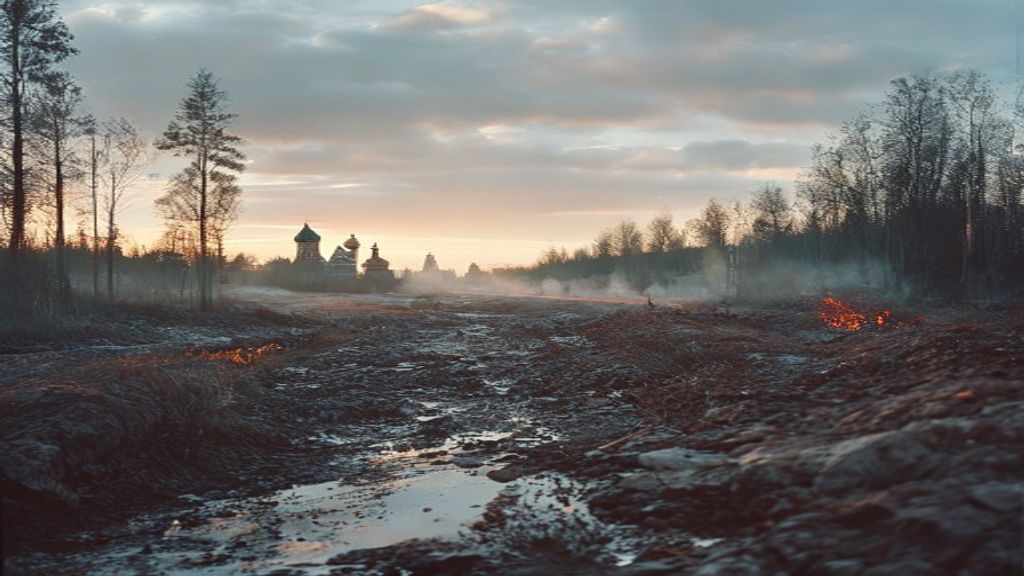

KYIV — A US-brokered three-day ceasefire between Russia and Ukraine, hailed as the most significant diplomatic breakthrough since the full-scale invasion began over four years ago, came under severe strain on its second day as both sides traded accusations of violations amid ongoing battlefield clashes along the sprawling front line.
The truce, which took effect on May 9 and is set to expire on May 11, was designed to halt all combat operations and facilitate a prisoner swap involving 1,000 detainees from each side. Washington framed the agreement as a critical confidence-building measure that could pave the way for broader peace negotiations. Yet within hours of the ceasefire’s commencement, the fragile arrangement began to fracture, raising urgent questions about whether either party possesses the political will — or the operational control — to sustain a lasting cessation of hostilities. The stakes could not be higher: with European security architecture in flux and US military assets increasingly stretched across multiple theatres of confrontation, the window for a negotiated settlement may be narrower than either Moscow or Kyiv acknowledges.
| Parameter | Details |
|---|---|
| Ceasefire Duration | May 9–11, 2026 (three days) |
| Broker | United States (President Donald Trump) |
| Prisoner Swap | 1,000 prisoners exchanged per side |
| Reported Clashes (May 10) | 147 front-line engagements reported by Ukraine |
| Drone Strikes | 27 Russian long-range drones launched; all intercepted |
| Key Figures | Vladimir Putin, Volodymyr Zelenskyy, Donald Trump |
| Conflict Duration | Over four years (since February 2022) |
Situational Breakdown
Ukraine’s General Staff reported 147 separate clashes along the front line on May 10, the ceasefire’s second day, painting a picture of a truce that exists on paper but has yet to fully materialise on the ground. The engagements spanned multiple sectors of the roughly 1,200-kilometre contact line, with Ukrainian forces alleging that Russian units continued offensive probing operations in the Donetsk and Zaporizhzhia oblasts. Kyiv’s air force command separately confirmed that Russia launched 27 long-range attack drones overnight, all of which were intercepted before reaching their targets. — CNN
Moscow, for its part, accused Ukrainian forces of provocative shelling and small-arms fire in several sectors, though Russian state media offered considerably less granular reporting on specific incidents. The mutual accusations follow a familiar pattern observed in previous localised truces, where the absence of a robust monitoring mechanism allows both sides to frame defensive postures as enemy aggression. Without neutral observers on the ground — a role previously filled in limited capacity by the OSCE — independent verification of ceasefire compliance remains virtually impossible. — Al Jazeera
The prisoner swap component of the deal appeared to proceed with fewer complications, though neither side provided comprehensive public accounting of the exchange by the ceasefire’s midpoint. Families of prisoners of war on both sides have expressed cautious relief, even as humanitarian organisations warn that thousands more remain in captivity with uncertain fates. — The Japan Times
Putin Signals Openness to Direct Talks
In what diplomats are describing as the most conciliatory language to emerge from the Kremlin in months, Russian President Vladimir Putin suggested the war may be approaching its conclusion and indicated a willingness to meet Ukrainian President Volodymyr Zelenskyy face-to-face in a third country, contingent on the finalisation of a peace framework.
Putin indicated Russia’s war on Ukraine could be coming to an end and he is open to meeting Zelenskyy abroad if peace terms are agreed — Al Jazeera
The statement, while carefully hedged, represents a notable shift in tone from Moscow, which has spent much of the past year dismissing Zelenskyy’s legitimacy as a negotiating partner. Analysts caution, however, that Putin’s rhetoric has historically oscillated between conciliation and escalation depending on battlefield dynamics and domestic political calculations. The Kremlin’s insistence that peace terms be “agreed” before any summit effectively places the burden of concession on Kyiv, a framing that European allies have previously rejected as a precondition designed to entrench Russian territorial gains.
Washington’s Balancing Act
President Trump, who has positioned himself as the indispensable dealmaker in the conflict, struck an optimistic tone regarding the trajectory of negotiations, asserting that both parties are moving closer to a resolution.
Trump said negotiations are ongoing and both sides are getting closer to a resolution every day — NPR
The White House’s role as ceasefire broker marks a reassertion of American diplomatic engagement after months in which Washington’s attention was divided across multiple geopolitical flashpoints. Trump administration officials have privately acknowledged that the ceasefire’s viability depends on sustained pressure on both Moscow and Kyiv — a delicate balancing act complicated by domestic political considerations and the administration’s broader strategic recalibration in Europe.
Critics of the administration’s approach argue that a three-day ceasefire without enforcement mechanisms amounts to little more than a diplomatic gesture, one that risks legitimising the status quo on the ground while providing insufficient guarantees to either party. European leaders, notably in Warsaw and Tallinn, have expressed concern that any peace framework negotiated primarily between Washington and Moscow could sideline Ukrainian sovereignty and undermine NATO’s eastern flank security guarantees.
The Enforcement Gap
The 147 reported clashes on a single day of a supposedly active ceasefire underscore a structural problem that has plagued every attempt at de-escalation since 2022: the absence of credible verification and enforcement mechanisms. Unlike the Minsk agreements, which at least nominally involved OSCE monitoring missions, the current ceasefire framework relies almost entirely on the belligerents’ self-reporting — a system that has proven catastrophically unreliable.
Military analysts note that front-line dynamics in a conflict of this scale make instantaneous ceasefire compliance extraordinarily difficult. With forces in close contact across hundreds of kilometres, the distinction between defensive fire and offensive action becomes functionally meaningless at the tactical level. What matters, experts argue, is the strategic trajectory: whether the overall tempo of operations decreases meaningfully over the ceasefire period, and whether the prisoner exchange proceeds in good faith.
The drone strikes present a particularly provocative data point. Long-range drone operations require deliberate planning and authorisation at levels far above the front-line unit. Ukraine’s interception of 27 such drones during the ceasefire suggests either a failure of command-and-control communication within the Russian military, or a deliberate decision to test the truce’s boundaries — neither interpretation bodes well for the ceasefire’s durability.
The Prisoner Exchange: A Rare Humanitarian Win
Amid the battlefield tensions, the prisoner swap of 1,000 detainees from each side represents one of the largest single exchanges since the conflict’s early months. For the families involved, the swap is a moment of profound relief after years of uncertainty, inadequate communication, and in many documented cases, mistreatment in captivity.
Humanitarian organisations have long argued that prisoner exchanges should be decoupled from broader political negotiations, treated as baseline obligations under international humanitarian law rather than bargaining chips. The fact that this exchange was bundled into a ceasefire package — effectively making the return of prisoners contingent on a broader diplomatic arrangement — reflects the deeply transactional nature of the current negotiations.
BolotoSAI Assessment
As the ceasefire enters its final hours on May 11, the most likely outcome is a formal expiration without renewal, followed by a resumption of full-scale military operations. The 147 clashes and 27 drone strikes on a single day demonstrate that neither side has made the operational adjustments necessary for a genuine cessation of hostilities. The ceasefire’s true value may lie not in what it achieved on the battlefield, but in the diplomatic signals it generated — particularly Putin’s stated willingness to meet Zelenskyy and Trump’s framing of accelerating progress.
Three scenarios bear watching in the coming weeks. First, the ceasefire could serve as a template for a longer, more robust truce with international monitoring — though this would require concessions on verification that Moscow has historically resisted. Second, the diplomatic momentum could dissipate entirely if battlefield dynamics shift, particularly if either side perceives a military advantage that negotiation would forfeit. Third, and perhaps most consequentially, back-channel negotiations between Washington and Moscow could produce a framework agreement that presents Kyiv with a fait accompli — a scenario that would test NATO cohesion and European security commitments to their limits.
What is certain is that the gap between ceasefire rhetoric and battlefield reality has never been more starkly exposed. The next seventy-two hours will reveal whether this three-day truce was a genuine stepping stone toward peace, or merely another pause in a war that has defied every prediction of its conclusion.

 By
By
 By
By