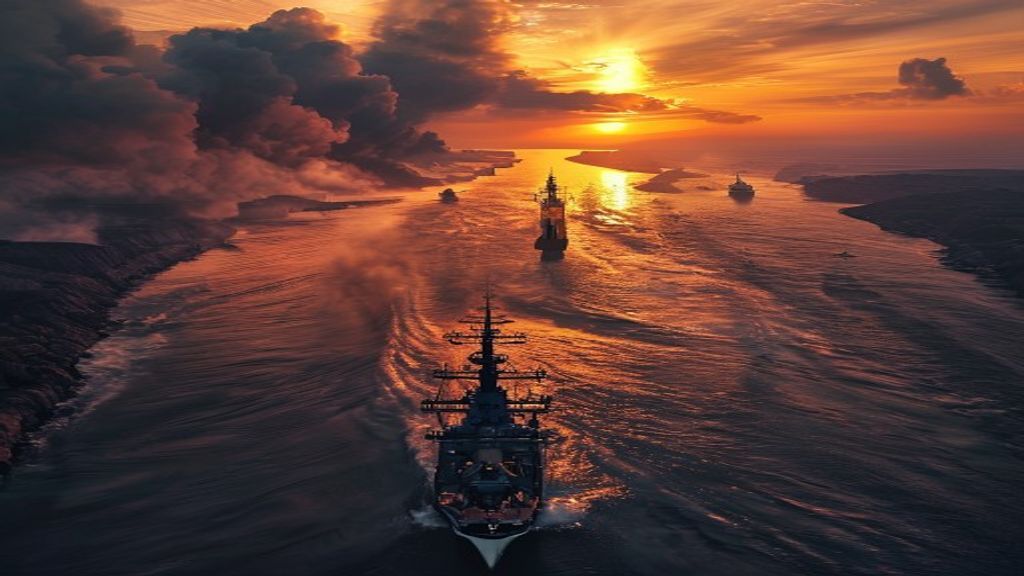

WASHINGTON — The United States military sank six Iranian naval boats and escorted two merchant vessels through the Strait of Hormuz on Sunday under what the Pentagon has dubbed “Project Freedom,” marking a dramatic escalation in the months-long confrontation between Washington and Tehran over the world’s most critical oil chokepoint.
The operation came as the United Arab Emirates reported Iranian missile and drone strikes on its Fujairah oil port — the first such attack since a fragile April ceasefire collapsed — raising fears that the conflict is spiraling beyond the bilateral US-Iran standoff into a broader regional conflagration. Iran responded by warning all commercial shipping to avoid the strait without Iranian coordination, effectively reasserting its claim to control the waterway through which roughly one-fifth of the world’s oil supply historically transits. US gas prices have now surged to $4.46 per gallon, a four-year high that is injecting energy costs squarely into domestic political calculations.
The Strait of Hormuz has been largely blocked to commercial traffic since February 2026, when a joint US-Israeli air campaign against Iranian nuclear and military facilities triggered Tehran’s retaliation through naval mines, fast-attack boats, and anti-ship missile batteries positioned along its coastline. The escalation follows Washington’s earlier Trump Rejects Iran’s 14-Point Peace Plan, Eyes New Military Options, a decision that effectively closed the diplomatic window and set the stage for the current military confrontation.
| Parameter | Details |
|---|---|
| Operation | Project Freedom — US Navy escort of merchant ships through Strait of Hormuz |
| Date | May 4, 2026 |
| Iranian Losses | Six naval boats sunk by US forces |
| UAE Attack | Iranian missile and drone strikes on Fujairah oil port — first since April ceasefire |
| US Gas Price | $4.46 per gallon — four-year high |
| Strait Status | Largely blocked since February 2026 |
| Key Players | US Navy, Iranian military command, UAE, global shipping industry |
Situational Breakdown
Sunday’s confrontation unfolded when US Navy warships entered the Strait of Hormuz escorting two commercial tankers, directly challenging Iran’s de facto blockade of the waterway. Iranian Revolutionary Guard Corps fast-attack boats moved to intercept the convoy, and US forces engaged and sank six of them in what the Pentagon described as defensive action. The two merchant vessels completed their transit, but the engagement marks the most significant direct naval combat between American and Iranian forces since the conflict’s escalation earlier this year. — CNN
Simultaneously, Iran launched missile and drone attacks on the UAE’s Fujairah oil port, a critical facility located just outside the strait on the Gulf of Oman coast. Fujairah has served as a staging hub for vessels attempting to avoid the most dangerous sections of the waterway, making it both strategically vital and symbolically significant. The attack shattered what remained of the April ceasefire and brought a third nation directly into the line of fire, raising urgent questions about whether Gulf Arab states will be drawn deeper into the conflict. — Al Jazeera
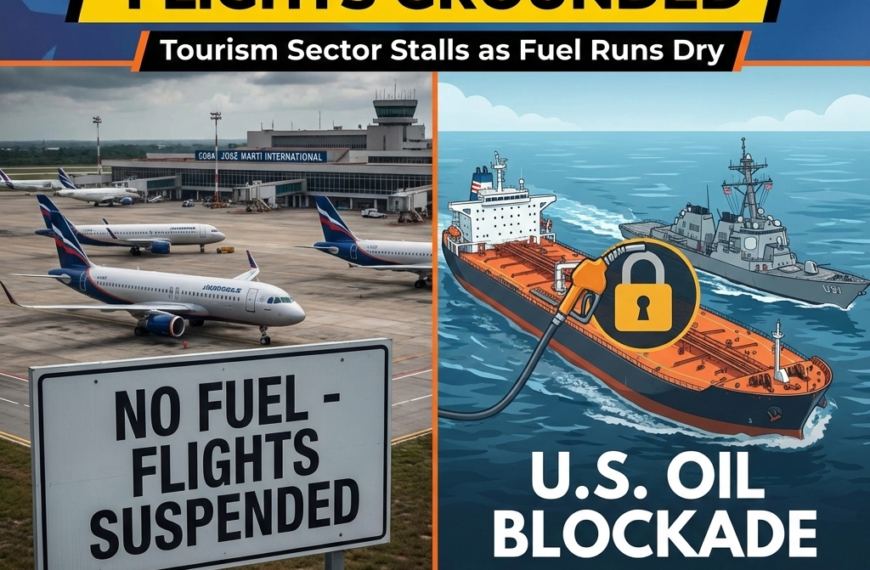
The shipping industry’s response has been unambiguous. Despite the successful escort, commercial operators remain deeply skeptical that Project Freedom can guarantee safe passage on any consistent basis. Insurance premiums for Gulf transits have skyrocketed, and the vast majority of tanker traffic continues to reroute around the Cape of Good Hope, adding weeks to delivery times and billions to global logistics costs. — NPR
Project Freedom and the Limits of Military Escorts
The Pentagon’s Project Freedom represents Washington’s most assertive attempt yet to reopen the Strait of Hormuz through sheer military force. By escorting commercial vessels with naval firepower, the United States is attempting to demonstrate that it can guarantee freedom of navigation — a principle that has underpinned American naval doctrine in the Persian Gulf for decades.
But the operation’s success is measured in individual transits, not systemic reopening. Two ships passed through on Sunday. Roughly 50 to 60 tankers per day used the strait before the blockade. The gap between symbolic demonstration and commercial viability remains enormous, and the shipping industry knows it.
“The strait remains incredibly hazardous and most ships will continue avoiding transit until both sides offer something more concrete.”
Tim Huxley, Chairman of Mandarin Shipping, told NPR that the industry requires sustained, verifiable safety guarantees — not one-off military operations — before commercial traffic will return. The economics are brutal: rerouting around Africa costs more, but a single missile strike on a supertanker costs everything.
Iran’s Calculated Escalation
Tehran’s response to Project Freedom was swift and calibrated to send multiple messages simultaneously. The naval engagement in the strait itself demonstrated Iran’s willingness to absorb tactical losses — six boats are replaceable — while maintaining its strategic posture. The Fujairah attack, however, represented a significant escalation by striking a third country’s infrastructure.
Ali Abdollahi, head of Iran’s military unified command, issued an unambiguous warning that frames the strait as Iranian-controlled territory:
“US forces will be attacked if they enter the strait and commercial ships should refrain from moving unless they coordinate with Iran.”
The statement, reported by Al Jazeera, effectively positions Iran as the gatekeeper of the Hormuz passage — a claim that directly contradicts international maritime law but is backed by the geographic reality of Iran’s coastline running the entire northern edge of the strait. By attacking Fujairah, Tehran also signaled that alternative routing through the Gulf of Oman is not safe either, compressing the options available to commercial operators.
The UAE Dimension: A Wider War?
The strike on Fujairah introduces a dangerous new variable. The UAE has largely sought to maintain a careful distance from the US-Iran confrontation, pursuing quiet diplomacy even as its Gulf neighbor became a battlefield. The missile and drone attack on its sovereign territory and critical energy infrastructure forces Abu Dhabi into a position where neutrality becomes increasingly untenable.
Fujairah is not merely a port — it is the world’s second-largest bunkering hub, where ships refuel and resupply. Damage to its facilities ripples through global supply chains in ways that extend far beyond the price of crude oil. If the UAE responds militarily or formally aligns with the US escort operations, it could trigger a cascade of regional alignments that transforms a bilateral confrontation into a multilateral conflict involving Gulf Cooperation Council states, with unpredictable consequences for global energy markets.
Economic Shockwaves and the $4.46 Question
American consumers are already paying the price. At $4.46 per gallon, US gas prices have reached levels not seen since the post-pandemic surge of 2022, and the trajectory suggests further increases are likely. The strait’s closure has removed approximately 17 million barrels per day of potential transit capacity from the global oil supply chain, and while alternative routes exist, they cannot fully compensate for the volume and efficiency losses.
The domestic political implications are significant. Energy costs function as a regressive tax, hitting lower-income households hardest, and sustained prices above $4.50 historically correlate with declining consumer confidence and presidential approval ratings. The administration faces the uncomfortable reality that its military operations in the Gulf, however strategically justified, are contributing to the very economic pain that erodes its political support at home.
Global oil markets responded to Sunday’s events with Brent crude futures climbing above $95 per barrel in early Asian trading, with analysts warning that a sustained closure could push prices toward the psychologically significant $100 mark — a threshold that would trigger further economic ripple effects across transportation, manufacturing, and food production sectors worldwide.
BolotosAI Assessment
The Strait of Hormuz crisis is entering its most dangerous phase. Project Freedom demonstrated that the US Navy can push individual ships through the chokepoint, but it simultaneously proved that doing so requires direct naval combat — a model that cannot scale to the volume needed for meaningful commercial reopening. Iran’s willingness to lose six boats while simultaneously striking Fujairah reveals a strategy of attrition and geographic expansion designed to raise the cost of American intervention beyond what Washington can sustain politically and economically.
Three outcomes now appear most probable. First, the US doubles down on military escorts, potentially expanding Project Freedom into a sustained naval operation — but this risks a major incident, such as the loss of a commercial vessel or a US warship, that could force a dramatic escalation or an equally dramatic retreat. Second, the UAE attack triggers a broader coalition response that internationalizes the conflict but also internationalizes the risk, drawing in European and Asian naval forces with their own political constraints. Third, and perhaps most likely in the medium term, economic pain forces all parties back to the negotiating table — but only after gas prices and insurance costs have climbed high enough to make diplomacy less painful than continued confrontation.
What to watch: the UAE’s formal response to the Fujairah attack in the coming 48 hours, any shift in insurance underwriters’ risk classifications for Gulf shipping, and whether China — the strait’s largest customer — breaks its silence to pressure both sides. The strait has been a flashpoint for decades. What is different now is that it is no longer a hypothetical risk but an active war zone, and the world’s energy infrastructure is being stress-tested in real time.

 By
By


 By
By