
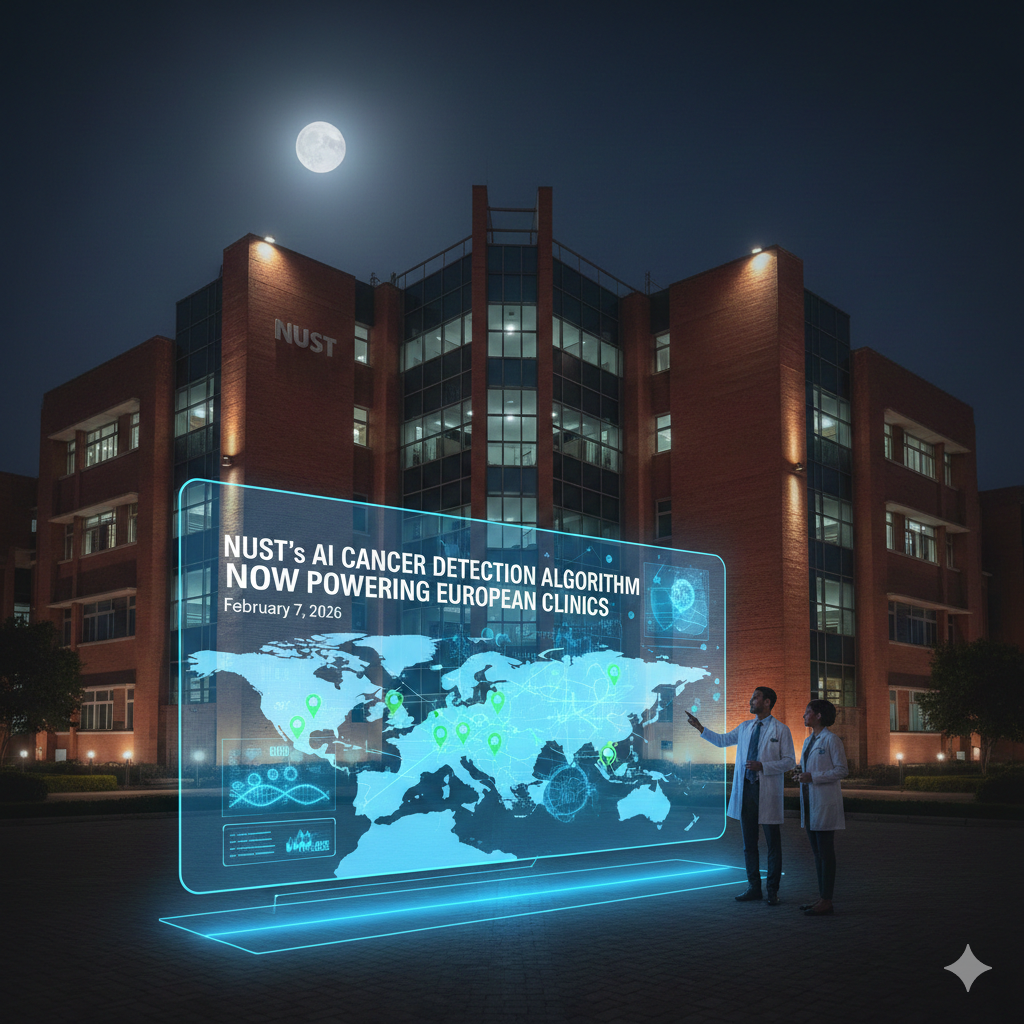

ISLAMABAD, Pakistan – In a landmark leap for both medical technology and South Asian innovation, a groundbreaking artificial intelligence (AI) algorithm developed at Pakistan’s National University of Sciences and Technology (NUST) is now being deployed in clinical settings across Europe, dramatically speeding up and improving the accuracy of cancer diagnosis.
The AI system, born from years of research at NUST’s School of Electrical Engineering and Computer Science, was initially trained to analyze histopathological images and microscopic scans of tissue biopsies, with a precision rivaling expert pathologists. The algorithm excels at detecting subtle, early-stage cellular abnormalities indicative of cancers, particularly breast and colorectal, which are often missed in traditional screenings.
The Journey:
The journey from a university lab to European hospitals was paved through a strategic partnership with MedScan Analytics, a Swiss digital health startup. After rigorous validation trials that met the European Union’s stringent medical device regulations (MDR), the technology was integrated into the diagnostic workflow of a network of clinics in Switzerland and Germany.
“For us, this is a moment of immense pride and validation,” said Dr. Ayesha Farooq, lead researcher on the NUST project. “We built this tool to address a global need for faster, more accessible diagnostic support. To see it directly impacting patient care in Europe proves that pioneering science knows no borders.”
In practice, the NUST algorithm serves as a powerful “second opinion” for pathologists. When a biopsy scan is uploaded, the AI quickly highlights areas of concern, prioritizing high-risk cases and cutting down analysis time from days to just hours. This faster process is crucial for early intervention, greatly enhancing patient outcomes.
“The integration has been seamless,” noted Prof. Klaus Werner, a lead pathologist at a Frankfurt-based clinic participating in the rollout. “The AI doesn’t replace the human expert, but it enhances our capabilities. It’s like having an exceptionally diligent assistant who never tires, ensuring we don’t overlook critical details.”
This successful commercialization marks a significant shift, demonstrating how academic research from Pakistan can compete and excel on the global health tech stage. It also opens the door for future deployments, with MedScan Analytics and NUST reportedly in talks to introduce the AI system in hospitals across the Middle East and Southeast Asia.
The story of NUST’s algorithm is more than a technical achievement; it is a potent symbol of how locally-developed AI solutions are poised to address some of the world’s most pressing health challenges, one accurate diagnosis at a time.


 By
By



 By
By