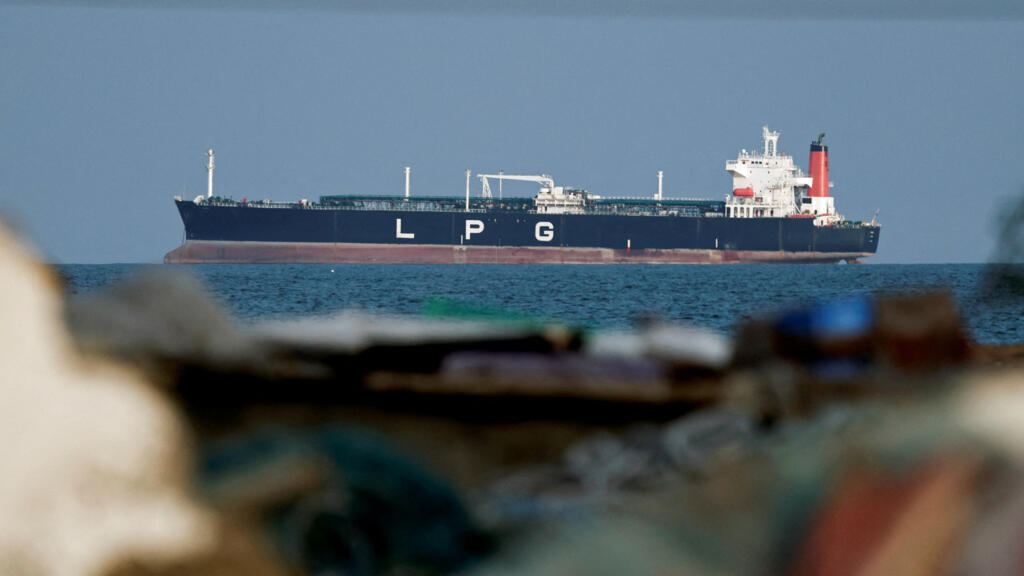

NEW YORK — The United Nations Security Council is set to vote Friday on a significantly diluted resolution that would authorize countries to use “all defensive means necessary” to reopen the Strait of Hormuz, the critical maritime chokepoint that has been effectively closed to international shipping since late February following a dramatic escalation of hostilities between Iran and a US-Israeli military coalition.
The Bahraini-drafted resolution, which has undergone multiple rounds of revision after fierce opposition from China and Russia, represents the international community’s most concerted diplomatic effort yet to address a crisis that has sent oil prices surging past $105 per barrel and threatened to upend global energy markets. The strait, through which roughly one-fifth of the world’s oil supply typically transits, has become the epicenter of a geopolitical standoff with no clear end in sight. A UK-led coalition of 40 nations has separately pledged to take action, adding military pressure to the diplomatic track.
| Parameter | Details |
|---|---|
| Resolution Sponsor | Bahrain |
| Vote Date | April 3, 2026 |
| Authorization Scope | “All defensive means necessary” to secure transit passage |
| Duration | At least six months with quarterly reporting |
| Key Opposition | China and Russia (veto-holding members) |
| Oil Prices | Surpassed $105 per barrel |
| Parallel Military Effort | UK-led coalition of 40 countries |
SITUATIONAL BREAKDOWN
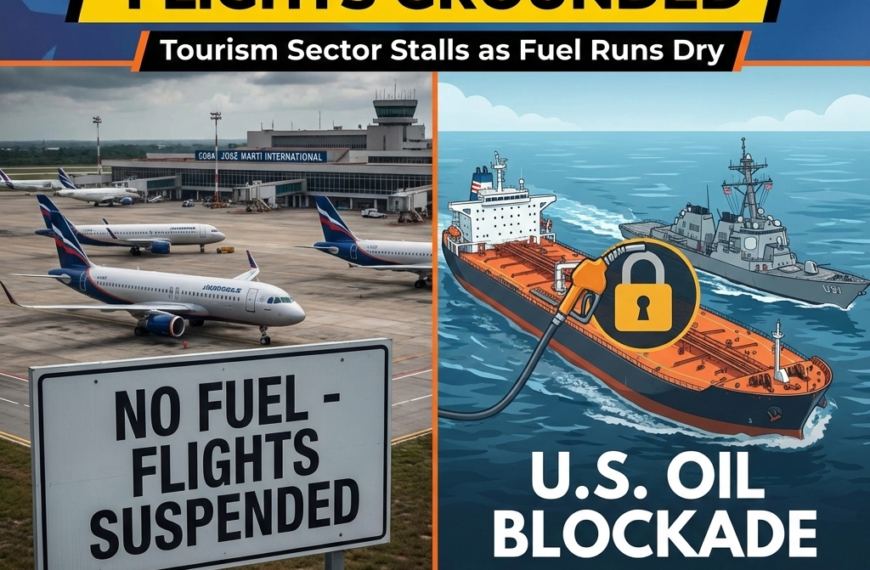
The crisis traces its origins to late February 2026, when joint US-Israeli military strikes targeted Iranian nuclear and military infrastructure. Iran responded by declaring the Strait of Hormuz closed to all commercial shipping — a threat Tehran has made periodically over the past two decades but never fully executed until now. The closure has stranded hundreds of tankers, disrupted supply chains across Asia and Europe, and triggered the most severe energy price shock since the 2022 Russian invasion of Ukraine. Insurance premiums for vessels in the Persian Gulf have skyrocketed, with several major shipping companies suspending operations entirely. — The Washington Post
Bahrain, a Gulf Cooperation Council member that hosts the US Fifth Fleet, took the lead in drafting the resolution, positioning itself as a mediator between Western powers demanding freedom of navigation and regional states wary of further escalation. The original text was far more muscular, invoking Chapter VII of the UN Charter — the legal basis for enforcement actions including the use of force. However, after weeks of closed-door negotiations, the language was softened to emphasize “defensive measures” rather than offensive military operations, a concession designed to prevent a Chinese or Russian veto. — The National News
Despite these revisions, the outcome of Friday’s vote remains deeply uncertain. Diplomats familiar with the negotiations say China and Russia have not explicitly committed to abstaining, leaving open the possibility that one or both could still exercise their veto power. A failed resolution would represent a significant blow to the UN’s credibility and could accelerate the shift toward unilateral or coalition-based military action outside the Security Council framework. — Al Jazeera
The Diplomatic Tightrope: Why the Resolution Was Watered Down
The evolution of the Bahraini draft tells the story of a Security Council deeply fractured along familiar geopolitical lines. The initial text, circulated in mid-March, would have authorized member states to “use all necessary means” to secure the strait — language that mirrors resolutions used to justify military interventions in Libya in 2011 and the first Gulf War in 1991. For Western sponsors, this was a straightforward assertion of international maritime law and the principle of freedom of navigation enshrined in the UN Convention on the Law of the Sea.
For Moscow and Beijing, however, the original language was a blank check for Western military intervention in a region where both have significant strategic and economic interests. As reporting from Reuters has detailed, China imports roughly 40 percent of its crude oil through the Strait of Hormuz, giving it an acute interest in the waterway’s reopening — but not at the cost of endorsing what it views as American unilateralism.
“Russia and China, both aligned with Iran, objected to language that they argued would legitimise military action.” — The National News
The compromise language — replacing “all necessary means” with “all defensive means necessary” — may seem like semantic hairsplitting, but in the lexicon of UN resolutions, the distinction carries enormous legal and political weight. “Defensive means” implies a reactive posture: escorting convoys, repelling attacks on commercial vessels, deterring mine-laying operations. It does not, at least in theory, authorize preemptive strikes on Iranian military installations or a broader campaign to degrade Iran’s naval capabilities.
The UK-Led Coalition: A Parallel Track
Regardless of how Friday’s vote unfolds, a separate military track is already in motion. The United Kingdom has assembled a coalition of 40 countries — including France, Australia, Japan, South Korea, and several Gulf states — that has pledged to take collective action to secure the strait. The coalition has not specified what form that action will take, but naval assets from multiple member states have already been deployed to the region, and joint exercises in the Arabian Sea have intensified in recent weeks.
The existence of this parallel effort underscores a growing reality: the Security Council’s ability to respond to acute security crises is increasingly constrained by great-power rivalry. In much the same way that the Council was sidelined during the Syrian civil war and the early stages of the Ukraine conflict, the Hormuz crisis may ultimately be resolved — or not — outside the UN framework. The coalition approach carries its own risks, however. Without a Security Council mandate, any military action in the strait would rest on shakier legal footing and could be characterized by Iran and its allies as aggression rather than collective security.
Oil Markets and the Global Economic Fallout
With Brent crude surpassing $105 per barrel and showing no signs of retreating, the economic consequences of the strait closure are rippling far beyond the Middle East. European natural gas prices have also spiked as LNG shipments from Qatar — the world’s largest exporter — remain bottlenecked. Analysts at major investment banks have warned that if the closure persists through the summer, oil could test $130, a level that would almost certainly tip several major economies into recession.
“The draft resolution would authorize member states to use defensive measures in the strait and adjacent waters to secure transit passage and deter attempts to close or obstruct navigation.” — The Washington Post
The energy shock is also reshaping domestic politics across the globe. In the United States, gasoline prices have crossed the psychologically significant $5-per-gallon threshold in multiple states, adding economic anxiety to an already volatile political environment. In Europe, governments are scrambling to extend energy subsidies that were supposed to wind down after the post-Ukraine crisis stabilization. Even in seemingly unrelated domains, the ripple effects are being felt — Maple Leafs Fire GM Brad Treliving as Playoff Drought Looms may have dominated Canadian sports headlines this week, but the country’s energy-dependent provinces are watching the Hormuz crisis with far greater urgency.
Iran’s Strategic Calculus
Tehran has framed the strait closure as a legitimate act of self-defense in response to what it calls unprovoked aggression by the United States and Israel. Iranian officials have repeatedly stated that the waterway will remain closed until Western sanctions are lifted and a comprehensive security agreement for the Persian Gulf is negotiated — demands that Washington has dismissed as non-starters. Iran’s Revolutionary Guard Corps Navy, which controls operations in the strait, has deployed fast-attack boats, naval mines, and anti-ship missile batteries along the coastline, creating a formidable defensive perimeter.
Yet Iran’s position is not without vulnerabilities. The closure has also disrupted its own oil exports and those of its ally Iraq, squeezing already strained government revenues. Domestically, the economic pain of prolonged isolation is mounting, with inflation accelerating and the rial weakening sharply on unofficial markets. Some analysts believe Tehran may be looking for a face-saving off-ramp — a possibility that a carefully worded UN resolution, with its emphasis on defensive rather than offensive action, could theoretically provide.
🇵🇰 WHAT THIS MEANS FOR PAKISTAN
Pakistan finds itself in an acutely uncomfortable position. The country imports approximately 85 percent of its crude oil, with a significant portion transiting the Strait of Hormuz. The price surge has already worsened Pakistan’s chronic current account deficit and placed additional pressure on its foreign exchange reserves at a time when the government is negotiating a critical IMF bailout program. Every dollar increase in the price of oil translates directly into higher import bills, increased inflation, and deeper fiscal strain for a country already teetering on the edge of economic crisis.
Strategically, Islamabad must navigate between its historically close relationship with Saudi Arabia and the Gulf states — which broadly support the resolution and the reopening of the strait — and its relationship with Iran, with which Pakistan shares a long and often tense border. The Gwadar port, a flagship project of the China-Pakistan Economic Corridor, sits just outside the strait’s approaches, making Pakistan a potential alternative transit route if the crisis persists — but also a potential target if the conflict expands.
Pakistan’s diplomatic response has been cautious, calling for de-escalation and dialogue while avoiding direct criticism of either side. However, the economic reality may force Islamabad’s hand. If the closure drags on and fuel shortages begin to bite domestically, Pakistan may have little choice but to align more explicitly with the coalition seeking to reopen the waterway, even at the risk of antagonizing Tehran and Beijing.
BOLOTOSAI ASSESSMENT
Friday’s vote is unlikely to resolve the Strait of Hormuz crisis regardless of its outcome. If the resolution passes — most likely with Chinese and Russian abstentions rather than affirmative votes — it will provide legal cover for defensive naval operations but will not, on its own, compel Iran to reopen the waterway. If it fails due to a veto, the UK-led coalition will move forward anyway, but without the legitimacy that a Security Council mandate would confer.
Three scenarios warrant close attention in the weeks ahead. First, a negotiated partial reopening: Iran allows escorted commercial convoys through the strait under a de facto ceasefire, buying time for broader negotiations. This is the outcome most diplomats privately hope for. Second, a military confrontation: coalition naval forces attempt to clear mines or escort vessels through the strait, leading to a direct clash with Iranian forces. This scenario carries catastrophic escalation risks and could draw in regional powers from Hezbollah to the Houthis. Third, a prolonged stalemate: the strait remains closed for months, oil prices continue climbing, and the global economy absorbs a slow-motion energy shock that reshapes trade patterns, accelerates the energy transition, and redraws the geopolitical map of the Middle East.
What to watch: the exact vote tally and accompanying statements from China and Russia, which will signal whether diplomatic space for a negotiated solution still exists; the pace and posture of coalition naval deployments in the coming days; and any back-channel communications between Tehran and Washington, which remain the only realistic path to a durable resolution. The strait may be narrow, but the consequences of what happens there will be felt across every continent.

 By
By


 By
By