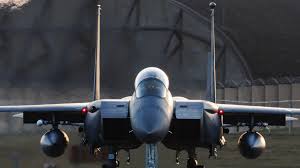

WASHINGTON — A United States Air Force F-15E Strike Eagle was shot down over central Iran on Thursday, marking one of the most significant aerial losses since the U.S.-Iran conflict erupted five weeks ago. One crew member — the pilot — was rescued alive by U.S. special forces operating on Iranian soil, while a desperate search continues for the second crew member, a weapons systems officer whose fate remains unknown.
The shootdown represents a dramatic escalation in a conflict that has rapidly intensified since hostilities began in early March 2026. The F-15E, a twin-seat multirole strike fighter that has served as a backbone of American air power for decades, was conducting operations over Iranian territory when it was struck by Iranian fire. Both crew members ejected from the stricken aircraft before it crashed. The incident triggered a complex and dangerous search-and-rescue operation that itself came under sustained enemy fire, injuring additional American service members and damaging multiple U.S. aircraft.
The loss underscores the growing lethality of Iran’s air defense network and raises urgent questions about the trajectory of a conflict that has already stretched well beyond what many analysts initially anticipated. With one American airman still missing on hostile ground and Iranian authorities actively hunting for him, the human stakes of this war have never been more starkly illustrated.
| Parameter | Details |
|---|---|
| Aircraft Lost | F-15E Strike Eagle, shot down over central Iran |
| Date of Incident | April 3, 2026 |
| Crew Status | Pilot rescued alive; Weapons Systems Officer missing |
| Rescue Casualties | A-10 Warthog pilot ejected and recovered; two helicopter crews injured |
| Conflict Duration | Five weeks since onset of U.S.-Iran hostilities |
| Iranian Response | Regional governor issued public plea; $60,000 bounty reported |
| Key Sources | NBC News, CBS News, The Washington Post, CNN, NPR |
SITUATIONAL BREAKDOWN
The sequence of events on April 3 paints a picture of an operation that quickly spiraled into one of the most harrowing episodes of the conflict. The F-15E Strike Eagle, operating as part of ongoing American air operations over Iran, was hit by Iranian fire while flying over central Iranian territory. Both the pilot and weapons systems officer successfully ejected from the aircraft — a procedure that, while survivable, subjects aircrew to extreme physical forces and deposits them into hostile terrain with minimal resources. U.S. defense officials confirmed that special operations forces were deployed and successfully located the pilot on Iranian soil, extracting him alive in what must have been an extraordinarily high-risk ground operation deep inside enemy territory. — NBC News
The rescue mission itself became a battlefield. A U.S. A-10 Warthog — the iconic ground-attack aircraft known for its durability — was damaged by hostile fire over the Persian Gulf while supporting the recovery effort. Its pilot was forced to eject but was subsequently recovered. Additionally, two search-and-rescue helicopters sustained hits from enemy fire during the operation, injuring their crews, though both aircraft managed to return safely to base. The cascading losses highlight the density and effectiveness of Iranian anti-aircraft capabilities, which have evidently improved since the conflict’s opening days. — CBS News
Meanwhile, the search for the missing weapons systems officer continues under increasingly difficult circumstances. Iranian authorities have not only mobilized military assets to find the downed American but have also turned to civilian populations for assistance. A regional governor in Iran’s southwest issued a public plea for locals to locate those aboard the F-15E, and merchants in the area have reportedly pooled resources to offer a bounty of approximately $60,000 for the airman’s capture. The involvement of civilian networks adds a deeply unpredictable dimension to what is already a race against time. — The Daily Beast
THE COST OF AIR SUPERIORITY
The loss of the F-15E forces a sobering reassessment of American air dominance in the Iranian theater. The Strike Eagle has been a mainstay of U.S. air operations in the Middle East for over three decades, seeing extensive service in Iraq, Afghanistan, Syria, and Libya. Its shootdown is not merely a material loss — it is a psychological blow that demonstrates Iran’s capacity to contest American control of the skies.
“The jet was struck by Iranian fire and the two crew members ejected safely. U.S. special forces located one of the crew members and rescued him, alive, on Iranian territory.” — U.S. defense officials via NBC News
Iran’s integrated air defense system, which includes Russian-supplied S-300 batteries alongside domestically produced systems like the Bavar-373, has long been regarded as one of the most formidable in the region. The shootdown suggests these systems are performing effectively under combat conditions — a development that will have implications far beyond this single incident. Every subsequent American sortie over Iranian airspace now carries measurably greater risk, and mission planners will be forced to allocate additional resources to suppression of enemy air defenses.
THE HUMAN DIMENSION: A MISSING AIRMAN
At the center of this story is a single American service member — a weapons systems officer whose name has not been publicly released — alone on the ground in a hostile nation. The distinction between the two crew members’ fates is stark: the pilot was found and extracted, but the WSO remains unaccounted for, with both American forces and Iranian authorities racing to reach him first.
“A regional governor in Iran’s southwest issued a public plea Friday for locals to find those on board the F-15E and promised a reward.” — The Daily Beast
The reported $60,000 bounty offered by local merchants adds a chilling civilian dimension. In a nation where the average annual income is a fraction of that sum, the financial incentive to locate — and presumably detain — the missing American is enormous. History offers uncomfortable precedents: the capture of downed pilots has repeatedly become a propaganda flashpoint in modern conflicts, from the Balkans to the Middle East. Should the WSO be found by Iranian forces or civilians before American rescuers reach him, the diplomatic and political consequences could reshape the conflict’s trajectory.
RESCUE UNDER FIRE: THE SECONDARY LOSSES
The damage sustained by the A-10 Warthog and two rescue helicopters during the extraction operation deserves scrutiny in its own right. The A-10, designed specifically to absorb punishment and continue flying, was hit with sufficient force over the Persian Gulf to compel its pilot to eject — an extraordinary outcome for an aircraft built around a titanium armored cockpit. That the pilot was recovered is testament to the proficiency of American combat search-and-rescue capabilities, but the loss of a second aircraft in the same operational window represents a significant tactical setback.
The injured helicopter crews, while safely returned to base, represent further attrition of specialized personnel whose training and experience cannot be quickly replaced. In the broader context of a five-week conflict, these cumulative losses — aircraft damaged, crews injured, assets diverted to rescue operations — illustrate the compounding costs of sustained combat operations against a near-peer adversary with modern air defense capabilities. As BBC News has reported, the intensity of U.S. air operations over Iran has steadily escalated since the conflict’s opening phase.
STRATEGIC IMPLICATIONS FOR THE CONFLICT
Five weeks into hostilities, the shootdown of the F-15E crystallizes a reality that Washington has been reluctant to publicly acknowledge: this conflict is neither quick nor cheap. The initial expectation among some policymakers — that American technological superiority would produce rapid results — has given way to a grinding campaign against an adversary that has spent decades preparing for precisely this scenario. As Reuters’ Middle East coverage has extensively documented, Iran’s asymmetric capabilities extend well beyond conventional air defense.
The incident also carries significant domestic political weight. In an era where public tolerance for American military casualties has sharply diminished, the image of a missing airman on Iranian soil — and the spectacle of Iranian civilians hunting for him — could catalyze opposition to the conflict in Congress and among the American public. The comparisons to historical incidents involving captured pilots, while imperfect, are inevitable and politically potent. At a time when America’s attention is also directed toward ambitious civilian endeavors like NASA’s historic Artemis II moon mission, the contrast between aspiration and conflict could not be more stark.
🇵🇰 WHAT THIS MEANS FOR PAKISTAN
Pakistan occupies a uniquely precarious position as the U.S.-Iran conflict intensifies. Sharing a 959-kilometer border with Iran along the volatile Balochistan frontier, Islamabad faces immediate security concerns ranging from potential refugee flows to the risk of conflict spillover. The shootdown of a U.S. fighter jet deep inside Iranian territory signals that the war is far from winding down — and Pakistan’s border security apparatus must prepare accordingly.
Economically, Pakistan remains vulnerable to disruptions in energy markets that any sustained Middle East conflict inevitably produces. With Pakistan already navigating a fragile economic recovery under IMF supervision, prolonged instability in the Persian Gulf could drive fuel prices higher and strain foreign exchange reserves at precisely the wrong moment. The Iran-Pakistan gas pipeline, long delayed by geopolitical complications, now faces yet another indefinite postponement as the conflict makes any bilateral energy cooperation with Tehran politically untenable.
Diplomatically, Islamabad will be under renewed pressure from both Washington and Beijing to clarify its position. Pakistan has historically maintained working relationships with both the United States and Iran, but the deepening of this conflict narrows the space for ambiguity. Any escalation that draws in Gulf allies — particularly Saudi Arabia, with whom Pakistan maintains deep military ties — could force Islamabad into uncomfortable choices that its current government would strongly prefer to avoid.
BOLOTOSAI ASSESSMENT
The shootdown of a U.S. F-15E over Iran and the ongoing search for a missing American weapons systems officer represent a potential inflection point in a conflict that shows no signs of resolution. Three outcomes demand close attention in the days ahead.
First, the fate of the missing WSO will dominate the next news cycle and could dominate the conflict’s political narrative for far longer. If Iranian forces capture him, the resulting propaganda value and diplomatic leverage for Tehran would be immense — potentially shifting the calculus of negotiations and public opinion in ways that military planners cannot easily counter with firepower alone.
Second, the demonstrated effectiveness of Iranian air defenses will force a tactical recalibration of American air operations. Expect to see increased deployment of standoff munitions, greater reliance on unmanned platforms, and intensified SEAD (Suppression of Enemy Air Defenses) missions — all of which carry their own escalatory risks and resource costs.
Third, watch for the domestic political fallout in Washington. Five weeks of conflict with mounting losses and no clear endgame is precisely the kind of scenario that erodes public support. Congressional voices calling for authorization debates, withdrawal timelines, or diplomatic off-ramps will grow louder. The question is whether the administration can articulate a theory of victory before the political ground shifts beneath it.
What is already clear is that the era of cost-free American air operations in the Middle East is over. Iran has demonstrated that it can impose real costs — in aircraft, in personnel, and in political capital. How Washington responds to this new reality will define not just this conflict, but the architecture of American military engagement in the region for years to come.

 By
By

 By
By