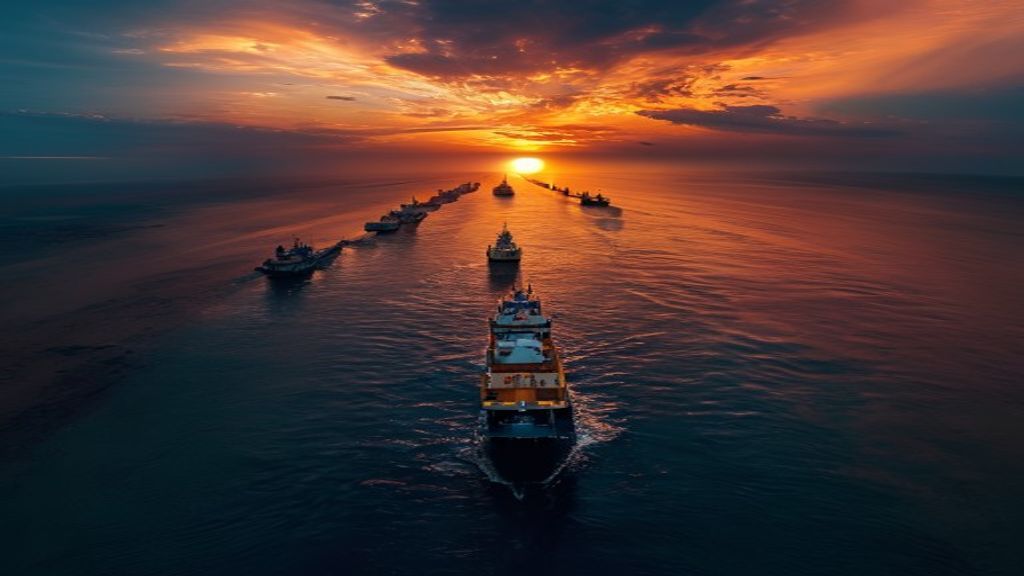

ISLAMABAD — Iran has formally proposed reopening the Strait of Hormuz in exchange for the United States lifting its naval blockade and ending hostilities, transmitting the offer through Pakistani diplomatic channels in what analysts are calling the most significant de-escalation signal since the US-Israel war on Iran began on February 28.
The proposal, confirmed by regional officials and reported across multiple international outlets, deliberately sidesteps the deeply contentious issue of Iran’s nuclear programme — a calculated omission that has drawn both cautious optimism and sharp criticism from Washington. US Secretary of State Marco Rubio acknowledged the offer exceeded expectations but made clear that any comprehensive agreement must address Tehran’s nuclear ambitions. President Trump discussed the proposal with senior aides over the weekend but appears unlikely to accept terms that leave the nuclear file unresolved. Meanwhile, Brent crude closed above $108 per barrel on Friday, roughly 50% higher than pre-conflict levels, underscoring the staggering economic toll the standoff continues to inflict on global energy markets.
| Parameter | Details |
|---|---|
| Proposal | Reopen Strait of Hormuz in exchange for US blockade lift and ceasefire |
| Mediator | Pakistan (via diplomatic channel established during Islamabad Talks) |
| Conflict Start Date | February 28, 2026 (US-Israel military operations against Iran) |
| Casualties | 3,375+ killed in Iran; 2,509 killed in Lebanon |
| Brent Crude Price | Above $108/barrel (~50% increase since conflict began) |
| US Position | Any deal must address Iran’s nuclear programme |
| Key US Official | Secretary of State Marco Rubio |
Situational Breakdown
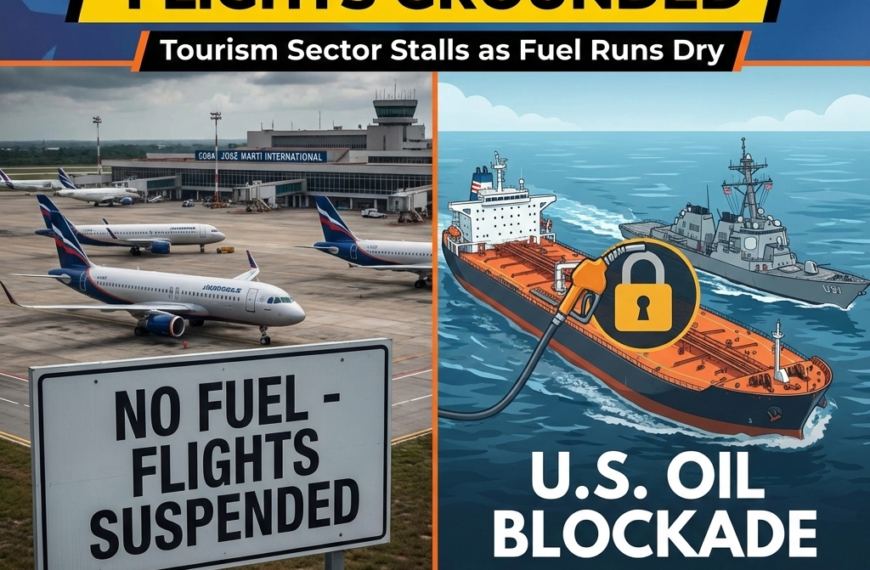
The Strait of Hormuz, through which approximately 20% of the world’s oil supply passes daily, has been effectively choked since US naval forces imposed a blockade in early March as part of the broader military campaign against Iran. Shipping insurers have refused coverage for tankers transiting the waterway, and several major oil-producing Gulf states have been forced to reroute exports through overland pipelines with limited capacity. The resulting supply squeeze has sent energy prices spiralling, with consequences felt from European factories to South Asian fuel pumps. — CNN
Iran’s decision to route its proposal exclusively through Islamabad reflects a deliberate strategic calculation. Pakistan hosted the initial round of exploratory talks between Iranian and American intermediaries earlier this month, and Tehran has repeatedly signalled that it views Pakistan as the only credible neutral broker in the conflict. The Iranian Ambassador to Pakistan, Reza Amiri Moghadam, told Al Jazeera that Tehran would accept no other venue, citing deep institutional trust between the two nations. — Al Jazeera
Washington’s response has been measured but ultimately non-committal. Administration officials speaking to Axios described the proposal as a “starting point, not a finish line,” noting that the deliberate exclusion of the nuclear file represents a fundamental gap. The Pentagon, meanwhile, has continued positioning additional carrier strike groups in the Arabian Sea, suggesting military planners are not yet anticipating a near-term diplomatic resolution. — Axios
The Nuclear Impasse: Washington’s Red Line
At the heart of Washington’s hesitation lies a familiar impasse that has defined US-Iran relations for over two decades. The Trump administration has been unequivocal that any agreement must include binding constraints on Iran’s nuclear enrichment capabilities — a demand Tehran has historically rejected as an infringement on its sovereignty.
“The Iranian proposal is better than what we expected them to submit, but any future deal must block Iran from obtaining a nuclear weapon.” — US Secretary of State Marco Rubio via CNBC
Rubio’s statement, delivered during a press briefing covered by Reuters, represents a carefully calibrated position: acknowledging progress while maintaining maximum leverage. Analysts note that by publicly praising the proposal’s scope while rejecting its omissions, the administration is attempting to keep negotiations alive without appearing weak domestically. The political calculus is further complicated by bipartisan Congressional pressure to maintain a hardline stance, with several senior senators publicly warning against any deal that does not include nuclear inspections.
Tehran’s Strategic Gambit
Iran’s decision to decouple the Hormuz issue from its nuclear programme is widely viewed as a tactically sophisticated move. By offering to resolve the most economically damaging aspect of the conflict — the effective shutdown of the world’s most critical oil chokepoint — Tehran is attempting to build international momentum for a ceasefire while preserving its nuclear bargaining chips for a later, more favourable negotiating environment.
“Tehran would only do talks in Pakistan and nowhere else because they trust Pakistan.” — Iranian Ambassador Moghadam via Al Jazeera
The insistence on Pakistan as the sole venue is itself a strategic statement. By elevating Islamabad’s role, Iran accomplishes multiple objectives: it bypasses European and Gulf Arab intermediaries that Tehran views as compromised, it strengthens its relationship with a nuclear-armed neighbour, and it forces Washington to engage on terms that are not entirely of its choosing. Iranian officials have also reportedly indicated through back-channels that they would be open to discussing a broader security framework — but only after a ceasefire is established and the blockade lifted, according to BBC’s Middle East coverage.
The Human and Economic Cost
While diplomats negotiate, the human toll continues to mount. Over 3,375 people have been killed in Iran since the conflict began, with civilian infrastructure — including hospitals, power stations, and water treatment facilities — sustaining significant damage. In Lebanon, where Hezbollah’s involvement has drawn Israeli military operations, the death toll has reached 2,509, with entire neighbourhoods in Beirut’s southern suburbs reduced to rubble.
The economic devastation extends far beyond the immediate conflict zone. With Brent crude trading above $108 per barrel, consumers worldwide are absorbing the pain of a protracted energy crisis. European nations have activated emergency petroleum reserves, while developing economies across Africa and South Asia face mounting fiscal pressure. In a week where global attention has also turned to cultural milestones — Michael Jackson Biopic ‘Michael’ Opens to Mixed Reviews Worldwide — the contrast between entertainment headlines and wartime suffering has underscored the peculiar dissonance of modern media consumption.
The Role of Oil Markets
Energy markets have responded to Iran’s proposal with cautious optimism but no significant retreat. Brent crude dipped briefly below $107 on initial reports of the offer before rebounding above $108 as traders assessed the low probability of a swift resolution. The sustained price elevation reported by Al Jazeera has already triggered inflationary cascading effects across global supply chains, with shipping costs, petrochemical prices, and airline fuel surcharges all climbing sharply.
OPEC+ members, particularly Saudi Arabia and the UAE, face a delicate balancing act. While higher oil prices have boosted government revenues, the geopolitical instability threatening their immediate neighbourhood has forced massive defence spending increases and complicated long-term economic diversification plans. Neither Riyadh nor Abu Dhabi has publicly commented on Iran’s proposal, though Gulf diplomatic sources suggest both capitals are quietly encouraging American engagement.
🇵🇰 Pakistan Connection
Pakistan’s emergence as the central mediating power in this conflict represents perhaps the most consequential diplomatic elevation Islamabad has experienced in a generation. Having successfully hosted the initial Islamabad Talks and now serving as the exclusive conduit for Iran’s Hormuz proposal, Pakistan has positioned itself as indispensable to any resolution. The trust Tehran places in Islamabad — explicitly stated by Ambassador Moghadam — gives Pakistan leverage with both sides that no other regional actor currently possesses.
Domestically, however, the war’s economic fallout has been devastating. Petrol prices have surged over 40% in a single month, hitting PKR 458 per litre and triggering widespread protests across major cities including Karachi, Lahore, and Islamabad. Transport costs have cascaded through the economy, driving up food prices and squeezing an already beleaguered middle class. For Prime Minister Sharif’s government, the mediating role carries both enormous diplomatic prestige and enormous domestic risk: Pakistani citizens are paying a direct price for a conflict they had no part in starting, and public patience is wearing thin.
BOLOTOSAI Assessment
Iran’s Hormuz proposal is the most substantive diplomatic opening since the conflict began — but it is almost certainly not enough to end the war on its own. Washington’s insistence on nuclear concessions and Tehran’s equally firm refusal to discuss its programme within a ceasefire framework suggest that this proposal will evolve into a prolonged negotiation rather than a breakthrough moment.
Three outcomes demand close attention. First, if Pakistan can successfully broker even a partial reopening of the Strait — perhaps through a humanitarian shipping corridor — it could demonstrate that incremental diplomacy works and build momentum for broader talks. Second, if Washington rejects the proposal outright, oil prices could spike beyond $115, creating acute economic crises in import-dependent economies from Pakistan to Kenya. Third, and perhaps most consequentially, the nuclear question will not remain sidelined indefinitely; at some point, either through diplomatic pressure or military escalation, it will force itself back to centre stage.
What to watch in the coming days: Pakistan’s formal diplomatic response, any movement on US carrier group positioning in the Arabian Sea, and whether OPEC+ signals willingness to increase output to ease market pressure. The world cannot afford for this negotiation to fail — but the structural obstacles to its success remain formidable.

 By
By


 By
By