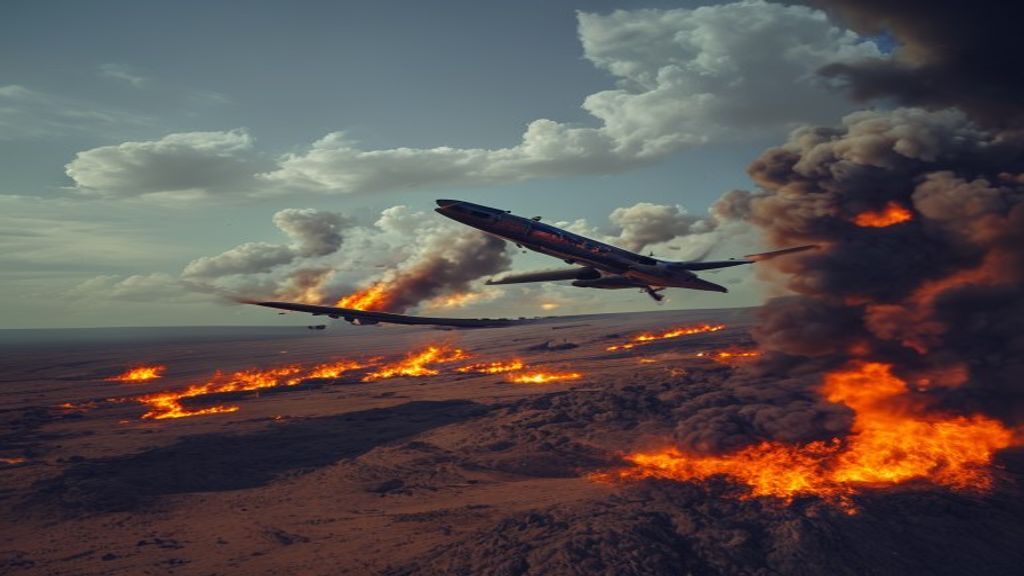

DUBAI — Iran claimed it shot down a US F-15 fighter jet over its southwestern airspace and confirmed a second American aircraft crashed into the Persian Gulf near the Strait of Hormuz on Thursday, marking the deadliest aerial confrontation of the five-week-old US-Iran war as Gulf oil infrastructure burned across three countries.
The twin shootdowns — if confirmed by independent sources — represent a significant escalation in a conflict that has already reshaped global energy markets and drawn in regional powers from Israel to Pakistan. US and Israeli warplanes responded with punishing strikes against Iranian petrochemical plants in Khuzestan province and the Bushehr nuclear facility, while Tehran unleashed retaliatory ballistic missile salvos against oil infrastructure in Kuwait, Qatar, and the United Arab Emirates. The Strait of Hormuz, through which roughly twenty percent of the world’s oil supply normally transits, has effectively been choked shut, with daily vessel traffic collapsing from 150 ships to approximately 15.
With Brent crude surging eight percent to around $109 per barrel and civilian casualties mounting across the region, diplomatic channels remain dangerously thin. Only Pakistan and China have put forward a formal mediation framework, while Washington has issued ultimatums that threaten to widen the conflict further still.
| Parameter | Details |
|---|---|
| Conflict Duration | Five weeks (began late February 2026) |
| Aircraft Losses Claimed | One F-15 downed over SW Iran; one aircraft crashed near Strait of Hormuz |
| Oil Infrastructure Hit | Kuwait (Mina Al-Ahmadi refinery), Qatar (QatarEnergy tanker), UAE (Habshan gas facility) |
| Strait of Hormuz Traffic | Collapsed from ~150 to ~15 vessels per day |
| Brent Crude Price | $109/barrel (+8% surge) |
| Key Diplomatic Effort | China-Pakistan five-point peace initiative; Islamabad offers to host talks |
| Lebanon Displacement | Over one million civilians displaced by expanded Israeli ground invasion |
Situational Breakdown
The aerial engagements on April 3 represent the first confirmed loss of American combat aircraft in a state-on-state confrontation since the 2003 Iraq War. Iranian state television broadcast footage purporting to show wreckage of an F-15E Strike Eagle scattered across farmland in Khuzestan province, though the Pentagon had not confirmed the losses at the time of reporting. A second aircraft — its type unspecified by Iranian authorities — was said to have gone down in the waters near the Strait of Hormuz, with Iranian Revolutionary Guard Navy vessels reportedly conducting search operations in the area. — NPR
The retaliatory strikes against Gulf oil infrastructure stunned regional capitals. Kuwait’s Mina Al-Ahmadi refinery, one of the largest in the Middle East, was set ablaze by what Kuwaiti officials described as medium-range ballistic missiles. Three missiles targeted Qatar, with one striking a QatarEnergy-flagged tanker anchored off Ras Laffan. The UAE’s Habshan gas processing facility — a critical node in Abu Dhabi’s energy network — sustained what Emirati state media called “significant but contained” damage. All three Gulf states have historically maintained careful diplomatic balancing acts between Washington and Tehran, making them reluctant participants in a conflict they desperately sought to avoid. — Al Jazeera
Meanwhile, Israel expanded its ground offensive deeper into southern Lebanon, with the Israeli Defense Forces announcing operations in areas north of the Litani River for the first time. The United Nations estimates more than one million Lebanese civilians have been displaced since the ground campaign began, creating a humanitarian crisis that has largely been overshadowed by the Gulf theatre. — Al Jazeera
The Energy Chokepoint: Hormuz Under Siege
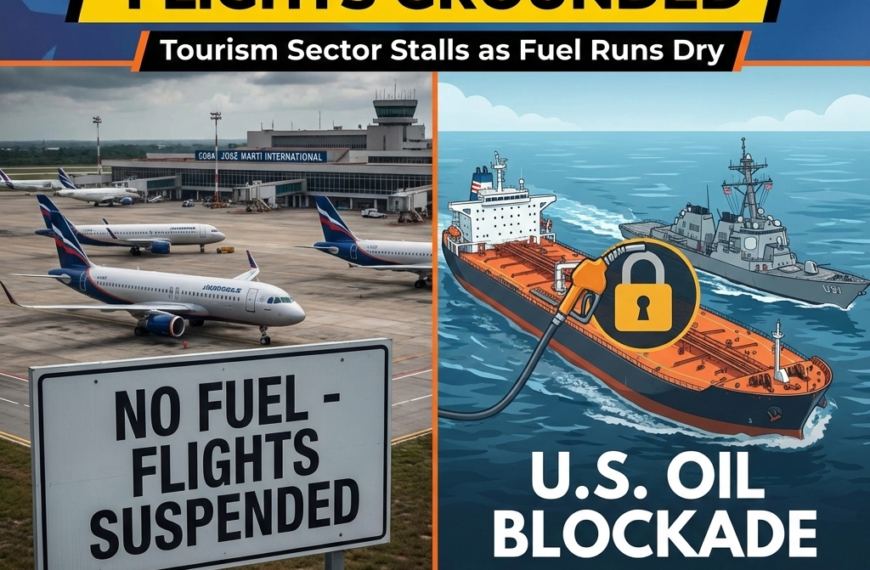
The near-total shutdown of the Strait of Hormuz has triggered what energy analysts are calling the most severe supply disruption since the 1973 oil embargo. Before the conflict, approximately 21 million barrels of oil passed through the narrow waterway daily aboard roughly 150 vessels. That figure has now cratered to an estimated 15 ships per day, most of them running under naval escort from coalition or Chinese warships.
The collapse in shipping traffic has sent shockwaves through commodity markets far beyond crude oil. Liquefied natural gas shipments from Qatar — the world’s largest LNG exporter — have been severely disrupted, threatening energy supplies to customers across Asia and Europe who had only recently weaned themselves off Russian pipeline gas. Petrochemical feedstocks, fertiliser components, and refined fuel products that transit the strait have all seen double-digit price spikes.
The eight percent surge in Brent crude to $109 per barrel may only be the beginning. If the strait remains effectively closed through April, Goldman Sachs analysts have warned that prices could breach $130, levels not seen since the immediate aftermath of Russia’s 2022 invasion of Ukraine.
Washington’s Ultimatum and the Escalation Ladder
President Trump’s response to the aircraft losses was characteristically direct and alarming in equal measure. Speaking from the White House, he issued what amounted to a one-week ultimatum to Tehran:
“Trump warned the US will attack Iranian power and desalination plants next week if Iran does not reopen the Strait of Hormuz.” — NPR
The threat to target civilian infrastructure — power grids and desalination plants that provide drinking water to tens of millions of Iranians — drew immediate condemnation from humanitarian organisations and raised serious questions about compliance with international humanitarian law. Iran’s population of 88 million is heavily dependent on desalination in its southern coastal provinces, and the destruction of such facilities could trigger a humanitarian catastrophe dwarfing the current conflict’s toll.
Military analysts noted that striking power infrastructure would also degrade Iran’s air defence networks, potentially opening the door to deeper strikes against hardened nuclear and military targets. The escalation ladder, in other words, has no obvious rung at which both sides might agree to stop climbing.
The Diplomatic Vacuum
Against this backdrop of escalation, the diplomatic landscape remains barren. The United Nations Security Council has been paralysed by vetoes, with Russia and China blocking US-backed resolutions while the United States vetoes calls for an immediate ceasefire. European nations have called for restraint but offered no concrete mediation framework.
Into this vacuum has stepped an unlikely partnership. Pakistan’s Foreign Minister Ishaq Dar, speaking alongside his Chinese counterpart, announced a joint five-point peace initiative and extended a direct offer:
“Pakistan would be honoured to host and facilitate meaningful talks between both sides.” — FM Ishaq Dar, Al Jazeera
The China-Pakistan initiative reportedly includes proposals for an immediate Hormuz ceasefire corridor, a phased de-escalation timeline, third-party monitoring of the strait, and a broader framework for addressing the underlying nuclear and sanctions disputes that precipitated the conflict. Whether either Washington or Tehran will engage with the framework remains uncertain, but the absence of any competing diplomatic channel gives it outsized significance.
A Region Ablaze: Collateral Theatres
The Gulf war has metastasised into what some observers are calling a regional conflagration with multiple active fronts. Israel’s expanded ground invasion of Lebanon, which had been framed as a limited operation against Hezbollah positions, has now displaced over one million civilians and shows no signs of concluding. While the technology sector continues normal operations elsewhere — Apple Celebrates 50th Anniversary With Global Events this week — the Middle East finds itself engulfed in its most dangerous military crisis in decades.
The strikes against Bushehr — Iran’s only operational nuclear power plant — have raised particular alarm. While the facility was reportedly struck with precision munitions targeting adjacent military installations rather than the reactor itself, the International Atomic Energy Agency issued an urgent statement warning of “unacceptable risks” from military operations near nuclear facilities. The spectre of a radiological incident, even an accidental one, hangs over every subsequent strike package.
🇵🇰 Pakistan Connection
Pakistan finds itself on the front line of the conflict’s economic fallout. The country imports nearly eighty percent of its oil from Gulf states, and the effective closure of the Strait of Hormuz has triggered a full-blown energy crisis. The government has imposed a four-day workweek for all public and private sector offices and ordered school closures nationwide to reduce fuel consumption. Rolling blackouts have intensified in Punjab and Sindh provinces, and petrol rationing is now in effect across major cities.
Islamabad has responded on both the military and diplomatic fronts. Operation Muhafiz-ul-Bahr (Guardian of the Sea) has deployed Pakistan Navy assets to secure maritime supply routes, with frigates and maritime patrol aircraft operating in the Arabian Sea to protect tankers bound for Pakistani ports. Diplomatically, the joint China-Pakistan five-point peace initiative represents Pakistan’s most ambitious mediation effort since its Cold War-era role as a conduit between Washington and Beijing. FM Dar’s offer to host talks in Islamabad carries historical resonance — the city served as a back-channel venue during the US-Taliban negotiations that produced the 2020 Doha Agreement. Whether Pakistan can replicate that diplomatic success in a far more complex and volatile conflict remains the critical question.
BOLOTOSAI Assessment
The US-Iran war has reached a tipping point. The loss of American combat aircraft — if confirmed — will intensify domestic pressure on the Trump administration to escalate rather than negotiate, while Iran’s willingness to strike Gulf state oil infrastructure has shattered the assumption that Tehran would limit retaliation to avoid alienating regional neighbours. Three scenarios demand close attention in the coming days.
First, if President Trump follows through on his threat to strike Iranian power and desalination infrastructure, the conflict will cross a threshold from which de-escalation becomes nearly impossible. Civilian infrastructure targeting would unite Iranian public opinion behind the war effort and potentially draw condemnation even from traditional US allies, further isolating Washington diplomatically.
Second, the Strait of Hormuz remains the conflict’s centre of gravity. Every day it remains closed costs the global economy billions and pushes energy-dependent nations — from Pakistan to Japan to Germany — toward economic crisis. The pressure on all parties to either reopen the strait or find alternative supply routes will only intensify, and it is this economic pain, rather than military outcomes, that is most likely to eventually force both sides to the negotiating table.
Third, the China-Pakistan mediation initiative deserves serious attention precisely because no one else is trying. In a conflict where the principal combatants have no direct diplomatic channels and the traditional multilateral institutions are gridlocked, any credible framework for dialogue — however imperfect — represents the only visible off-ramp. Watch Islamabad closely this week.

 By
By


 By
By