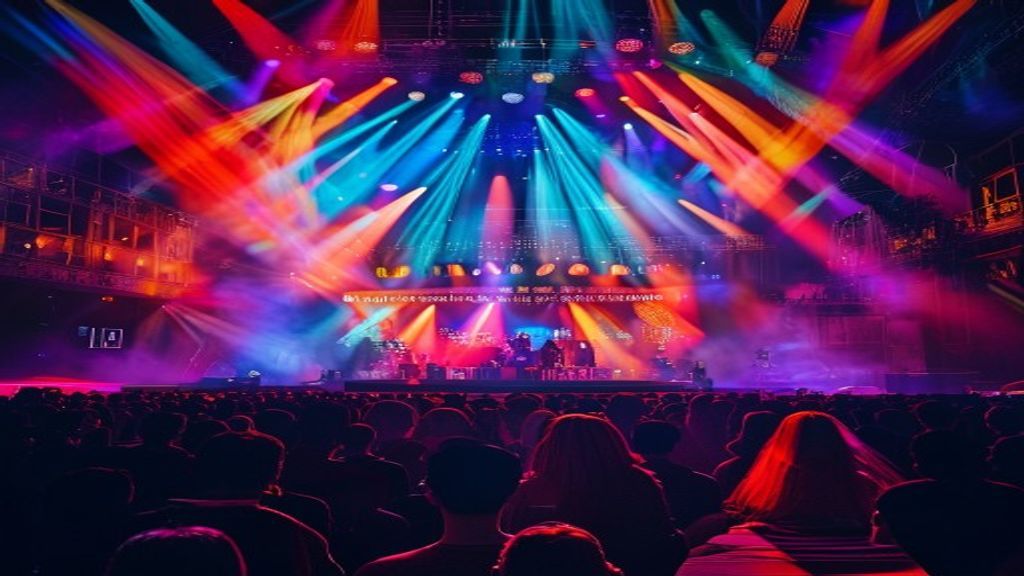

LONDON — Pakistani psychological thriller Psycho etched its name into Lollywood history on March 30 when its teaser was screened at London’s iconic O2 Arena, marking the first time a Pakistani film has ever launched a trailer at one of the world’s most prestigious entertainment venues.
The milestone screening positions Pakistan’s film industry on a global stage it has long aspired to reach. Directed by and starring veteran actor Shaan Shahid alongside an ensemble cast featuring Meera, Sonya Hussyn, and Javed Sheikh, Psycho is the brainchild of Pakistani-American businessman M. Sulman Butt, produced under his Red Lipstick Productions banner with backing from Geo Films. The film is slated for an Eid ul-Azha 2026 release, timing that places it squarely in the most commercially significant window on Pakistan’s cinematic calendar. The O2 debut represents a calculated gamble — one that signals Lollywood is no longer content to compete solely within South Asian markets.
| Parameter | Details |
|---|---|
| Film | Psycho (Psychological Thriller) |
| Director & Lead | Shaan Shahid |
| Key Cast | Meera, Sonya Hussyn, Javed Sheikh |
| Producer | M. Sulman Butt (Red Lipstick Productions) |
| Distribution Partner | Geo Films |
| Teaser Venue | The O2 Arena, London (March 30, 2026) |
| Planned Release | Eid ul-Azha 2026 |
SITUATIONAL BREAKDOWN
The screening at the O2 Arena — a 20,000-capacity venue that has hosted everyone from Beyoncé to the ATP Finals — was not a coincidence of timing but a deliberate statement of intent. By choosing one of Europe’s highest-profile entertainment destinations, the producers positioned Psycho alongside the kind of blockbuster marketing campaigns typically reserved for Hollywood studios. The teaser played to an audience that included members of the Pakistani diaspora in Britain, international media, and entertainment industry professionals, generating immediate social media buzz that trended across multiple platforms. — The Express Tribune
The film’s cast adds significant weight to the project. Shaan Shahid, widely regarded as one of Pakistan’s most bankable leading men with a career spanning over three decades, pulls double duty as director and star. Meera, whose dramatic range has made her one of Lollywood’s most recognizable faces internationally, is joined by Sonya Hussyn, a rising force in Pakistani drama who brings a younger demographic’s attention to the project. Veteran Javed Sheikh rounds out the principal cast, lending credibility and cross-generational appeal. — DESIblitz
Behind the camera, the financial architecture is equally noteworthy. M. Sulman Butt’s Pakistani-American background reflects a growing trend of diaspora investment flowing back into Pakistan’s creative industries. Red Lipstick Productions’ partnership with Geo Films — part of Pakistan’s largest media conglomerate — ensures domestic distribution muscle to match the film’s international ambitions. — Digital Media Net
A FIRST FOR PAKISTANI CINEMA ON THE WORLD STAGE
The significance of the O2 screening cannot be overstated. While Bollywood has long utilized international venues for premieres and promotional events — from lavish London red carpets to Times Square takeovers — Pakistani cinema has historically been confined to domestic premieres or smaller diaspora-focused events. The O2 debut shatters that ceiling entirely.
Actress Meera called the O2 screening a historic moment for Pakistan, saying having a Pakistani trailer shown at an arena of that stature was unprecedented.
Her words carry particular resonance given the challenging landscape Pakistani cinema navigated through 2025, a year that saw multiple theatrical releases underperform and left exhibitors questioning the commercial viability of local productions. That a Lollywood film would respond not by retreating but by launching at one of the world’s most famous arenas speaks to a renewed confidence among Pakistani filmmakers and their financial backers.
THE METHOD BEHIND THE MADNESS: MEERA’S COMMITMENT
Adding a layer of intrigue — and controversy — to the production is the revelation that actress Meera was reportedly admitted to a psychiatric facility in New York during filming, attributed to the intense emotional demands of her role. While details remain limited, the reports have fueled speculation about the depth of psychological territory Psycho explores and the method-acting approach Meera adopted for the project.
The incident draws parallels to Hollywood’s long and complicated history with method acting, where performers from Daniel Day-Lewis to Heath Ledger have pushed psychological boundaries in pursuit of authenticity. For Pakistani cinema, where such extreme dedication to character work is relatively uncommon, the story adds a dimension of seriousness to the production that distinguishes it from typical Lollywood fare. Much as Sharon Stone has reflected on the personal toll of career-defining roles, Meera’s experience underscores the real human cost behind compelling performances.
THE THRILLER GENRE AS LOLLYWOOD’S GLOBAL ENTRY POINT
The choice of genre is strategically significant. Psychological thrillers travel across cultural boundaries more easily than romantic dramas or comedies, which often rely on culturally specific humor and social norms. By anchoring its international debut in a genre with universal appeal, Psycho positions itself to attract audiences beyond the South Asian diaspora.
Industry observers noted the early global buzz signals a growing appetite for high-quality Pakistani films in the international thriller genre.
This observation aligns with broader trends in global cinema. South Korean thrillers broke through to mainstream Western audiences with Parasite, while Turkish, Nigerian, and Indonesian genre films have found growing international audiences through streaming platforms. Pakistani cinema, with its rich storytelling traditions and untapped talent pool, has the raw ingredients to follow a similar trajectory — but has until now lacked the marketing ambition to announce itself on that stage.
THE BUSINESS MODEL: DIASPORA CAPITAL MEETS DOMESTIC MUSCLE
The production’s financial structure reveals an emerging model for Pakistani filmmaking. M. Sulman Butt represents a new class of diaspora entrepreneurs who have built capital abroad and are now reinvesting it in Pakistan’s creative economy. This is not philanthropic — it is a calculated commercial bet that Pakistani content can generate returns on the international market.
The Geo Films partnership provides the domestic infrastructure that diaspora-funded productions often lack. Distribution networks, media promotion through Geo’s television channels, and established relationships with Pakistani exhibitors give Psycho the dual advantage of international ambition backed by local operational capability. It is a model that, if successful, could be replicated across multiple productions and fundamentally reshape how Lollywood finances its most ambitious projects.
🇵🇰 WHAT THIS MEANS FOR PAKISTAN
For an industry that has lived in Bollywood’s shadow for decades, the O2 screening represents something far larger than a single film’s marketing stunt. It is a declaration that Pakistani cinema intends to compete on the global stage on its own terms. After a bruising 2025 that left theater owners and producers alike questioning the future of domestic filmmaking, 2026 is shaping up as a potential inflection point — and Psycho is leading the charge.
The economic implications extend beyond box office returns. A successful international launch could attract foreign investment into Pakistan’s broader entertainment sector, create opportunities for Pakistani technical crews to work on internationally scaled productions, and establish distribution pipelines that benefit future Lollywood releases. London’s Pakistani diaspora — numbering over 1.5 million — represents a built-in audience that has been underserved by quality content from their homeland.
Perhaps most importantly, the O2 moment gives young Pakistani filmmakers, actors, and writers something they have rarely had: proof that the ceiling is not fixed. If Psycho can screen at the O2, the next Pakistani film can premiere at Cannes, Toronto, or Venice. Ambition, once demonstrated, becomes contagious.
BOLOTOSAI ASSESSMENT
The O2 teaser screening has accomplished its primary objective: it has made the world pay attention to a Pakistani film before a single frame of the final cut has been publicly released. That alone is an achievement few Lollywood productions have managed. However, the harder work lies ahead.
Three outcomes to watch: First, whether the Eid ul-Azha release can convert international buzz into domestic box office numbers — Pakistan’s theatrical market remains the financial backbone of any local production. Second, whether Psycho secures international distribution deals, particularly on streaming platforms where South Asian thriller content is increasingly in demand. Third, whether the diaspora-capital funding model demonstrated by Red Lipstick Productions attracts imitators, potentially creating a pipeline of internationally ambitious Pakistani productions.
The risk is real. Hype without substance has sunk projects before, and the Eid release window is fiercely competitive. But the strategic intelligence behind this campaign — the venue choice, the cast assembly, the production partnership structure — suggests a team that understands both the art and the business. If Psycho delivers on its promise, it will not merely be a successful film. It will be the moment Pakistani cinema proved it belongs in the global conversation.

 By
By



 By
By