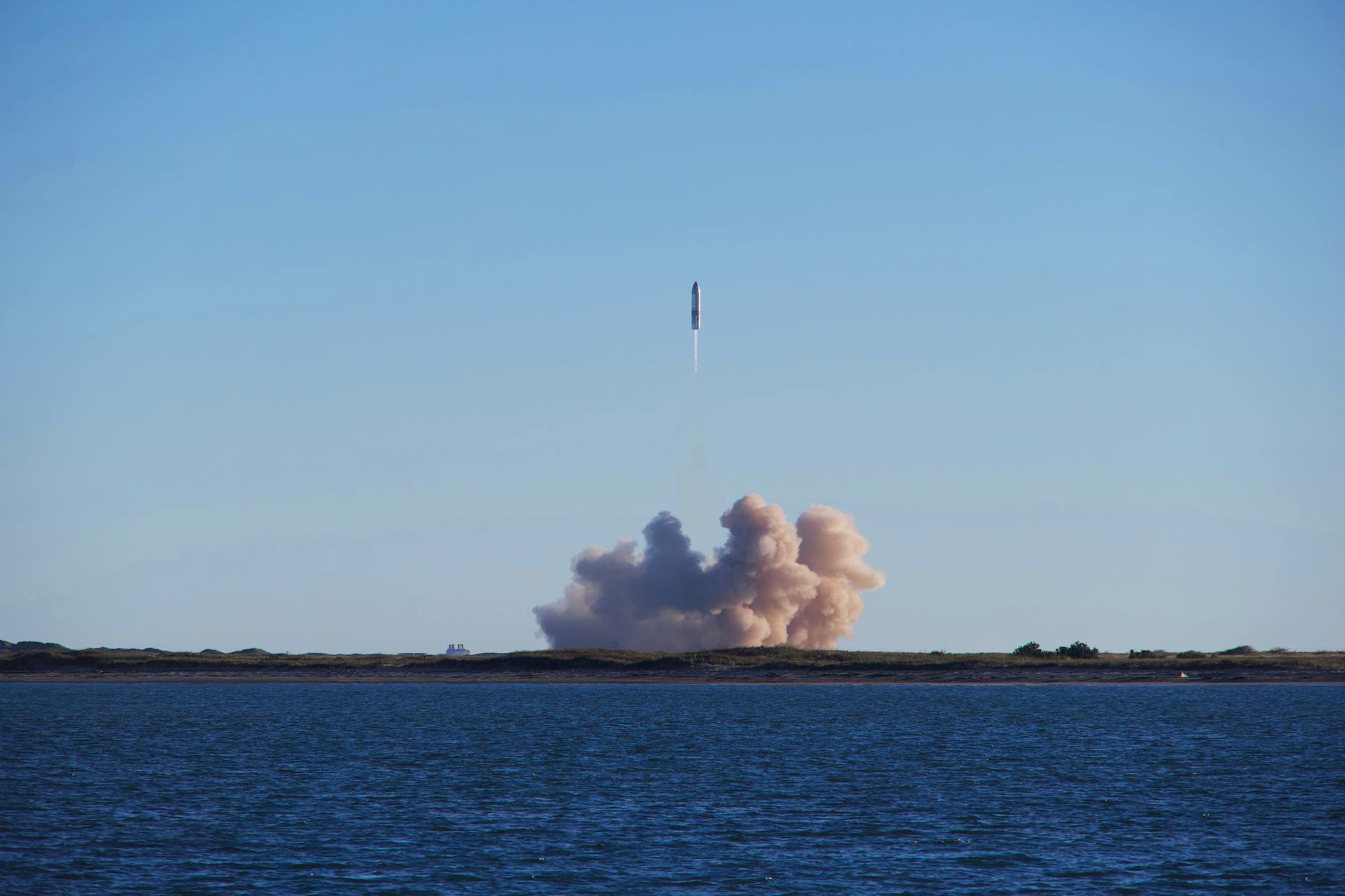

CAPE CANAVERAL, Florida — NASA’s Artemis II mission launched from Kennedy Space Center on April 1, 2026, sending four astronauts on a trajectory around the Moon — marking the first crewed lunar flight since the Apollo 17 mission more than five decades ago.
The Space Launch System (SLS) rocket and Orion spacecraft lifted off carrying Commander Reid Wiseman, Pilot Victor Glover, Mission Specialist Christina Koch, and Canadian Space Agency astronaut Jeremy Hansen on an approximately 10-day journey that will take them farther from Earth than any humans have ever traveled. The mission represents a pivotal moment in NASA’s broader Artemis program, which aims to return astronauts to the lunar surface and eventually establish a sustained human presence on the Moon as a stepping stone toward Mars.
The successful launch caps years of delays, budget overruns, and technical challenges that tested the resolve of NASA’s leadership and its international partners. With global attention fixed on the mission, the Artemis II flight is being viewed not merely as a test of hardware but as a reassertion of American ambitions in an increasingly competitive space race involving China, India, and private-sector players like SpaceX and Blue Origin.
| Parameter | Details |
|---|---|
| Mission | Artemis II — Crewed Lunar Flyby |
| Launch Date | April 1, 2026, Kennedy Space Center, Florida |
| Crew | Reid Wiseman (Commander), Victor Glover (Pilot), Christina Koch (Mission Specialist), Jeremy Hansen (CSA) |
| Duration | Approximately 10 days |
| Maximum Distance | 252,021 statute miles from Earth (surpassing Apollo 13 record by 3,366 miles) |
| TLI Burn Duration | 5 minutes, 55 seconds |
| Last Crewed Lunar Mission | Apollo 17 — December 1972 |
SITUATIONAL BREAKDOWN
The launch sequence proceeded without significant anomalies, with the SLS rocket’s twin solid rocket boosters and four RS-25 engines generating approximately 8.8 million pounds of thrust to clear the launch tower. Within minutes of reaching orbit, mission controllers confirmed all spacecraft systems were nominal. The translunar injection (TLI) burn — a critical 5-minute, 55-second engine firing — successfully propelled Orion beyond Earth orbit and onto a free-return trajectory around the Moon. This maneuver was the most significant milestone of the early mission, as it committed the crew to a path that will carry them roughly 252,021 statute miles from Earth, exceeding the farthest distance any humans have traveled. — NASA
The crew composition itself carries symbolic weight. Victor Glover is set to become the first Black astronaut to fly beyond low Earth orbit, while Christina Koch — who previously set the record for the longest single spaceflight by a woman — adds further distinction to the mission. Jeremy Hansen’s inclusion represents Canada’s deep partnership in the Artemis program, secured through the nation’s contribution of the Canadarm3 robotic system to the planned Lunar Gateway station. The diversity of the crew has been highlighted by NASA leadership as reflective of a new era in space exploration. — CNN
While the mission does not include a lunar landing, it serves as a comprehensive systems validation for the Orion spacecraft and its life-support capabilities in deep space. Engineers will monitor radiation exposure, communication latency, and navigation accuracy — all of which are critical for the subsequent Artemis III mission, which aims to land astronauts near the Moon’s south pole. — Space.com
A 54-Year Wait: Why Artemis II Matters
The last time human beings ventured beyond Earth orbit was December 1972, when Apollo 17 astronauts Gene Cernan and Harrison Schmitt walked on the lunar surface. In the intervening 54 years, human spaceflight was confined to low Earth orbit — the domain of the Space Shuttle program and the International Space Station. Artemis II shatters that boundary.
“This is the first time astronauts have traveled beyond Earth orbit since Apollo 17 in 1972.” — NASA
The psychological and geopolitical significance of this cannot be overstated. For a generation that grew up watching Mars rovers and Hubble images but never witnessed humans leave Earth’s neighbourhood, Artemis II is a tangible demonstration that deep space human exploration is not a relic of the Cold War era but a living, evolving endeavour. The mission is also a validation of the SLS architecture, which has faced persistent criticism over cost — estimated at over $4 billion per launch — and repeated schedule slips.
Breaking Records: The Farthest Humans Have Ever Traveled
Orion’s projected maximum distance of 252,021 statute miles from Earth will surpass the record set inadvertently by Apollo 13 in 1970, when a service module explosion forced the crew on a wide free-return trajectory. Artemis II will exceed that mark by 3,366 miles — but this time, by design rather than emergency.
“The Artemis 2 Orion spacecraft successfully performed its translunar injection burn in a 5 minute, 55 second maneuver that sent the probe beyond Earth orbit.” — Space.com
The record-setting distance is not merely a bragging right. It allows NASA to test Orion’s heat shield performance during re-entry at speeds approaching 25,000 miles per hour — conditions that cannot be replicated in low Earth orbit. The uncrewed Artemis I mission in 2022 tested these parameters without astronauts aboard, but verifying crew safety under identical conditions remains the essential prerequisite for Artemis III’s planned lunar landing.
The Crew: Making History on Multiple Fronts
Commander Reid Wiseman, a former Navy test pilot and NASA’s current chief astronaut, leads a crew that is as accomplished as it is diverse. Wiseman previously spent 165 days aboard the International Space Station and brings extensive operational experience to the mission. Pilot Victor Glover, who commanded the SpaceX Crew-1 mission to the ISS, carries the weight of historical significance as the first person of African descent to travel to the Moon’s vicinity.
Christina Koch’s resume already includes a 328-day ISS mission and the first all-female spacewalk. Jeremy Hansen, a former CF-18 fighter pilot, becomes the first Canadian to leave Earth orbit. The four-person crew has trained together for years, building the kind of cohesion that mission planners consider essential for deep space operations where communication delays with Earth can reach several seconds.
The Geopolitical Space Race
Artemis II does not exist in a vacuum — geopolitically or commercially. China’s space program has announced plans to land astronauts on the Moon by 2030, and has demonstrated rapid progress with its Chang’e robotic missions. India’s Chandrayaan-3 successfully soft-landed near the lunar south pole in 2023, making it the fourth country to achieve a lunar landing. In much the same way organisational shakeups can signal urgent strategic pivots in professional sports, NASA’s acceleration of the Artemis timeline reflects an institution acutely aware that its dominance in human spaceflight is no longer guaranteed.
The involvement of commercial partners — Lockheed Martin built Orion, Boeing managed the SLS core stage, and SpaceX is contracted to provide the Starship lunar lander for Artemis III — illustrates how deeply the private sector is embedded in what was once an exclusively government enterprise. This public-private model is being closely watched by other spacefaring nations as a potential blueprint for sustainable exploration funding.
🇵🇰 WHAT THIS MEANS FOR PAKISTAN
Pakistan’s space ambitions, while modest compared to the superpowers, are quietly growing. The national space agency SUPARCO has been undergoing institutional reform, and Pakistan launched its iCube Qamar lunar orbiter aboard China’s Chang’e 6 mission in 2024 — a small but symbolically important step. Artemis II’s success reinforces the reality that lunar exploration is transitioning from a two-player game to a multi-national endeavour, creating potential openings for emerging spacefaring nations to contribute instruments, research, or even astronaut candidates through international partnership frameworks.
For Pakistan’s growing STEM community, the Artemis program represents both inspiration and a benchmark. The country’s universities have expanded aerospace engineering programs in recent years, and young Pakistani scientists have participated in NASA-affiliated research competitions. The Artemis Accords — a set of bilateral agreements governing peaceful lunar exploration — remain open for signature, and Pakistan’s potential accession could unlock collaborative opportunities with NASA, the Canadian Space Agency, and other signatories.
More immediately, the commercial and technological spillovers from Artemis-era innovations — in materials science, life support systems, and satellite communications — could benefit Pakistan’s telecommunications and remote sensing sectors, which rely on cutting-edge space technology for agricultural monitoring, disaster management, and defence applications.
BOLOTOSAI ASSESSMENT
Artemis II is a validation flight, but its implications extend far beyond technical checklists. If the mission proceeds as planned and the crew returns safely within approximately 10 days, NASA will have cleared the most critical hurdle before Artemis III — the mission designed to land the first woman and first person of colour on the lunar surface. The political pressure to maintain momentum will be immense, particularly as China’s crewed lunar program advances.
Three outcomes to watch in the coming months: First, the performance of Orion’s heat shield during re-entry will determine whether any design modifications are needed before Artemis III, potentially affecting the timeline. Second, SpaceX’s readiness to deliver the Starship Human Landing System remains the single largest variable in the Artemis III schedule — any delays there could push the landing beyond 2028. Third, congressional appetite for sustained Artemis funding in a tightening fiscal environment will be tested as the per-launch cost of SLS faces renewed scrutiny.
What is not in doubt is the historical magnitude of the moment. After 54 years confined to Earth’s orbital backyard, humanity is once again reaching for the Moon — this time with the intention of staying. Artemis II is the proof that the road back to the lunar surface, however long and expensive, is no longer theoretical. It is underway.


 By
By



 By
By