
VATICAN CITY — Pope Leo XIV used his first Palm Sunday homily to deliver one of the most forceful papal denunciations of war in recent memory, declaring that God “does not listen to the prayers of those who wage war” and warning world leaders against invoking religion to justify military campaigns raging across the Middle East and Eastern Europe.
The March 29 address, delivered before tens of thousands gathered in St. Peter’s Square, came as the US-Israeli military campaign against Iran entered its second month and Russia’s war in Ukraine ground on with no ceasefire in sight. The pontiff’s words were immediately interpreted as a pointed rebuke to leaders on multiple sides of these conflicts — several of whom have framed their military operations in explicitly religious or civilisational terms. His remarks carried particular weight given that Leo XIV, elected earlier this year, has staked his papacy on a return to the Church’s role as a moral counterweight to geopolitical violence. With Christian communities across the Middle East facing displacement and persecution, the Pope’s plea for peace resonated far beyond the Vatican walls.
| Parameter | Details |
|---|---|
| Key Figure | Pope Leo XIV, head of the Catholic Church |
| Event | First Palm Sunday homily, St. Peter’s Square, Vatican City |
| Date | March 29, 2026 |
| Conflicts Referenced | US-Israeli campaign in Iran (Month 2); Russia-Ukraine war (ongoing) |
| Core Message | God rejects prayers of warmakers; no religion justifies armed conflict |
| Audience | Tens of thousands at St. Peter’s Square; global broadcast |
| Sources | NPR, Vatican News, National Catholic Reporter |
SITUATIONAL BREAKDOWN
Pope Leo XIV’s homily struck at the heart of a growing pattern in 21st-century warfare: the use of sacred language to sanctify military operations. In Washington, senior officials have repeatedly framed the Iran campaign as a defence of civilisational values. In Moscow, the Russian Orthodox Church has blessed the Ukraine invasion as a spiritual mission. In Tehran, the clerical establishment has declared resistance a religious duty. The Pope, by naming none of these actors but addressing all of them, performed a diplomatic high-wire act — issuing universal moral condemnation without singling out any single belligerent. — NPR
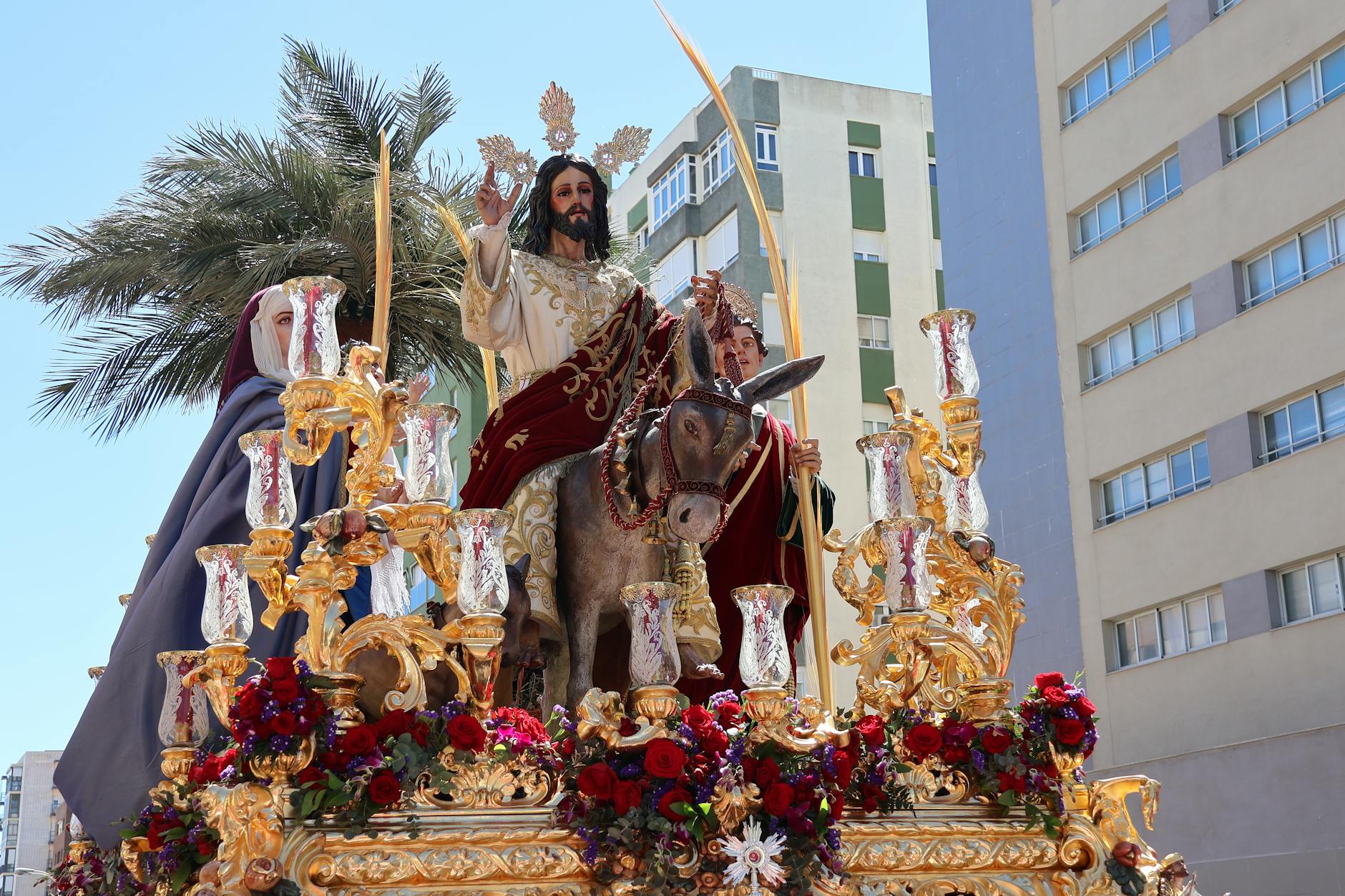
The timing was deliberate. Palm Sunday marks Christ’s entry into Jerusalem — a city now at the geographic centre of a war that has drawn in the world’s largest military powers. By anchoring his antiwar message in the liturgical calendar, Leo XIV connected ancient Christian narrative directly to the present crisis, reminding believers that the figure they venerate this week explicitly rejected the politics of violence. The homily also carried an implicit challenge to Catholic politicians in the United States and Europe who have supported the Iran campaign while professing their faith. — Vatican News
For Middle Eastern Christians — Maronites, Chaldeans, Copts, and others — the Pope’s specific prayer carried life-and-death significance. These communities, already diminished by decades of conflict, now face a regional war that threatens to scatter them further. Leo XIV’s decision to name them explicitly was a signal that the Vatican sees their survival as a priority, not a footnote. — National Catholic Reporter
A THEOLOGY OF REJECTION: THE POPE’S SHARPEST LANGUAGE
What set this homily apart from routine papal calls for peace was its theological severity. Previous popes have pleaded for ceasefires; Leo XIV went further, declaring that God actively rejects the prayers of warmakers. This is not mere rhetoric — it is a doctrinal claim that places leaders who invoke God while ordering airstrikes outside the boundaries of legitimate faith.
“Brothers and sisters, this is our God: Jesus, King of Peace, who rejects war, whom no one can use to justify war. He does not listen to the prayers of those who wage war, but rejects them.” — Pope Leo XIV
The statement carries an unmistakable edge. By asserting that God “rejects” wartime prayers rather than simply not answering them, the Pope suggested a form of divine judgement — a claim that will energise the global peace movement while infuriating hawks who see military action as morally justified. Vatican analysts noted that Leo XIV’s language echoed the prophetic tradition of the Hebrew Bible, in which God condemns the ritual worship of those who oppress the vulnerable.
THE IRAN CONFLICT: RELIGION AS A WEAPON ON ALL SIDES
The US-Israeli military campaign against Iran, now in its second month, has been saturated with religious framing from its inception. Evangelical Christian leaders in the United States have described the operation as fulfilment of biblical prophecy. Israeli officials have invoked existential survival narratives rooted in Jewish history. Iranian clerics have declared holy resistance. In this environment, the Pope’s intervention serves as a rare voice insisting that no God sanctions the killing now underway.
The conflict has already produced significant civilian casualties and a humanitarian crisis that aid agencies have struggled to address amid active hostilities. While the military dimensions of the campaign continue to dominate Western media coverage, it is worth noting that the escalation in defence spending and autonomous weapons development — including efforts like Saronic’s $1.75 billion raise to scale its AI-powered autonomous naval fleet — reflects a broader trend toward permanent war footing that the Pope’s message implicitly challenges.
UKRAINE: THE FORGOTTEN WAR THAT WON’T END
Though the Iran conflict has consumed global attention, Leo XIV did not allow Ukraine to fade from view. Russia’s campaign, now well into its fourth year, has been blessed by the Moscow Patriarchate in language that mirrors the very religious justification the Pope condemned. Patriarch Kirill has described the invasion as a “holy struggle” against Western moral decay — a framing that Leo XIV’s homily directly contradicts.
“Christ, King of Peace, cries out again from his cross: ‘God is love! Have mercy! Lay down your weapons!'” — Pope Leo XIV
By invoking Christ “crying out from his cross,” the Pope placed the victims of both wars — Ukrainian and Iranian civilians alike — in the position of the crucified, and their attackers in the position of those who crucified. It is difficult to imagine a more pointed theological indictment. The Vatican’s evolving diplomatic posture under Leo XIV suggests this was not a one-off statement but the opening salvo in a sustained campaign to reassert moral authority over the language of faith in wartime.
GLOBAL REACTION: PRAISE AND PUSHBACK
The homily drew immediate praise from peace organisations, progressive Catholic movements, and governments in the Global South that have refused to align with either bloc in the Iran conflict. Several Latin American and African leaders cited the Pope’s words in their own statements calling for diplomatic solutions. Muslim scholars also noted, with cautious approval, that the Pope’s condemnation was universal — it did not single out Islam or any other faith, but challenged all who weaponise belief.
Pushback was equally swift. Conservative Catholic commentators in the United States accused the Pope of moral equivalence, arguing that defensive military action against Iran’s nuclear programme cannot be placed in the same category as Russian aggression in Ukraine. Evangelical leaders who have supported the Iran campaign dismissed the homily as naive pacifism. In Moscow, state media largely ignored the address, while the Russian Orthodox Church issued no formal response — a silence that speaks volumes about the widening rift between Rome and Moscow.
🇵🇰 WHAT THIS MEANS FOR PAKISTAN
Pakistan watches this moment with acute interest. As a Muslim-majority nation sharing a border with Iran, Islamabad faces direct fallout from the widening Middle East conflict — from refugee flows to energy supply disruptions through the Iran-Pakistan gas pipeline, which has already been complicated by sanctions pressure. The Pope’s antiwar stance, while religiously rooted in Christianity, provides Pakistan’s diplomats with a powerful multilateral talking point: even the head of the world’s largest Christian denomination rejects the theological justification being used to bomb a Muslim-majority neighbour.
Pakistan’s own interfaith dynamics also come into play. The country’s small but significant Christian minority — estimated at 2 to 3 million — takes moral cues from the Vatican. Leo XIV’s explicit prayer for Middle Eastern Christians resonates with Pakistani Christians who have faced their own persecution and who see papal attention to minority communities under siege as directly relevant to their experience. The statement strengthens the hand of those in Pakistan who argue for interfaith solidarity as a strategic national interest, not merely a diplomatic courtesy.
More broadly, Pakistan’s positioning as a non-aligned voice calling for de-escalation in Iran gains credibility when the Vatican is saying the same thing. Islamabad has carefully avoided being drawn into either the US-Israeli or the Iranian camp; Leo XIV’s universalist condemnation of all warmakers provides moral cover for this neutrality at a time when pressure to choose sides is intensifying.
BOLOTOSAI ASSESSMENT
Pope Leo XIV’s Palm Sunday message marks a significant escalation in the Vatican’s willingness to challenge the religious narratives underpinning active military conflicts. This is not the gentle diplomacy of suggestion — it is a direct theological claim that God stands against those who wage war, regardless of which flag or scripture they carry. Three developments are now worth watching closely.
First, expect the Vatican to follow this rhetoric with diplomatic action. Leo XIV’s papacy has already signalled interest in mediation roles; this homily establishes the moral authority to back such efforts. A papal envoy to the Iran conflict or a renewed Vatican-brokered channel for Ukraine talks would be logical next steps. Second, the Pope’s words will intensify the internal Catholic debate in the United States, where support for the Iran campaign runs along political and denominational lines. Catholic members of Congress who voted to authorise military force will face pointed questions from their bishops. Third, the broader phenomenon of religious justification for warfare is unlikely to abate — if anything, the Pope’s condemnation may cause belligerents to double down on their sacred narratives rather than abandon them.
What is clear is that Leo XIV has chosen to make antiwar theology the defining feature of his early papacy. Whether this translates into tangible diplomatic outcomes or remains a prophetic voice in the wilderness will depend on whether political leaders fear moral judgement as much as they fear military defeat. History suggests they do not — but history also shows that popes who speak clearly in times of war are remembered long after the generals are forgotten.

 By
By
 By
By