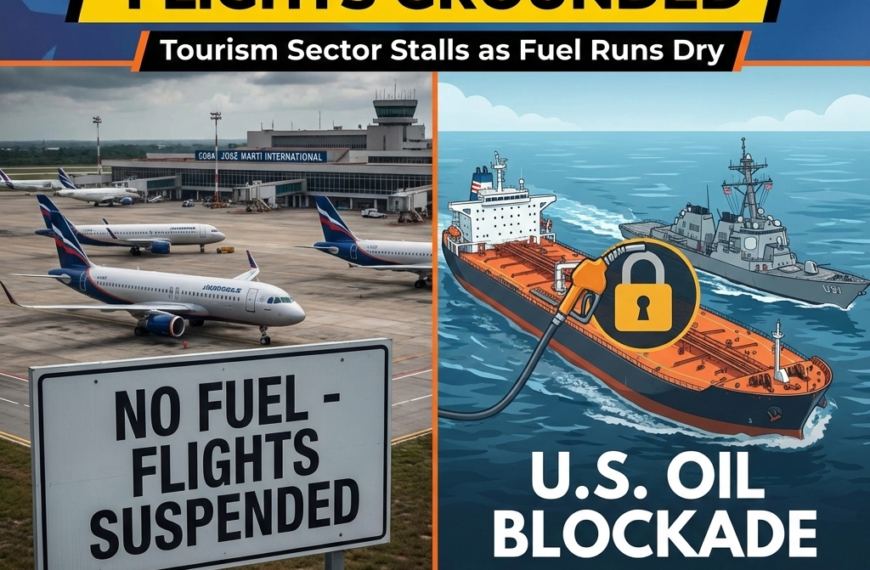
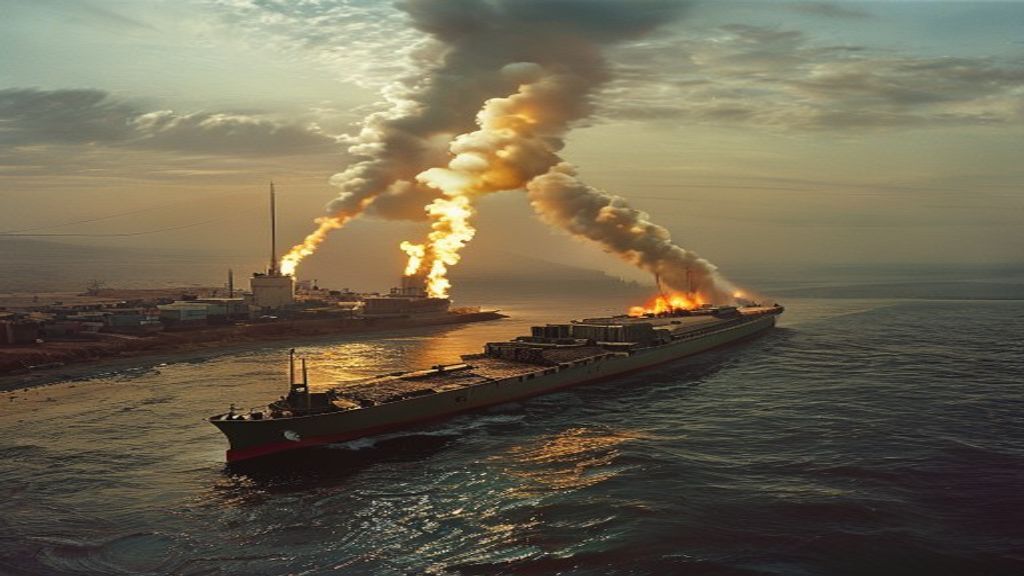

DOHA — An Iranian ballistic missile struck an oil tanker seventeen nautical miles north of the Qatari capital on Tuesday, puncturing its hull above the waterline in a dramatic escalation of hostilities that has sent crude prices soaring past $104 a barrel and plunged the Persian Gulf’s vital shipping lanes into a state of unprecedented danger.
The attack, which came as part of a volley of three missiles launched from Iranian territory, marks the first confirmed strike on a commercial vessel in Qatari waters since the 2026 Iran conflict erupted between Tehran and a US-Israel military coalition. The crew of the stricken tanker was reportedly unharmed, but the symbolism of the strike — hitting the economic lifeline of a key American ally in the Gulf — has reverberated across global energy markets and diplomatic corridors alike. In a simultaneous assault, Iran deployed a drone against Kuwait International Airport, igniting a large fire on the airport’s western tarmac and temporarily halting all civilian air traffic.
The twin attacks represent a calculated Iranian strategy to demonstrate that no Gulf state is beyond its reach, a message aimed as much at Washington and Tel Aviv as at Doha and Kuwait City. With Brent crude having surged more than forty percent since hostilities began, the economic fallout is rapidly globalising a conflict that many had hoped would remain contained.
| Parameter | Details |
|---|---|
| Date of Strike | April 1, 2026 |
| Location | 17 nautical miles north of Doha, Qatar |
| Missiles Launched | 3 from Iranian territory; 1 confirmed hit on tanker |
| Brent Crude Price | Above $104/barrel (+40% since conflict began) |
| Secondary Target | Kuwait International Airport (drone strike, large fire) |
| Belligerents | Iran vs. US-Israel coalition |
| US Timeline Estimate | President Trump suggests conflict could end in 2-3 weeks |
SITUATIONAL BREAKDOWN
The missile that struck the tanker was part of a three-projectile salvo launched in the early hours of Tuesday morning. Two of the missiles were reportedly intercepted by coalition air defence systems operating in the northern Gulf, but the third evaded detection long enough to impact the vessel’s starboard hull above the waterline. Damage assessments suggest the tanker, which was carrying a partial load of liquefied natural gas, is structurally intact but will require drydock repairs before returning to service. The attack underscores the growing sophistication of Iran’s missile programme and the difficulty of defending vast stretches of open water against saturation tactics. — Al Jazeera
Simultaneously, the drone strike on Kuwait International Airport created a scene of chaos as a fireball erupted near fuel storage facilities on the airport’s western perimeter. Kuwaiti civil defence authorities confirmed the fire was brought under control within ninety minutes, but all flights were diverted for several hours, stranding thousands of passengers. Kuwait, which has attempted to maintain a degree of neutrality in the broader conflict, immediately recalled its ambassador from Tehran and summoned the Iranian chargé d’affaires for what officials described as a formal protest of the highest order. — Associated Press
The dual strikes appear designed to demonstrate Iran’s capacity for multi-vector warfare — combining ballistic missiles and unmanned aerial systems in coordinated attacks across multiple sovereign territories. Military analysts note that the simultaneous targeting of both a maritime and an aviation asset suggests a deliberate effort to stretch coalition defence networks and expose vulnerabilities in Gulf state air defences. — CNN
The Energy Market Shockwave
Global energy markets reacted with immediate alarm. Brent crude, which had already climbed steadily since the outbreak of hostilities, surged past $104 a barrel in Asian trading hours — a level not seen since the aftermath of Russia’s full-scale invasion of Ukraine in 2022. Natural gas futures in Europe spiked in sympathy, with traders pricing in the possibility that LNG shipments through the Strait of Hormuz could face sustained disruption.
The Strait of Hormuz, through which roughly twenty percent of the world’s oil supply passes daily, has long been identified as the single most consequential chokepoint in global energy infrastructure. President Trump, addressing the issue at a press briefing, appeared to signal that protecting the strait might not be a unilateral American responsibility.
“That’ll be for France. That’ll be for whoever’s using the strait.” — US President Donald Trump, on protecting the Strait of Hormuz
The remark sent a chill through European capitals, where policymakers have relied on the implicit assumption of American naval supremacy in the Gulf for decades. The growing interest in autonomous naval systems like those being developed by Saronic takes on new urgency in a theatre where traditional manned vessels are increasingly vulnerable to asymmetric threats.
Diplomatic Paralysis and the Trust Deficit
Efforts to negotiate a ceasefire have stalled entirely. Iranian Foreign Minister Abbas Araghchi, speaking to reporters in Tehran, offered a blunt assessment of the diplomatic landscape that leaves little room for optimism.
“The trust level is at zero.” — Iranian Foreign Minister Abbas Araghchi, on prospects of talks with the US
The statement reflects a deep Iranian conviction that Washington’s partnership with Israel in the current campaign has eliminated any pretence of honest brokering. Tehran views the conflict as existential — not merely a military confrontation but an attempt at regime destabilisation that justifies striking at the economic infrastructure of states it considers complicit in the coalition’s operations. Qatar’s hosting of American military facilities at Al Udeid Air Base has long made it a potential target in any regional conflagration.
For its part, President Trump has suggested the conflict could conclude within two to three weeks, stating that Iran does not need to agree to a deal for him to end the war. The ambiguity of that statement — whether it implies a military conclusion or a unilateral American withdrawal — has left allies and adversaries alike parsing every word for signals of intent.
Coalition Fault Lines Emerge
The attacks on Qatar and Kuwait have exposed fractures within the Gulf Cooperation Council that Iran appears determined to exploit. Qatar, which restored full diplomatic relations with Iran only in 2023 after years of regional isolation, now finds itself caught between its security dependence on the United States and its commercial ties with Tehran. Kuwait’s government, meanwhile, faces domestic pressure from a population that overwhelmingly opposes involvement in what many view as an American-Israeli war.
Saudi Arabia, the GCC’s largest member, has conspicuously avoided direct military involvement despite its long-standing rivalry with Iran. Riyadh’s diplomatic rapprochement with Tehran, brokered by China in 2023, appears to be holding — for now — but analysts warn that further Iranian strikes on Gulf state territory could force the Kingdom’s hand and widen the conflict into a truly regional war.
Maritime Security in a New Era
Tuesday’s strike on the tanker represents a threshold moment for international maritime law and the freedom of navigation. The last sustained campaign against commercial shipping in the Gulf — the so-called Tanker War of the 1980s — eventually drew direct American military intervention. Today’s geopolitical landscape is considerably more complex, with China, India, and several European nations all dependent on Gulf energy exports yet reluctant to be drawn into a military confrontation.
Insurance premiums for vessels transiting the Gulf have already doubled since the conflict began, and several major shipping companies have begun rerouting cargoes around the Cape of Good Hope, adding weeks and significant cost to deliveries. The cascading economic consequences of sustained disruption to Gulf shipping are difficult to overstate — affecting everything from petrol prices in Europe to fertiliser costs in South Asia.
🇵🇰 WHAT THIS MEANS FOR PAKISTAN
Pakistan finds itself in an acutely vulnerable position as the Gulf conflict intensifies. The country imports roughly eighty percent of its crude oil, with a significant portion transiting the Strait of Hormuz. With Brent crude above $104, Islamabad faces a ballooning import bill that could derail the fragile economic stabilisation achieved under its latest IMF programme. Every ten-dollar increase in oil prices costs Pakistan’s treasury an estimated $1.5 billion annually — money the country simply does not have.
Beyond economics, Pakistan’s diplomatic balancing act becomes more precarious by the day. Islamabad maintains strategic ties with both Iran and Saudi Arabia, has historically close relations with the Gulf states that host millions of Pakistani workers, and depends on Chinese goodwill — Beijing being the power most invested in Gulf stability. A wider regional war could force Pakistan to choose sides in a conflict where every alignment carries enormous costs. The safety of approximately nine million Pakistani expatriates working across the Gulf, many in Qatar and Kuwait, adds a humanitarian dimension that could quickly become a domestic political crisis.
Pakistan’s military establishment is also watching with concern as the conflict validates the effectiveness of missile and drone attacks against high-value maritime and aviation targets — a development with direct implications for the country’s own defence posture along its Makran coast and the strategically vital port of Gwadar.
BOLOTOSAI ASSESSMENT
The Iranian strikes on Qatari and Kuwaiti territory mark a dangerous new phase in a conflict that is rapidly outgrowing its original boundaries. Three scenarios demand close attention in the coming days.
First, the probability of a direct confrontation between Iranian forces and Gulf state militaries has increased substantially. If Iran continues striking sovereign territory of non-belligerent nations, the political pressure on Saudi Arabia, the UAE, and others to respond — with or without American backing — will become overwhelming. Second, the energy market disruption is approaching a tipping point. Sustained oil prices above $100 will trigger inflationary spirals in import-dependent economies across South Asia, Africa, and Southern Europe, creating domestic political crises far from the Gulf. Third, President Trump’s suggestion that the war could end in weeks raises the possibility of a sudden, unilateral American de-escalation that leaves Gulf allies exposed and Iran emboldened.
The variables to watch are the Strait of Hormuz — whether Iran moves from striking individual vessels to attempting a full blockade — and the Chinese response. Beijing, which imports more Gulf oil than any other nation, has thus far limited itself to diplomatic statements. A Chinese naval deployment to escort its own tankers through the strait would fundamentally alter the conflict’s dynamics and signal that the era of unchallenged American maritime dominance in the Gulf is definitively over. The next seventy-two hours will be decisive.

 By
By


 By
By