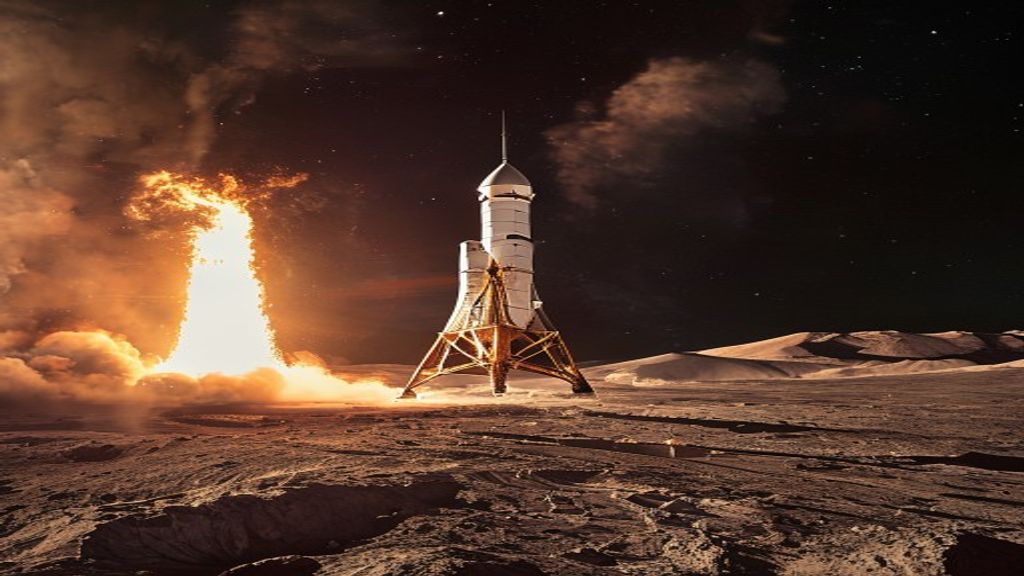

CAPE CANAVERAL, Florida — NASA launched the Artemis II mission on Tuesday evening, sending four astronauts on a trajectory around the Moon in what marks the first crewed voyage beyond low Earth orbit in more than half a century.
The Space Launch System rocket lifted off from Kennedy Space Center at 6:24 p.m. EDT on April 1, 2026, carrying NASA astronauts Reid Wiseman, Victor Glover, and Christina Koch, along with Canadian Space Agency astronaut Jeremy Hansen, on a ten-day free-return trajectory that will loop around the Moon and bring them safely back to Earth. The mission represents a historic milestone on multiple fronts: Glover becomes the first person of color, Koch the first woman, and Hansen the first non-U.S. citizen ever to travel beyond low Earth orbit. The last time humans ventured this far from home was Apollo 17 in December 1972 — more than 53 years ago.
The stakes could not be higher. Artemis II is the critical crewed test flight that validates the Orion spacecraft’s life-support systems, navigation, and re-entry capabilities before NASA attempts an actual lunar landing on Artemis III. The mission also cements international cooperation in deep-space exploration, with Canada’s participation signalling a broadening of the coalition that will eventually establish a sustained human presence on and around the Moon. For the global space community, Artemis II is the moment decades of planning, billions of dollars in investment, and an entirely new generation of hardware finally prove themselves with human lives on the line.
| Parameter | Details |
|---|---|
| Mission | Artemis II — Crewed Lunar Flyby |
| Launch Date | April 1, 2026, 6:24 p.m. EDT |
| Crew | Reid Wiseman (Commander), Victor Glover, Christina Koch, Jeremy Hansen (CSA) |
| Duration | 10 days (free-return trajectory) |
| Launch Site | Kennedy Space Center, Florida |
| Historic Firsts | First person of color, first woman, and first non-U.S. citizen beyond low Earth orbit |
| Last Comparable Mission | Apollo 17, December 1972 |
SITUATIONAL BREAKDOWN
The launch proceeded after mission controllers confirmed favourable weather conditions at the Cape, with forecasts indicating an 80 percent probability of acceptable conditions through the launch window. The Space Launch System, the most powerful rocket NASA has ever built, performed nominally during ascent, placing the Orion spacecraft on its planned trans-lunar injection trajectory. Within hours of launch, the crew confirmed all onboard systems were operating within expected parameters, and the Orion capsule began its four-day coast toward the Moon. — NASA
Commander Reid Wiseman set the tone for the mission with characteristic brevity upon arriving at Kennedy Space Center ahead of launch. The veteran astronaut and former Navy test pilot has waited years for this moment, having been named to the Artemis II crew in 2023. The crew’s composition — diverse in gender, race, and nationality — reflects a deliberate effort by NASA and its international partners to ensure that the return to deep space looks fundamentally different from the Apollo era. — CBS News
During the ten-day mission, the crew will spend approximately one day in close lunar observation, including unprecedented human views of the far side of the Moon. While robotic spacecraft and orbiting cameras have mapped the lunar far side extensively, no human eyes have ever observed it at close range. This single day of observation is expected to yield invaluable data on potential landing sites and geological features that will inform future Artemis surface missions. — Fox Weather
A CREW THAT MAKES HISTORY
The selection of the Artemis II crew was itself a watershed moment for human spaceflight. Victor Glover, a naval aviator who previously served as pilot on SpaceX Crew-1 to the International Space Station, now carries the distinction of being the first person of color to leave low Earth orbit. Christina Koch, who holds the record for the longest single spaceflight by a woman at 328 days aboard the ISS, becomes the first woman to venture toward the Moon. Jeremy Hansen, a fighter pilot and the first Canadian selected for a deep-space mission, represents the expanding international character of lunar exploration.
“Hey, let’s go to the Moon!” — Commander Reid Wiseman, upon arrival at Kennedy Space Center
Wiseman’s casual confidence belies the enormity of the undertaking. The Artemis II crew has trained together for years, running through thousands of simulated scenarios including emergency abort procedures, loss-of-communication protocols, and manual navigation exercises. Their mission, while not involving a lunar landing, is arguably the most dangerous phase of the Artemis programme: it is the first time the Orion spacecraft will carry humans through the Van Allen radiation belts, test its heat shield at lunar re-entry velocities with a crew aboard, and validate life-support systems far from any possibility of rescue.
THE TECHNOLOGY BEHIND THE RETURN
Artemis II relies on an entirely new architecture compared to the Apollo missions. The Space Launch System, which completed its maiden uncrewed flight during Artemis I in 2022, generates 8.8 million pounds of thrust at liftoff — 15 percent more than the Saturn V. The Orion spacecraft, built by Lockheed Martin with a European Service Module provided by the European Space Agency, is designed for deep-space endurance missions lasting up to 21 days.
The free-return trajectory chosen for Artemis II is a deliberate safety measure. Should any critical system fail during the outbound journey, the spacecraft’s momentum and the Moon’s gravity will naturally return it to Earth without requiring a major engine burn — the same principle that saved the crew of Apollo 13 in 1970. This conservative approach underscores NASA’s commitment to validating every element of the system before committing to the far riskier lunar landing attempt planned for Artemis III.
GEOPOLITICAL DIMENSIONS OF THE NEW MOON RACE
Artemis II does not exist in a vacuum. China’s Chang’e programme has accelerated dramatically, with plans for crewed lunar missions before 2030. India’s Chandrayaan-3 successfully landed near the lunar south pole in 2023. Russia, despite economic constraints, continues to signal lunar ambitions. The return of American astronauts to cislunar space is as much a geopolitical statement as a scientific one — a reassertion of U.S. leadership in an arena where dominance is no longer guaranteed.
The inclusion of a Canadian astronaut reflects the broader Artemis Accords framework, which now includes over 40 signatory nations committing to principles of peaceful exploration, transparency, and resource utilisation on the Moon. Canada’s contribution extends beyond personnel: the country is building the Canadarm3 robotic system for the planned Lunar Gateway station. Just as the space domain attracts new players, so too does the defence sector see surging investment in autonomous systems — as evidenced by Saronic’s recent $1.75 billion raise to scale its AI-powered autonomous naval fleet, a reminder that frontier technology investment is accelerating across both civilian and military domains.
WHAT HAPPENS DURING THE TEN DAYS
The mission profile is meticulously structured. After launch and trans-lunar injection, the crew will spend roughly four days coasting toward the Moon, conducting systems checks and science experiments en route. Upon reaching the Moon, Orion will swing behind the lunar far side, giving the crew a view that no human has ever witnessed at such proximity. The spacecraft will pass within approximately 6,400 miles of the lunar surface before the Moon’s gravity slings it back toward Earth.
The return journey will culminate in a high-speed re-entry, with the Orion capsule hitting Earth’s atmosphere at approximately 25,000 miles per hour — generating temperatures exceeding 5,000 degrees Fahrenheit on the heat shield. This re-entry test is considered one of the mission’s most critical objectives. A successful splashdown in the Pacific Ocean will validate the entire Orion system for future landing missions.
🇵🇰 WHAT THIS MEANS FOR PAKISTAN
Pakistan’s fledgling space programme, managed by the Space and Upper Atmosphere Research Commission (SUPARCO), has historically operated on modest budgets and limited ambitions. However, the Artemis era presents tangible opportunities. Pakistan became a signatory to the Artemis Accords in 2023, formally aligning itself with the U.S.-led framework for lunar exploration. This diplomatic step opens doors for Pakistani scientists and engineers to participate in collaborative research, access shared lunar data, and potentially contribute instruments or experiments to future Artemis missions.
More immediately, the technological spillovers from deep-space missions — in materials science, telecommunications, life-support systems, and remote sensing — have direct applications to Pakistan’s development priorities. The country’s growing satellite programme, which includes remote sensing assets for agricultural monitoring and disaster management, stands to benefit from advances in miniaturised electronics and radiation-hardened components being developed for the Artemis ecosystem. For a nation that loses billions annually to climate-related disasters, improved Earth-observation capabilities enabled by space technology cooperation are not abstract — they are existential.
The diplomatic dimension also matters. As the U.S. and China compete for partners in their respective lunar programmes, Pakistan’s strategic calculus — balancing deep ties with Beijing against growing technological engagement with Washington — will be tested. How Islamabad navigates this space diplomacy will shape its access to cutting-edge technology for decades to come.
BOLOTOSAI ASSESSMENT
Artemis II is not merely a nostalgia trip to the Moon — it is the inflection point that determines whether humanity’s return to deep space is real or rhetorical. A successful ten-day mission validates the Orion spacecraft for crewed operations, clears the path for the Artemis III lunar landing, and cements the international coalition that will build the Lunar Gateway station. Three outcomes deserve close attention.
First, watch the heat shield. Orion’s re-entry at lunar return velocities is the single highest-risk event of the mission, and the Artemis I test revealed unexpected ablation patterns that engineers have spent years analysing. A clean re-entry closes the last major technical question mark before a landing attempt. Second, monitor the geopolitical fallout. A visible American-led success in cislunar space will intensify the narrative of a new space race with China, potentially accelerating both nations’ timelines and budgets. Third, observe the diversity narrative. The historic firsts represented by Glover, Koch, and Hansen are not incidental — they are a deliberate signal that the next chapter of human space exploration will not replicate the exclusionary patterns of the last one.
If Artemis II succeeds, the Moon becomes tangibly closer for humanity. If it encounters serious problems, the entire programme’s timeline — and the political will sustaining it — faces existential risk. The world is watching. The countdown, at last, is over.


 By
By


 By
By