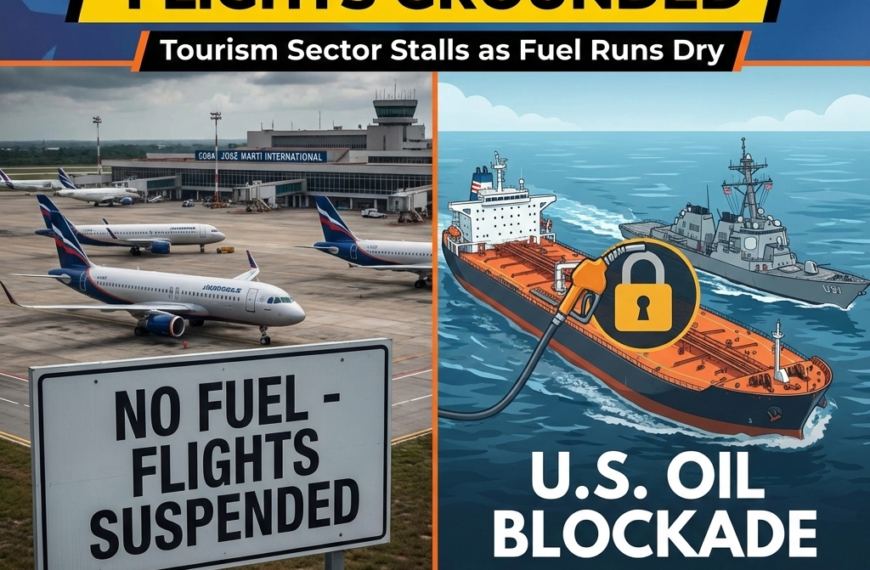
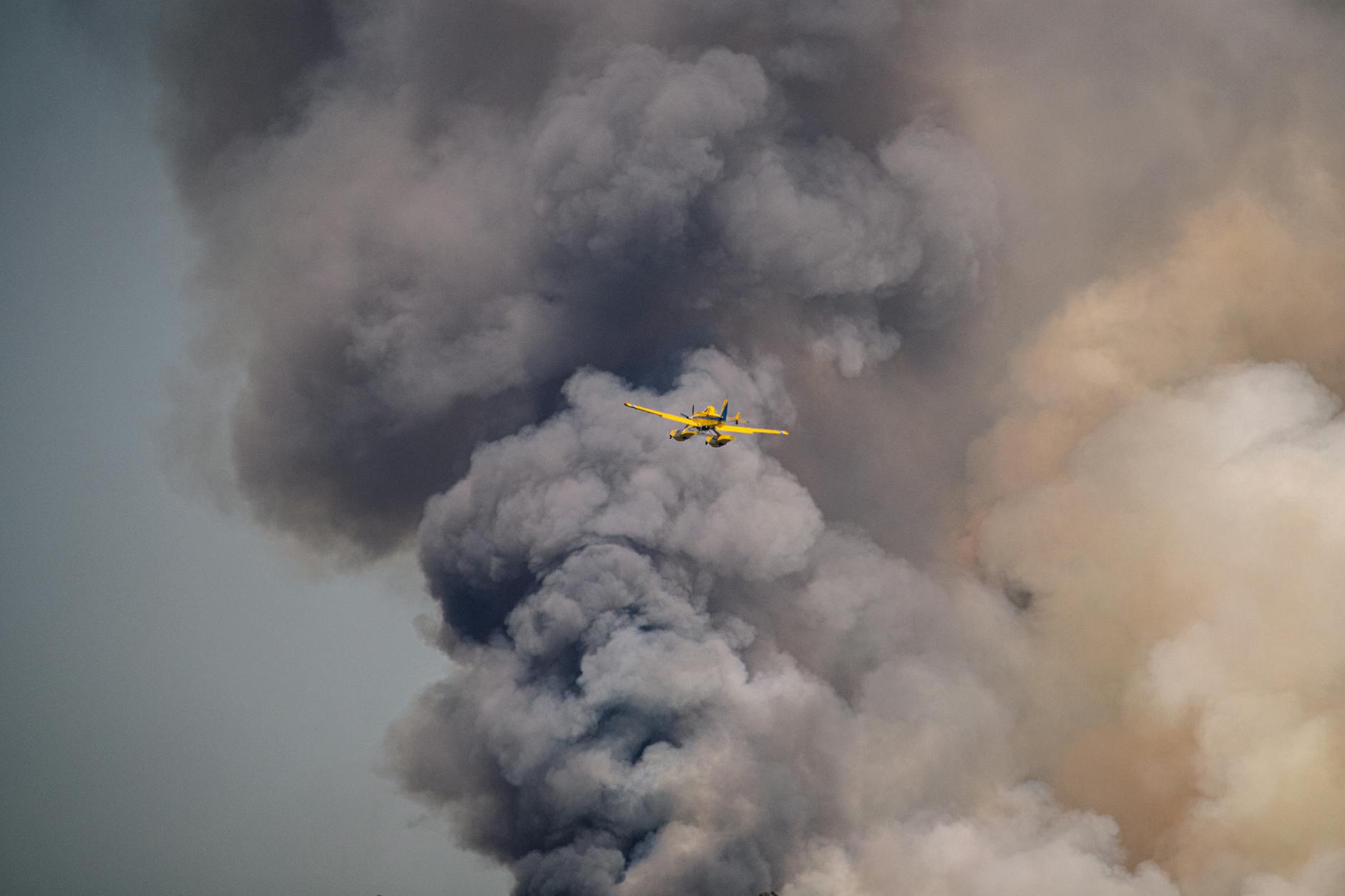

KUWAIT CITY — Iranian drones struck fuel storage tanks at Kuwait International Airport on Tuesday, igniting a massive blaze that took emergency crews 58 hours to extinguish in what officials called a “blatant assault” on the Gulf state’s critical aviation infrastructure.
The attack targeted tanks belonging to the Kuwait Aviation Fuel Company (KAFCO), sending thick plumes of black smoke billowing over the capital and temporarily disrupting flight operations at one of the region’s busiest transit hubs. While no casualties were reported and damage was confined to material losses, the strike sent shockwaves across the Persian Gulf, where multiple nations reported simultaneous Iranian military operations. Bahrain confirmed a separate fire at a company facility following what authorities described as an Iranian attack, underscoring the breadth and coordination of Tehran’s offensive posture. The escalation marks a dangerous new chapter in Gulf security, raising urgent questions about the vulnerability of civilian infrastructure across the region.
| Parameter | Details |
|---|---|
| Target | Kuwait Aviation Fuel Company (KAFCO) fuel storage tanks at Kuwait International Airport |
| Attack Method | Iranian drone strike |
| Casualties | None reported; material damage only |
| Fire Duration | 58 hours before fully extinguished |
| Key Spokesperson | Abdullah Al Rajhi, Kuwait Civil Aviation Authority |
| Other Targets | Bahrain reported a simultaneous Iranian attack on a company facility |
| Date | April 1, 2026 |
SITUATIONAL BREAKDOWN
The drone strike on Kuwait International Airport came without warning in the early hours of April 1, targeting the KAFCO fuel depot located on the airport’s perimeter. The initial explosions set off a chain reaction among interconnected storage tanks, creating an inferno that required the deployment of every available civil defense unit in Kuwait City. Aviation authorities immediately grounded all incoming and outgoing flights, diverting dozens of commercial aircraft to neighboring airports in Saudi Arabia and the UAE. The fire’s intensity was such that conventional suppression methods proved insufficient in the opening hours, forcing firefighters to adopt a containment-first strategy to prevent the blaze from reaching the main terminal complex. — Kuwait Times
Simultaneously, Bahrain’s Interior Ministry confirmed that a separate facility within the kingdom had come under Iranian attack, resulting in a fire that civil defense teams were scrambled to contain. While details of the Bahrain incident remained sparse, the coordinated timing across two Gulf Cooperation Council (GCC) member states pointed to a deliberate, multi-front Iranian operation designed to overwhelm regional air defenses and signal Tehran’s capacity for wide-area power projection. The GCC Secretariat convened an emergency session within hours, with member states issuing a joint condemnation of what they termed “unprovoked aggression against sovereign nations.” — Gulf News
International reaction was swift. The broader Middle East security landscape had already been tense in the weeks leading up to the strikes, with diplomatic channels between Tehran and Gulf capitals largely frozen. Western governments, including the United States and the United Kingdom, issued statements calling for immediate de-escalation, while the United Nations Security Council scheduled a closed-door briefing on the situation. — Anadolu Agency
THE ATTACK: ANATOMY OF A 58-HOUR BLAZE
The fire at the KAFCO facility proved to be one of the most challenging industrial blazes in Kuwait’s recent history. Fuel storage tanks, each holding thousands of barrels of aviation-grade kerosene, continued to feed the flames long after the initial drone impact. Firefighters from across the country, supplemented by specialized hazmat units, worked in rotating shifts to prevent the fire from spreading to adjacent infrastructure, including jet fuel pipelines feeding directly to the airport’s tarmac.
After 58 grueling hours, emergency teams finally brought the blaze under control. Kuwait’s Fire Service Directorate confirmed that advanced foam suppression systems, deployed from both ground and aerial platforms, were instrumental in the final stages of containment. Preliminary damage assessments suggest the destruction of multiple storage tanks and significant harm to surrounding fuel distribution infrastructure, though full evaluations are ongoing.
“This was a blatant assault on Kuwait’s airport.” — Abdullah Al Rajhi, Kuwait Civil Aviation Authority spokesman
Al Rajhi’s statement captured the gravity of the moment. Kuwait, historically one of the more diplomatically neutral Gulf states, found itself thrust into the center of a regional conflict it had long sought to mediate rather than participate in.
REGIONAL REPERCUSSIONS: GULF STATES ON HIGH ALERT
The simultaneous strikes on Kuwait and Bahrain have fundamentally altered the security calculus for every GCC member state. Saudi Arabia, the UAE, and Qatar have reportedly elevated their air defense postures to the highest levels since the 2019 Aramco drone attacks. Bahrain’s confirmation of its own incident added a chilling dimension to the crisis.
“Civil defense teams are extinguishing a fire at a company facility following what authorities described as an Iranian attack.” — Bahrain Interior Ministry
The Gulf region’s vulnerability to drone warfare has been a subject of intense debate since Houthi and Iranian-linked attacks on Saudi oil facilities in 2019. Despite billions of dollars invested in advanced air defense systems, including Patriot batteries and THAAD deployments, the ability of relatively inexpensive drones to penetrate layered defenses and strike high-value civilian targets remains a persistent and unresolved challenge.
Energy markets reacted immediately, with Brent crude futures spiking over four percent in early trading as concerns mounted over the security of Gulf oil and gas infrastructure. Aviation fuel prices are expected to face upward pressure in the coming weeks as supply chain disruptions ripple outward from the KAFCO facility’s destruction.
DIPLOMATIC FALLOUT AND INTERNATIONAL RESPONSE
The attacks have placed enormous strain on what remained of diplomatic engagement between Iran and its Gulf neighbors. Kuwait, which had historically served as a bridge between Tehran and Riyadh, now finds itself among the aggrieved parties. The Kuwaiti Foreign Ministry summoned Iran’s chargé d’affaires and demanded a full explanation, while the country’s National Assembly held an emergency session calling for a collective GCC military response.
The international community has been drawn deeper into the crisis. Religious and moral leaders have also weighed in on the broader conflict dynamics in the region. Just days earlier, Pope Leo XIV rejected using religion to justify war on Palm Sunday, a message that resonates powerfully as tensions between Muslim-majority nations threaten to engulf the region in broader conflict. The Vatican’s call for restraint adds to a growing chorus of voices urging all parties to step back from the brink.
Washington has reportedly offered Kuwait and Bahrain enhanced intelligence-sharing and additional air defense assets, though both governments have signaled a preference for a unified GCC response rather than bilateral arrangements with external powers.
IRAN’S STRATEGIC CALCULUS
Tehran has not issued a formal statement taking responsibility for the strikes, maintaining its characteristic ambiguity regarding military operations conducted through drone and missile platforms. However, analysts tracking Iranian military doctrine note that the coordinated nature of the attacks across multiple countries bears the hallmarks of operations directed by the Islamic Revolutionary Guard Corps (IRGC) Aerospace Force.
The timing of the strikes raises critical questions about Iran’s strategic objectives. With nuclear negotiations stalled and economic sanctions tightening, some observers suggest Tehran may be attempting to demonstrate its capacity to inflict significant economic damage on Gulf states as leverage in broader geopolitical negotiations. Others point to escalating regional proxy conflicts and argue the strikes represent a direct military escalation rather than a bargaining tactic.
🇵🇰 WHAT THIS MEANS FOR PAKISTAN
Pakistan watches this escalation with acute concern. The Gulf states, particularly Kuwait, Saudi Arabia, and the UAE, are home to an estimated nine million Pakistani expatriate workers whose remittances constitute a lifeline for the national economy. Any prolonged military conflict or disruption to Gulf economic activity would directly impact Pakistan’s foreign exchange reserves and the livelihoods of millions of families back home. Islamabad has already activated contingency planning for potential evacuations should the situation deteriorate further.
On the diplomatic front, Pakistan’s carefully calibrated neutral stance between Iran and the Gulf Arab states faces its most severe test in years. Pakistan shares a long border with Iran in Balochistan, and cross-border security incidents have periodically strained relations. Simultaneously, Islamabad depends heavily on Saudi and Emirati financial support, including deferred oil payment facilities and bilateral loans that have repeatedly prevented balance-of-payments crises. Being forced to choose sides in a Gulf-Iran military confrontation would be catastrophic for Pakistani diplomacy.
Energy security presents another dimension of vulnerability. Pakistan imports a significant portion of its petroleum products through Gulf supply chains. Any sustained disruption to regional fuel infrastructure, like the KAFCO destruction, could trigger fuel shortages and price spikes in Pakistan at a time when the economy is already under severe strain from IMF-mandated austerity measures.
BOLOTOSAI ASSESSMENT
The Iranian drone strikes on Kuwait and Bahrain represent the most significant direct military escalation by Tehran against GCC member states since the 2019 Aramco attacks. The targeting of civilian aviation infrastructure — rather than military installations — signals a deliberate strategy to maximize economic disruption and psychological impact while avoiding the military-to-military confrontation that might trigger an immediate armed response.
Three scenarios merit close attention in the coming days. First, a coordinated GCC military response remains possible if intelligence confirms additional planned Iranian operations; the activation of the Peninsula Shield Force would mark a historic collective defense invocation. Second, a diplomatic off-ramp could emerge through Turkish, Omani, or Chinese mediation, though the destruction of civilian infrastructure raises the threshold for what Kuwait and Bahrain would accept as adequate restitution. Third, and most concerning, Iran could interpret a muted international response as license for further strikes, potentially targeting oil export terminals or desalination plants that sustain Gulf populations.
What to watch: the GCC emergency summit expected within 48 hours, any movement at the UN Security Council, and whether Iran’s silence continues or gives way to either denial or justification. The next 72 hours will determine whether this becomes a contained incident or the opening chapter of a wider Gulf conflict.

 By
By


 By
By