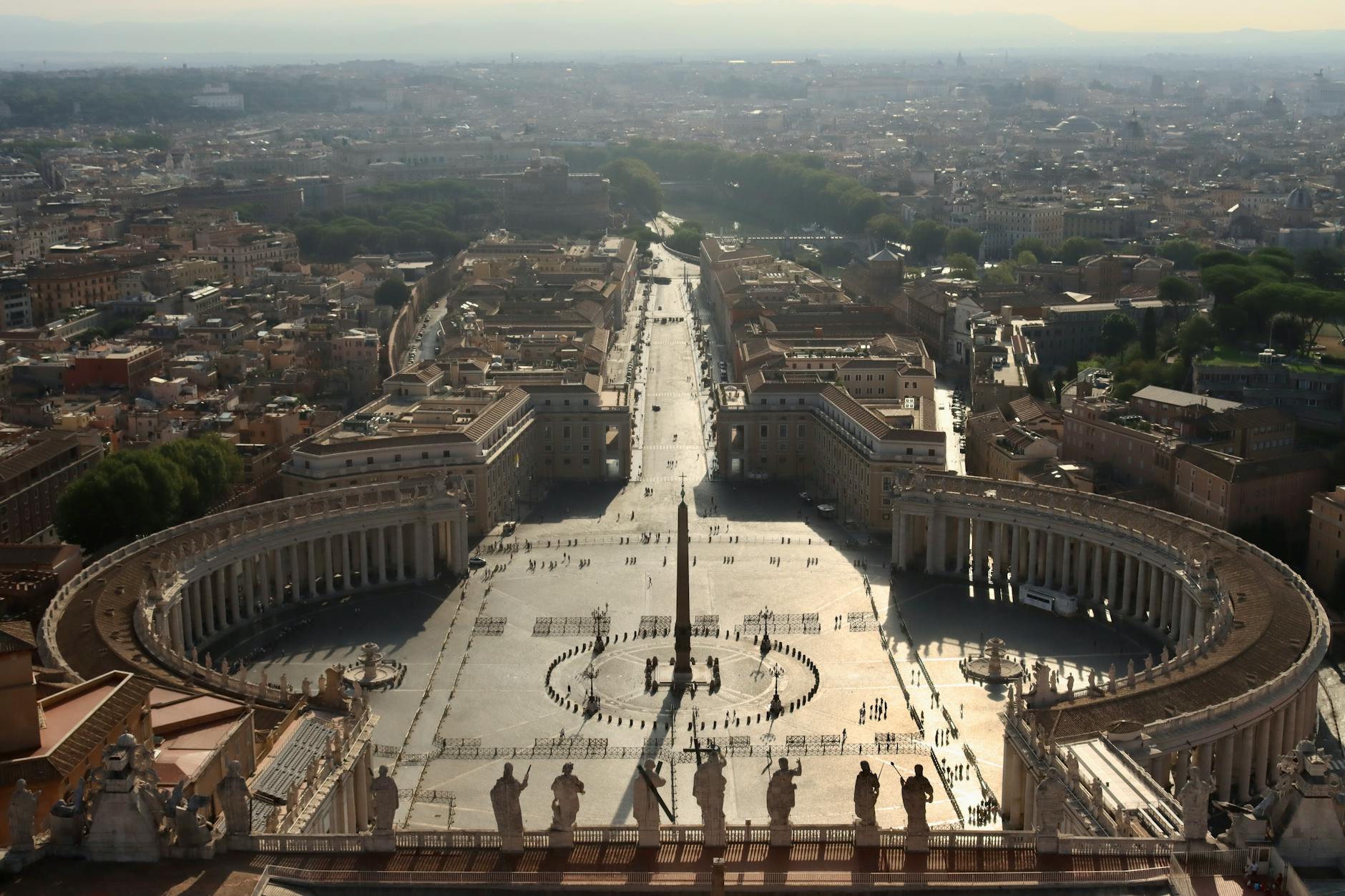

VATICAN CITY — Pope Leo XIV delivered a powerful rebuke of religiously motivated warfare during his first Palm Sunday Mass as pontiff, standing before tens of thousands of faithful gathered in St. Peter’s Square on March 29, 2026, and declaring that no party to any conflict may invoke God’s name to justify the taking of human life.
The homily, delivered amid the solemn pageantry of one of Christianity’s most sacred liturgical moments, carried particular weight given the escalating conflicts scarring multiple regions of the globe. With wars raging in Iran, Ukraine, and across the broader Middle East, the new Pope chose his first major Palm Sunday address to position himself unequivocally as a voice for peace and diplomatic resolution. The address drew immediate international attention, with diplomatic observers noting its directness and the pointed nature of its theological argument — that the very nature of Christ as “King of Peace” renders any attempt to weaponize faith fundamentally illegitimate. Vatican watchers have described the homily as a clear signal of the trajectory Leo XIV intends to chart for his pontificate on matters of global conflict and interfaith dialogue.
| Parameter | Details |
|---|---|
| Key Figure | Pope Leo XIV, Head of the Roman Catholic Church |
| Event | First Palm Sunday Mass of Leo XIV’s pontificate, March 29, 2026 |
| Location | St. Peter’s Square, Vatican City |
| Attendance | Tens of thousands of worshippers |
| Conflicts Referenced | Iran, Ukraine, and the broader Middle East |
| Central Theme | Jesus as King of Peace; rejection of war justified by religion |
| Liturgical Context | Palm Sunday, beginning of Holy Week 2026 |
SITUATIONAL BREAKDOWN
The Palm Sunday liturgy marks the beginning of Holy Week, the most sacred period in the Christian calendar, commemorating Christ’s triumphant entry into Jerusalem before his crucifixion and resurrection. For Pope Leo XIV, this first observance as pontiff offered an unparalleled global stage. The Vatican confirmed that the Mass was broadcast live across more than 120 countries, with millions watching as the Pope processed through St. Peter’s Square holding a palm frond before delivering his homily from the steps of the basilica. The sheer scale of the audience underscored the diplomatic as well as spiritual significance of his words. — Vatican.va
The Pope’s message arrived at a moment of acute global tension. The conflict in Ukraine continues to grind through its fourth year with no ceasefire in sight, while military operations in Iran and throughout the Middle East have displaced millions and left Christian minority communities in an increasingly precarious position. Humanitarian agencies have reported escalating civilian casualties across all three theatres of conflict, and multiple rounds of international mediation have stalled or collapsed entirely. Leo XIV’s specific mention of Christians in the Middle East reflected growing Vatican concern over the survival of some of the world’s oldest Christian communities, many of which have seen their populations dwindle by more than half over the past two decades. — National Catholic Reporter
Diplomatic analysts noted that while papal calls for peace are a longstanding tradition, Leo XIV’s language was notably more direct and confrontational than the measured diplomatic tones typically favoured by the Holy See. By declaring that God “does not listen to the prayers of those who wage war, but rejects them,” the Pope moved beyond general appeals for peace into what some theologians have described as a direct theological delegitimisation of wartime religious invocations — a message with implications for state and non-state actors across multiple faiths and conflicts. — NPR
A Theological Line in the Sand
At the heart of Leo XIV’s homily was a theological argument of striking clarity. By centring his address on the figure of Jesus as the “King of Peace,” the Pope constructed a Christological framework that leaves no room for the sacralisation of violence. This was not merely a political statement dressed in religious garb; it was a deeply doctrinal assertion that the very identity of the Christian God is fundamentally incompatible with the waging of war.
“Brothers and sisters, this is our God: Jesus, King of Peace, who rejects war, whom no one can use to justify war. He does not listen to the prayers of those who wage war, but rejects them.” — Pope Leo XIV
The implications of this framing extend well beyond Christianity. In a global landscape where religious rhetoric is routinely deployed to mobilise fighters, justify territorial expansion, and dehumanise adversaries, the Pope’s insistence that divine authority cannot be enlisted for military purposes represents a challenge to actors across the geopolitical spectrum. From nationalist movements in Eastern Europe to militant groups in the Middle East, the instrumentalisation of faith for warfare has become one of the defining features of twenty-first-century conflict. Leo XIV’s words, delivered from one of the world’s most visible religious platforms, amount to a direct confrontation with that trend.
The Plight of Middle Eastern Christians
Pope Leo XIV’s specific prayers for Christians in the Middle East highlighted what many observers have called one of the most under-reported humanitarian crises of the modern era. Once-thriving Christian communities in Iraq, Syria, Lebanon, and Palestine have been decimated by decades of conflict, political instability, and targeted persecution. In Iraq alone, the Christian population has fallen from an estimated 1.5 million before 2003 to fewer than 200,000 today.
The Vatican has long positioned itself as a protector and advocate for these communities, but Leo XIV’s emphasis on this issue in his very first Palm Sunday homily suggests he intends to elevate it to a central priority of his pontificate. The United States Conference of Catholic Bishops (USCCB) echoed the Pope’s concerns, calling on the international community to take concrete steps to ensure the safety and religious freedom of Christian minorities in conflict zones. The Pope’s call for warring parties to “lay down their weapons and pursue reconciliation” was understood by many as directed not only at state militaries but also at the militia groups and sectarian forces that have been responsible for much of the violence against religious minorities in the region.
Holy Week as a Catalyst for Diplomacy
The timing of the Pope’s address — at the start of Holy Week — was itself a strategic choice. Holy Week draws unparalleled global attention to the Vatican, and the themes of suffering, sacrifice, and resurrection that define the liturgical season provide a powerful rhetorical framework for appeals to peace. In previous pontificates, Holy Week addresses have served as launching pads for Vatican diplomatic initiatives, and there are already indications that Leo XIV may follow suit.
“Let us raise our prayer to the Prince of Peace that he may sustain the peoples wounded by war and open concrete paths to reconciliation and peace.” — Pope Leo XIV
The phrase “concrete paths to reconciliation” was seized upon by diplomatic correspondents as a signal that the Vatican may be preparing to take a more active role in mediation efforts. The Holy See maintains diplomatic relations with 183 states and has historically served as a back-channel facilitator in conflicts ranging from the Cuban Missile Crisis to the normalisation of US-Cuba relations. Whether Leo XIV’s words translate into specific diplomatic action in the coming weeks remains to be seen, but the groundwork appears to have been laid.
Global Reactions and Geopolitical Implications
International reaction to the homily was swift and broadly positive, though not without complexity. European leaders, many of whom are grappling with war fatigue over the Ukraine conflict, welcomed the Pope’s message as a reinforcement of the case for negotiated settlement. Ukrainian officials, while appreciating the call for peace, have historically expressed concern that undifferentiated peace appeals can implicitly equate aggressor and victim — a tension that has defined Vatican-Kyiv relations throughout the conflict.
In the Middle East, the Pope’s message resonated with Christian communities and civil society organisations that have long called for greater international attention to their plight. However, some analysts cautioned that the universality of the Pope’s language — rejecting all religious justification for war without naming specific parties — risks being interpreted differently by different audiences. For some, it was a courageous moral stand; for others, a diplomatic hedge. The true test of Leo XIV’s commitment will be whether the rhetoric of Palm Sunday is followed by the concrete diplomatic engagement his own words seemed to promise.
🇵🇰 WHAT THIS MEANS FOR PAKISTAN
Pakistan, home to an estimated 3 to 4 million Christians who constitute roughly 1.5 percent of the population, has a direct stake in the Pope’s message. Pakistani Christians have faced persistent challenges including blasphemy law misuse, targeted violence, and social marginalisation. The papal emphasis on protecting Christian minorities in conflict-affected regions resonates deeply with the Pakistani Christian community, which has repeatedly called for stronger international advocacy on its behalf. The Pope’s framing of religious violence as fundamentally incompatible with faith could provide moral ammunition to Pakistani civil society groups working to reform the country’s controversial blasphemy legislation.
On the geopolitical level, Pakistan’s complex relationships with several of the conflict zones mentioned by the Pope — particularly Iran and the broader Middle East — mean that Islamabad will be watching the Vatican’s diplomatic moves closely. Pakistan has traditionally positioned itself as a mediator in Middle Eastern disputes, and any Vatican-led peace initiative could create both opportunities and complications for Pakistani foreign policy. Furthermore, the Pope’s call for reconciliation carries implications for Pakistan’s own internal dynamics, where sectarian tensions continue to simmer and religious rhetoric is frequently deployed in political discourse.
For Islamabad’s diplomatic establishment, Leo XIV’s pontificate bears watching. A Pope who is willing to speak this directly about the instrumentalisation of religion in warfare may prove to be either a valuable ally in Pakistan’s own efforts to combat extremism or an uncomfortable mirror reflecting the gap between the country’s stated commitments to religious harmony and its ground-level realities.
BOLOTOSAI ASSESSMENT
Pope Leo XIV has used his first Palm Sunday to draw a theological line that will define the early character of his pontificate. The question now is whether the moral clarity of the homily will be matched by diplomatic action in the weeks and months ahead. Three outcomes bear watching.
First, the Vatican is likely to intensify its behind-the-scenes mediation efforts, particularly regarding Ukraine and the Middle East. The phrase “concrete paths to reconciliation” was not accidental — it signals institutional intent. Expect to see papal envoys dispatched to conflict zones before Easter. Second, Leo XIV’s explicit focus on Middle Eastern Christians suggests that the protection of religious minorities will become a signature issue of this pontificate, potentially leading to new Vatican partnerships with international organisations and Muslim-majority governments willing to engage on interfaith protection frameworks. Third, the theological directness of the Pope’s language — declaring that God rejects the prayers of warmakers — will reverberate through interfaith dialogue for years. It sets a standard that leaders of other faiths will be measured against and could catalyse a broader global conversation about the ethics of religious mobilisation in conflict.
What to watch: the Vatican’s Easter messaging, any appointment of special envoys to conflict regions, and whether Leo XIV follows words with the kind of bold diplomatic gambits — such as hosting peace summits or making direct appeals to heads of state — that would mark him as a pontiff willing to risk political capital for peace. The Palm Sunday homily was the overture. Holy Week will reveal whether the full symphony follows.
Also Read: Iran War Day 30: Houthis Strike Israel as Region Seeks Peace – bolotosai.com_EN

 By
By

 By
By