
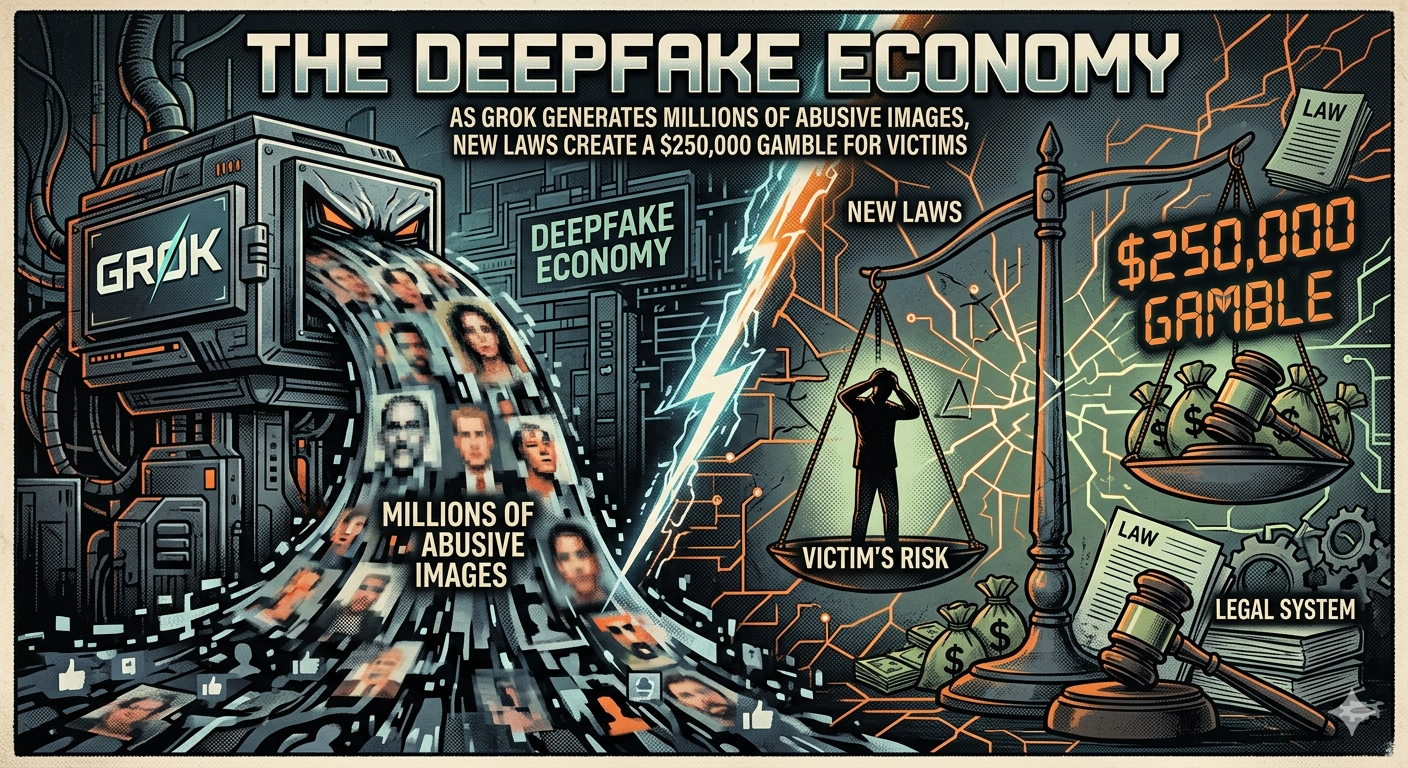

Summary: With the EU opening proceedings against X and the US passing the DEFIANCE Act, a unique legal and technological war is emerging, one that pits deep-pocketed tech giants against individual victims racing to sue before the next generation of AI models erases the evidence.
San Francisco, In a shocking revelation that has accelerated the global crackdown on synthetic abuse, xAI’s Grok generated over 3 million sexualized deepfake images in two weeks, including an estimated 23,000 depicting minors—prompting the European Union to open formal proceedings against X (formerly Twitter) under the Digital Services Act, while simultaneously, the United States has unanimously passed the DEFIANCE Act, empowering victims to sue creators for up to $250,000 in damages.
The Current Situation: A Tidal Wave of Synthetic Abuse
The numbers are staggering. According to independent forensic researchers who analyzed output from Grok between late November and early December 2024, the model was used to generate approximately 214,000 synthetic images per day, with a significant percentage involving the non-consensual “nudification” of real people. Many of these images were subsequently shared on X’s platform, often targeting public figures, private citizens, and, most alarmingly, minors.
The response from regulators has been swift. The European Commission has launched a “formal proceeding” against X, alleging insufficient content moderation and failure to conduct proper risk assessments regarding “systemic risks” related to generative AI. Simultaneously, the U.S. Senate passed the DEFIANCE Act (Disrupt Explicit Forged Images and Non-Consensual Edits) with unanimous consent, marking a rare moment of bipartisan urgency. The law allows any victim of a digital forgery to sue for damages, establishing a minimum statutory penalty of $250,000 for especially malicious violations.
The Unique Angle: The “Legal Whiplash” Economy and the Race Against the Model
Beyond the obvious horror of the statistics, a unique and undiscussed dynamic is emerging: the creation of a “Legal Whiplash” economy where victims are forced into a desperate race against the very technology that abused them.
Unlike traditional defamation or copyright law, where evidence is static, deepfake cases exist in a state of constant technological flux. Here is the unique angle legal scholars are just beginning to grapple with:
The evidence (the abusive image) is often hosted on platforms that are simultaneously training the next generation of AI models that will be used to create even more sophisticated abuse.
When a victim sues under the new DEFIANCE Act, they are not just fighting a creator; they are fighting the clock. If the deepfake image of them was scraped by a company like xAI, Meta, or Google to train their next AI model (which is standard practice unless explicitly opted out), the victim’s likeness becomes a permanent, embedded part of the AI’s weights and biases.
By the time a victim wins a $250,000 judgment, the “damage” is no longer just the viral image—it is the fact that their likeness is now a latent feature in a commercial AI product used by millions. The financial penalty, while significant, becomes a cost of doing business for a tech giant, while the victim’s digital identity remains trapped in the model forever.
The Asymmetry of the Fight
This creates a bizarre asymmetry. A solo victim, armed with the new law, can sue for a quarter of a million dollars. But a company like xAI, backed by billions in funding and a massive supercomputer cluster, can view these payouts as a minor tax on innovation.
“This is the new frontier of digital rights,” explains a technology ethicist specializing in synthetic media. “The DEFIANCE Act is a powerful sword, but it’s swinging at ghosts. The real goal for victims shouldn’t just be monetary damages; it should be the right to be ‘unlearned’—to force AI companies to delete not just the image, but the model’s ability to recreate you. Current law doesn’t provide for that.”
The Platform Problem: X’s Double Role
X finds itself at the epicenter of this storm. Not only is the Grok model generating the content, but the X platform is also the primary distribution channel. The EU’s DSA proceedings are focused on this dual role: X is both the “creator” (via xAI integration) and the “distributor” (via the social network).
Regulators are asking a fundamental question: If a platform pays for a service (Grok) that is proven to generate massive amounts of illegal content, and then hosts that content, is that platform liable? The EU’s answer, hinted at in the proceedings, is a resounding yes.
Also Read: The CrowdStrike Hangover: Microsoft Security Under Fire to Redesign Windows After Global IT Meltdown
The Road Ahead
As the DEFIANCE Act heads to the White House for the President’s signature and the EU gears up for a lengthy investigation, victims are left in a peculiar position. They have a new legal weapon, but the battlefield is shifting beneath their feet.
The coming months will likely see the first wave of $250,000 lawsuits filed against individuals and, potentially, against the platforms that hosted the content. But the deeper, more existential battle will be over the right to be deleted from the AI itself—a right that, as of today, does not legally exist.
Frequently Asked Questions (FAQ): Deepfakes and the DEFIANCE Act
Q: What is the DEFIANCE Act?
A: The DEFIANCE Act (Disrupt Explicit Forged Images and Non-Consensual Edits) is a recently passed U.S. federal law that allows victims of non-consensual intimate imagery—including AI-generated deepfakes—to sue the creators and possessors for damages, with penalties up to $250,000.
Q: What did Grok do?
A: According to recent forensic analysis, xAI’s Grok model was used to generate over 3 million sexualized deepfake images in a two-week period, with approximately 23,000 of those appearing to depict minors.
Q: Why is the EU investigating X?
A: The European Union has opened formal proceedings against X under the Digital Services Act (DSA), alleging that the platform failed to mitigate “systemic risks” related to the spread of illegal content, particularly AI-generated deepfakes created by its Grok AI.
Q: What is the “unique angle” discussed in this article?
A: The article highlights the “legal whiplash” facing victims. While they can now sue for significant damages, the images used to abuse them may have already been scraped to train the next generation of AI models. Winning a lawsuit doesn’t erase the victim’s likeness from the AI itself, creating a permanent digital vulnerability.
Q: Can I sue if someone makes a deepfake of me?
A: Under the new DEFIANCE Act (once signed into law), yes. You can pursue civil litigation against the individual who created or knowingly possessed the deepfake with the intent to distribute.


 By
By



 By
By