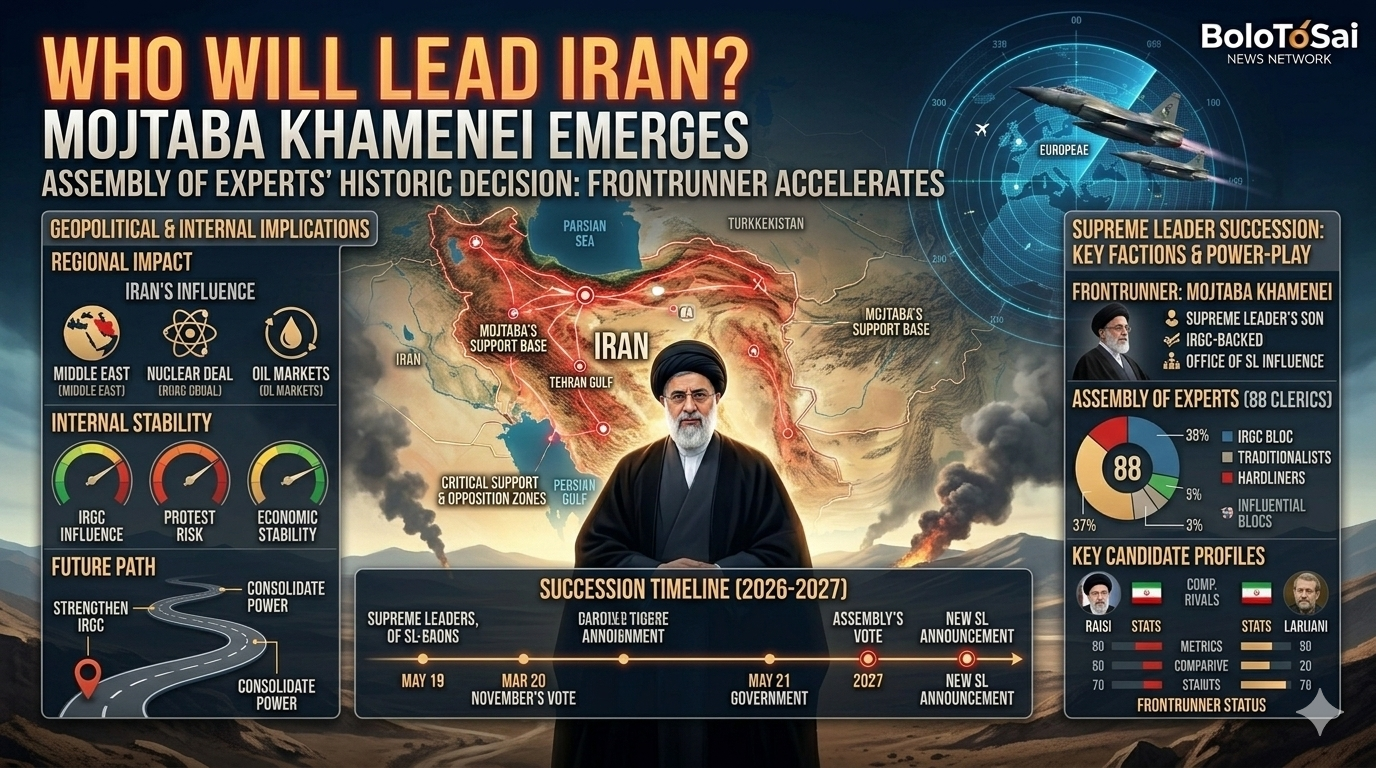

TEHRAN/QOMS/WASHINGTON — Seven days after the assassination of Ayatollah Ali Khamenei in joint US-Israeli airstrikes, Iran is on the verge of naming its third Supreme Leader in the Islamic Republic’s 47-year history. Iran’s top clerics are nearing a decision on the country’s next supreme leader, with the Assembly of Experts narrowing its list of candidates and vowing to announce a decision “as soon as possible.” CNN All eyes are on one name above all others — Mojtaba Khamenei, the 56-year-old son of the assassinated Supreme Leader — whose selection would create Iran’s first ever father-to-son leadership dynasty, sending shockwaves through both the Islamic Republic and the wider world.
ANALYTICAL BRIEF — IRAN LEADERSHIP CRISIS (7 MARCH 2026)
| Parameter | Details |
|---|---|
| Khamenei Assassinated | 28 February 2026 — US-Israeli strikes |
| Interim Leadership Council | President Pezeshkian, Chief Justice Mohseni-Eje’i, Cleric Arafi |
| Selection Body | Assembly of Experts — 88 senior clerics |
| Decision Timeline | “As soon as possible” — announcement imminent |
| Top Frontrunner | Mojtaba Khamenei — son of assassinated leader |
| Other Candidates | Alireza Arafi, Hassan Khomeini, Ali Larijani |
| IRGC Pressure | Backing Mojtaba — pushing for rapid election |
| Trump’s Warning | “Whoever is named is a legitimate target” |
| Assembly Office | BOMBED by Israel during succession session in Qom |
| Iran’s Position | Defiant — vows to continue fighting |
SITUATIONAL BREAKDOWN
The Constitutional Process — How Iran Picks Its Leader: A body of 88 senior clerics known as the Assembly of Experts will select Khamenei’s successor. The members are elected by the Iranian public every eight years and vetted by the Guardian Council — a separate body of 12 jurists that oversees the activities of Iran’s parliament. Al Jazeera The last time this process was triggered was in 1989, when a relatively junior Khamenei was elevated to the position after the death of the revolution’s founding father, Ayatollah Ruhollah Khomeini — and it took less than a day. euronews This time, with bombs still falling across Tehran, the process is proving far more complex — and far more dangerous.
Mojtaba Khamenei — The Man Who May Rule Iran: Mojtaba Khamenei, the second son of Ayatollah Ali Khamenei, has emerged as a potential figure to succeed his father, who was killed on the first day of the war with the United States and Israel. No official announcement has been made, but Israeli and Western media outlets have reported that Mojtaba is the frontrunner to become the new supreme leader of the Islamic Republic. Wikipedia He studied theology in Qom and fought as a young volunteer during the Iran-Iraq war in the 1980s — credentials that still carry weight within the revolutionary elite. His authority has largely come from proximity to power rather than religious stature, and he is believed to have deep relationships with senior figures in the Revolutionary Guard. Al Jazeera
The Dynasty Question: Mojtaba cannot inherit the position by bloodline alone — the Assembly must select him. However, political systems can become dynastic without rewriting constitutions. Dynastic outcomes emerge when informal power networks — family ties, political patronage, security ties and control over media — make one candidate appear more natural, safe or inevitable. Al Jazeera Georgetown University professor and Iran expert Mehran Kamrava said a Mojtaba succession would likely reflect the system’s instinct for survival: “The deep state in the Islamic Republic wants continuity. If Mojtaba is chosen, it would indicate more than anything else that the Islamic Republic is trying to ensure its own survival.” Al Jazeera
The IRGC Factor — The True Kingmakers: Amid the ongoing conflict, the Islamic Revolutionary Guard Corps pressured the Assembly of Experts to elect Mojtaba Khamenei as supreme leader. Wikipedia The IRGC holds vast military, economic and political power within Iran’s system — and its support for any candidate essentially determines the outcome. Al Jazeera With Iran’s entire military high command having been decimated in the opening strikes of the war, the IRGC’s influence over the succession process has never been greater — or more dangerous.
Other Contenders Still in the Race: Those who could step into the role include Hassan Khomeini, the grandson of Islamic Republic founder Ayatollah Ruhollah Khomeini. But the wild card could be Alireza Arafi — currently a member of the Guardian Council, deputy chairman of the Assembly of Experts and director of Iran’s Islamic seminaries. He is a seasoned politician with significant religious standing. Wikipedia As a hardline cleric and longtime ally of the late Khamenei, Arafi advocates for religious restrictions at home and anti-American resistance abroad — and was notably appointed by Khamenei himself to several prominent positions, suggesting he was favored. deccanchronicle
The Bombed Assembly — Succession Under Fire: On March 3, Iranian media reported that the Assembly of Experts’ office in Qom was struck during a session reportedly convened for electoral purposes. Wikipedia Israel has made clear it intends to disrupt the succession process at every turn. Israeli Defence Minister Israel Katz stated on March 4 that Khamenei’s successor — no matter his identity — would be considered a legitimate target for assassination. Wikipedia President Trump went further, dismissing the entire process: “Khamenei’s son is a lightweight. I have to be involved in the appointment.”
Iran Remains Defiant: Despite the leadership vacuum and the relentless bombing campaign, Iran’s interim Foreign Minister Abbas Araghchi has delivered a message of remarkable defiance. Speaking exclusively to Al Jazeera, Araghchi dismissed any suggestion that the US-Israeli strikes had achieved their aims: “There is no victory in this war. They have not been able to achieve their targets, and they will not be able to achieve their targets in the coming days.” euronews Drawing a parallel with last June’s 12-day war, he warned that the US and Israel “expected that in two or three days Iran would capitulate and surrender — but it took 12 days for them to understand Iran was not surrendering, and that they had no option but to ask for an unconditional ceasefire.” euronews
Will Anything Change Under New Leadership? Despite the shock of Khamenei’s assassination, few analysts expect Iran’s political system to transform overnight. The system may adjust tactically — in the past, Iranian leaders have loosened certain social restrictions after major crises to ease domestic pressure. But strategically, the structure of power inside Iran remains intact. Clerics, Revolutionary Guard commanders and security institutions still dominate the state — and their priority, especially in wartime, is stability. Al Jazeera A moderate or reformist is unlikely to take the helm and shift Iran in a new direction. deccanchronicle
🇵🇰 WHAT THIS MEANS FOR PAKISTAN
The identity of Iran’s next Supreme Leader carries direct implications for Pakistan:
If Mojtaba is chosen: A hardline, IRGC-backed Supreme Leader will almost certainly pursue an even more aggressive regional posture — escalating the war with the US and Israel rather than seeking a negotiated exit. This means continued Strait of Hormuz disruption, higher oil prices, and greater instability on Pakistan’s western border.
If a moderate emerges: A surprise moderate succession could open the door to diplomatic negotiations — potentially easing the regional crisis and stabilising Pakistan’s fuel import costs and remittance lifeline from Gulf workers.
Pakistan’s Diplomatic Position: Islamabad must carefully manage its relationship with whoever emerges as Iran’s new Supreme Leader — while simultaneously maintaining its partnerships with Gulf Arab states, the United States and China.
BOLOTSAI ASSESSMENT
Iran is making its most consequential decision in over three decades — under fire, under bombardment, and under the most extreme pressure in the Islamic Republic’s history. The selection of the next Supreme Leader will determine whether Iran fights on with renewed ideological fury or seeks a path toward de-escalation. Mojtaba Khamenei’s emergence as frontrunner suggests the Islamic Republic’s deep state is choosing survival and continuity over reform.
But with Israel explicitly threatening to assassinate whoever is chosen, and the US openly dismissing the process — the next Supreme Leader of Iran may be stepping into the most dangerous job on earth.
Six days after Ali Khamenei’s assassination, the decision on Iran’s next supreme leader remains in flux — but the announcement is now imminent. CNN
When it comes — BoloToSai will bring it to you first.
Sources: Al Jazeera, Bloomberg, CBS News, CNN, Asia Times, Carnegie Endowment, The Conversation | All figures verified at time of publishing — 7 March 2026
#IranSupremeLeader #MojtabaKhamenei #IranIsraelWar #BoloToSai #BreakingNews #IranLeadership

 By
By

 By
By