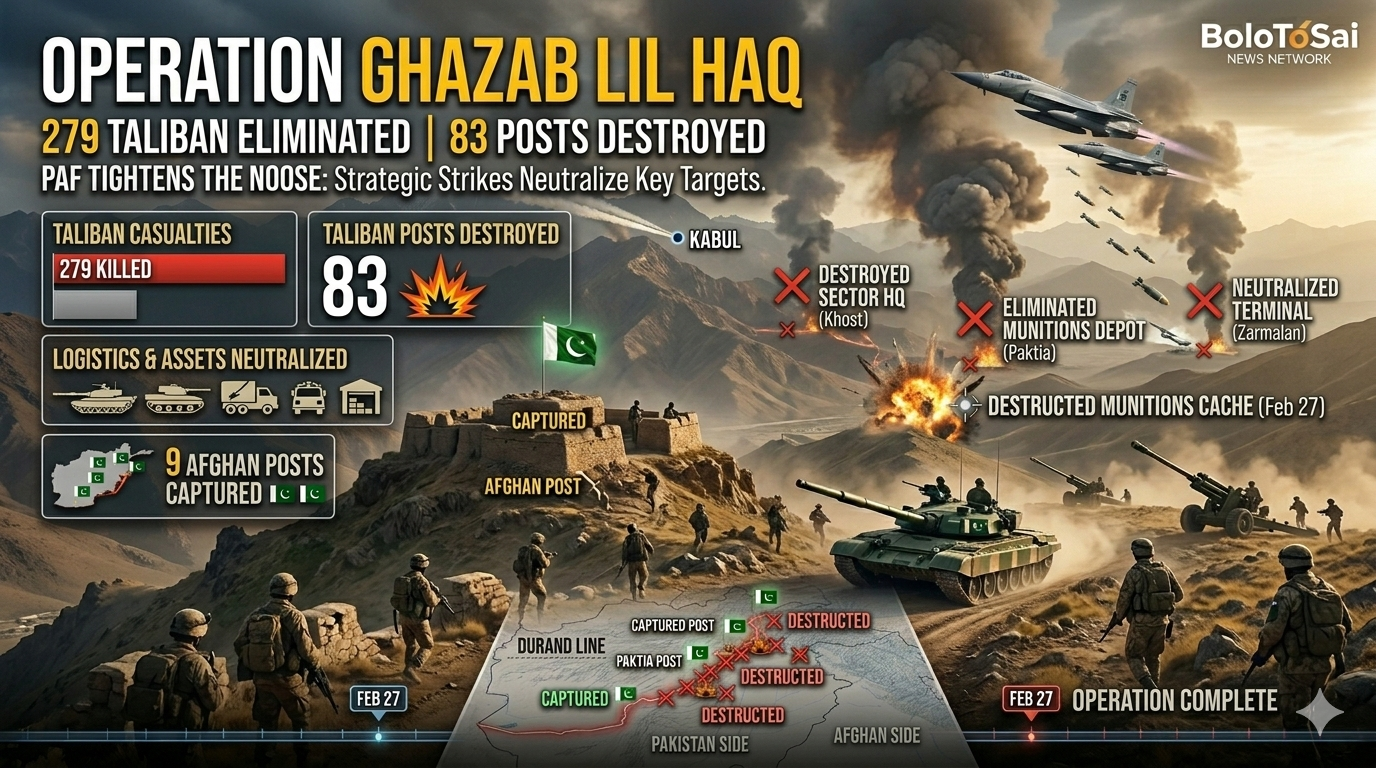

ISLAMABAD/KABUL — As the dust settles on one of the most significant military escalations in South Asia in decades, Pakistan’s armed forces have delivered a devastating blow to Afghan Taliban infrastructure across multiple provinces. Pakistan’s military confirmed on Friday that 279 Taliban fighters have been killed and over 400 injured in precision strikes hitting 22 strategic locations, with 83 Taliban border posts destroyed and 17 others captured by Pakistani forces.
ANALYTICAL BRIEF — OPERATION STATUS (28 FEB 2026)
| Parameter | Confirmed Figures |
|---|---|
| Taliban Fighters Killed | 279 |
| Taliban Fighters Injured | 400+ |
| Posts Destroyed | 83 |
| Posts Captured | 17 |
| Locations Struck | 22 |
| Pakistani Soldiers KIA | 12 |
| Pakistani Soldiers WIA | 27 |
| Key HQs Neutralized | 313 Brigade, 201 KBW Brigade, 205 Brigade (Kabul/Kandahar) |
SITUATIONAL BREAKDOWN
Phase I — The Provocation: Following weeks of cross-border terror attacks inside Pakistan — including the February 6 Islamabad mosque bombing (31 martyred), the Bajaur checkpoint attack (11 soldiers killed), and the Bannu suicide blast — Pakistan’s patience reached a breaking point. Defence Minister Khawaja Asif had issued a clear warning on February 11: curb militant activity or face consequences before Ramadan.
Phase II — Taliban’s Miscalculation: On the night of February 26, Afghan Taliban launched what they called “large-scale offensive operations” against Pakistani border positions, claiming to have overrun 15 posts. Pakistan’s government immediately rejected the claim. What followed was a strategic miscalculation that would cost the Taliban dearly.
Phase III — Operation Ghazab Lil Haq Unleashed: In the early hours of February 27, the Pakistan Air Force launched simultaneous precision strikes across Kabul, Kandahar, Paktia, Nangarhar and Paktika — the most expansive Pakistani military action inside Afghanistan since the TTP conflict began. High-value targets neutralized included:
- 313 Brigade HQ — the elite Taliban combat formation
- 201 KBW Brigade HQ — Kabul theatre command
- 205 Brigade HQ — Southern Command, Kandahar
- Intelligence Chief HQ and Ghazi Command Center
- Mullah Yaqub HQ — Office of the Taliban Defence Minister
- Pul-e-Charkhi Military Compound — the largest military installation east of Kabul
- Ammo depots in Nangarhar — crippling Taliban resupply capacity
Phase IV — The Kabul Strike: In a dramatic escalation, PAF conducted strikes in the vicinity of Kabul International Airport in the early hours of February 27, signaling Pakistan’s willingness to carry the fight to the Afghan capital itself. Defence Minister Asif declared publicly: “Our cup of patience has overflowed. Now it is open war.”
INTERNATIONAL REACTION
The global community has been watching with alarm. China’s Ministry of Foreign Affairs stated Beijing is “deeply concerned over the escalation along the Pakistan-Afghanistan border.” UNAMA (UN Assistance Mission in Afghanistan) confirmed Pakistani strikes in Paktika province damaged Taliban infrastructure. Meanwhile, Afghanistan’s Defence Ministry continues to claim civilian casualties — allegations Pakistan categorically denies, insisting all strikes are intelligence-based and selective.
Reports from Sunday Guardian indicate that Taliban Supreme Leader Hibatullah Akhundzada may have been among those killed in the Kandahar strikes, though this has not yet been officially confirmed by either side.
PAKISTAN’S POSITION
Pakistan’s Information Minister Attaullah Tarar confirmed that Taliban drone attempts against Pakistani targets in Khyber Pakhtunkhwa were successfully neutralized by Pakistan’s anti-drone systems with zero damage to life or property. Operations are continuing “on the direct directions of the Prime Minister,” signaling this is a nationally sanctioned, sustained campaign — not a limited retaliatory strike.
BOLOTSAI ASSESSMENT
Operation Ghazab Lil Haq represents a fundamental shift in Pakistan’s Afghanistan doctrine — from reactive border management to proactive strategic degradation of Taliban command infrastructure. With 83 posts destroyed, three brigade headquarters neutralized, and operations actively continuing, Pakistan has served notice that the era of cross-border impunity is over.
The next 72 hours will be critical.


 By
By



 By
By