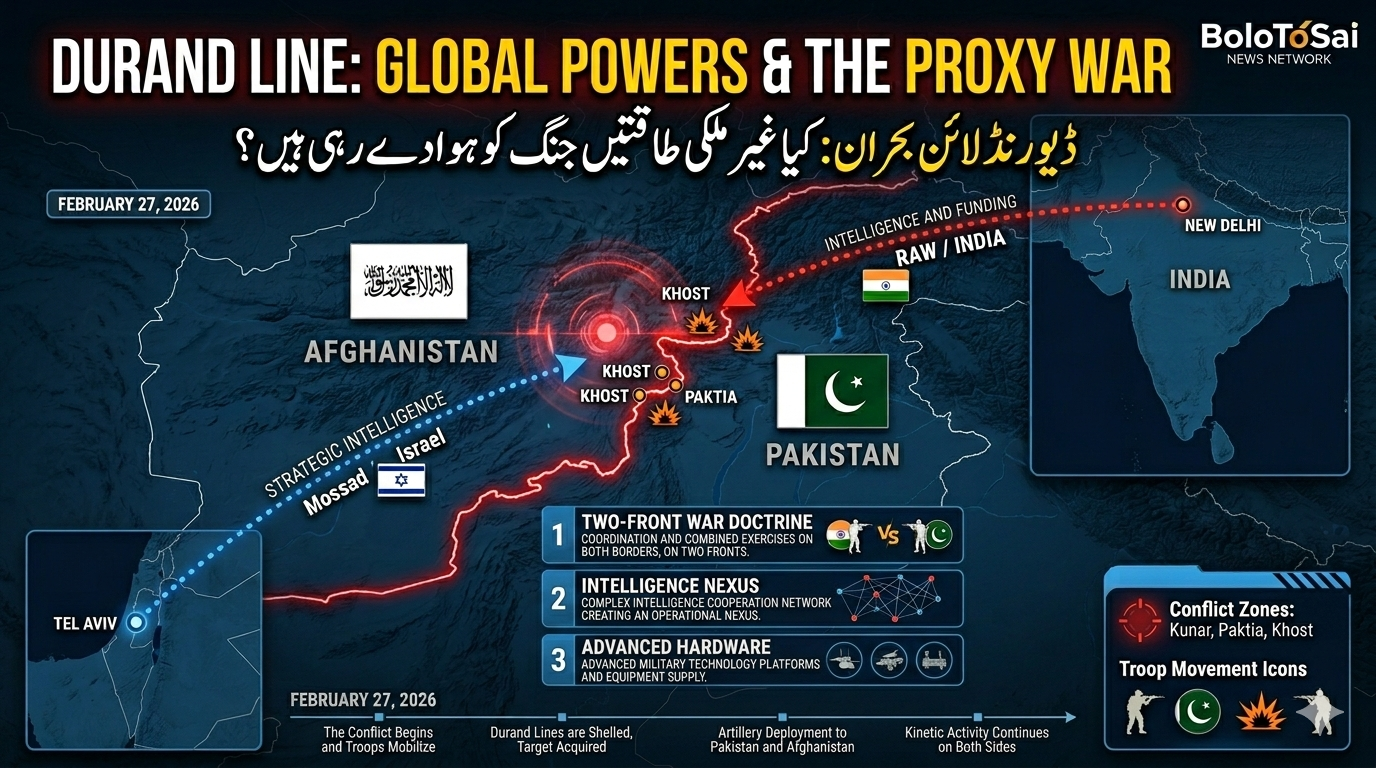

ISLAMABAD — The sheer scale and suddenness of the Afghan Taliban’s 2026 offensive against Pakistan has left military strategists asking one critical question: Who is backing this escalation? Historically, the Afghan Taliban relied on guerrilla tactics. However, the synchronized attacks on multiple Pakistani checkposts across Khost, Paktia, and Nuristan—utilizing advanced night-vision gear, heavy artillery, and coordinated logistics—suggest a level of funding and intelligence support that points beyond Kabul.
In Islamabad, defense analysts and intelligence circles are increasingly pointing toward a broader geopolitical proxy war, specifically the “invisible hand” of hostile intelligence agencies—namely India’s RAW, with alleged strategic alignment from Israel.
The “Two-Front War” Doctrine (The Indian Angle)
For decades, India’s strategic military doctrine has explored the concept of keeping Pakistan permanently engaged on its western border. By fueling instability along the Durand Line, New Delhi achieves a massive strategic victory: it forces the Pakistan Army to divert its elite strike corps, air assets, and financial resources away from the eastern border (Kashmir) and toward Afghanistan.
Defense experts argue that Indian intelligence (RAW) has historically maintained deep ties with anti-Pakistan militant factions, including the TTP and BLA, using Afghan soil as a launchpad. The sudden influx of cash and tactical intelligence required for the Taliban’s current “large-scale offensive” heavily implies a renewed injection of foreign resources designed to bleed Pakistan’s military and economy.
The Intelligence Nexus: India and Israel
Why would Israel be mentioned in this conflict? The defense and intelligence partnership between New Delhi and Tel Aviv is one of the tightest in the modern world. India is the largest buyer of Israeli military equipment, and their intelligence agencies (RAW and Mossad) frequently share data regarding regional adversaries.
From a broader geopolitical perspective, Pakistan remains the only nuclear-armed Islamic nation. For Israel, a Pakistan that is internally destabilized, economically drained, and militarily tied down in a perpetual border war is unable to project power or support anti-Israel diplomatic blocs in the Middle East. Analysts suggest that keeping Pakistan trapped in a “Western front crisis” serves the strategic interests of both India and Israel.
The Question of Hardware
The most glaring evidence of foreign involvement is the weaponry. While the Taliban inherited billions in leftover American military hardware in 2021, the maintenance, ammunition, and specialized use of heavy artillery require constant supply lines. The precision with which Pakistani outposts are currently being targeted suggests that satellite imagery and real-time electronic intelligence (SIGINT)—capabilities far beyond the Taliban’s indigenous reach—are being funneled to them by foreign state actors.
Conclusion: A Proxy Battleground
As the Pakistan Air Force (PAF) conducts retaliatory strikes and ground troops mobilize, it is becoming clear that Pakistan is not just fighting an insurgent neighbor. The Durand Line has once again become a chessboard for global powers. To secure its borders, Pakistan will have to defeat the Taliban’s foot soldiers while simultaneously dismantling the foreign intelligence networks funding them.
Also Read: STATE OF WAR: Large-Scale Hostilities Erupt Along the Durand Line – bolotosai.com_EN

 By
By


 By
By