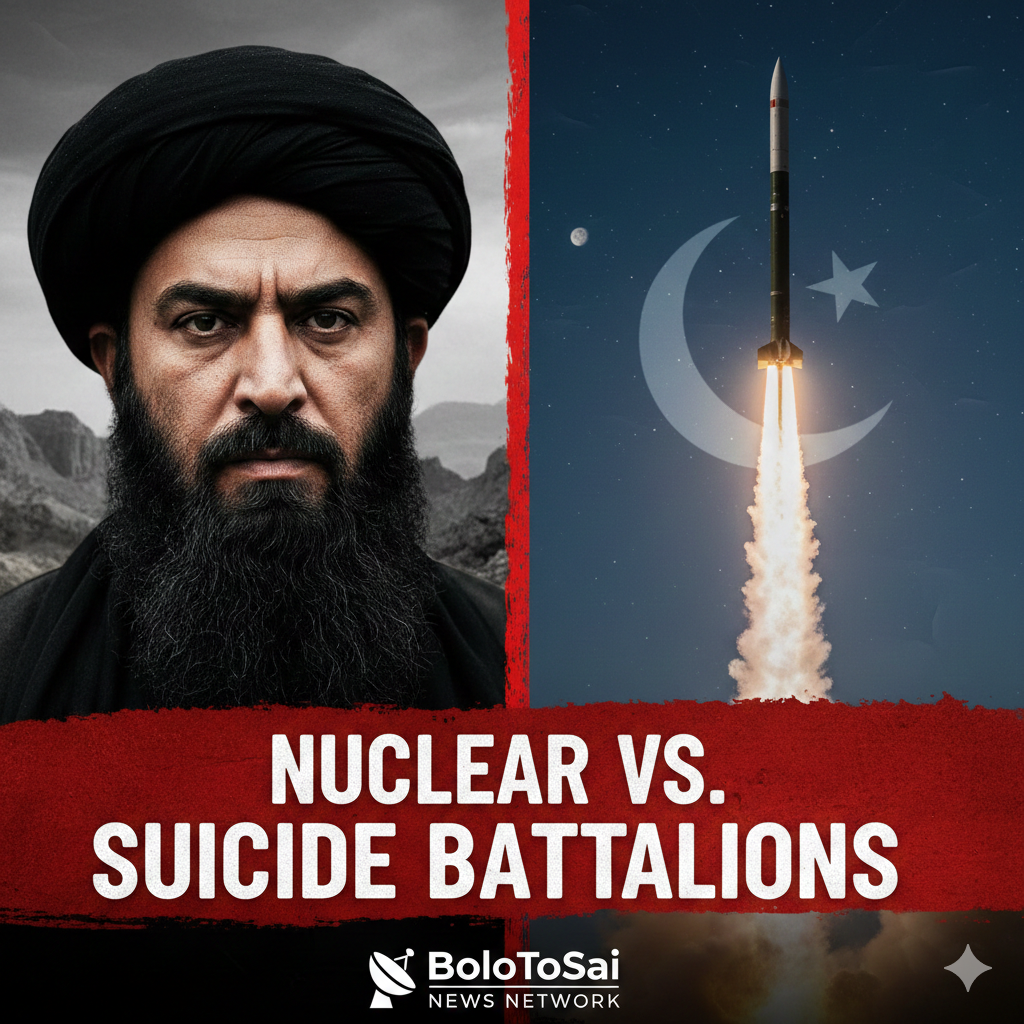

OVERVIEW: A Rhetorical Escalation
In a startling interview with TOLOnews, Abdul Hamid Khorasani, a controversial commander within the Taliban’s sphere, has issued a direct and provocative challenge to Pakistan’s national defense strategy. Khorasani’s remarks—which contrast Pakistan’s ballistic missiles and nuclear arsenal with his claim of “battalions of suicide bombers”—mark a dangerous new peak in the war of words between Kabul and Islamabad.
THE CONFESSION: “We have the Suicides”
Khorasani’s statement was blunt. He asserted that if Pakistan takes pride in its nuclear status and advanced missile technology, the Taliban and its affiliates (specifically mentioning the TTP) possess a weapon they believe is more effective: human assets trained for suicide missions.
“If Pakistan is proud of its ballistic missiles and nuclear bombs, we have battalions of suicide bombers… we have the capability to confront powers far stronger than Pakistan,” Khorasani stated.
This is more than just a threat; for Islamabad, it is a confession. For years, Pakistan has accused the Afghan Taliban of providing safe havens and logistical support to the Tehreek-e-Taliban Pakistan (TTP). Khorasani’s open admission that these suicide units are a strategic asset effectively validates Pakistan’s long-standing dossier of evidence regarding cross-border terrorism.
CONTEXT: The February 2026 Border Crisis
Khorasani’s remarks do not exist in a vacuum. They follow a week of intense military kinetic action:
- Feb 21-22: Pakistan launched “Intelligence-Based Operations” (IBOs) targeting seven militant hideouts in the Afghan provinces of Nangarhar, Paktika, and Khost.
- The Motive: These strikes were a retributive response to a surge in suicide attacks in Islamabad, Bajaur, and Bannu, including the devastating mosque bombing earlier this month that claimed 31 lives.
- The Breakdown: The fragile ceasefire brokered by Qatar and Turkiye in late 2025 has officially shattered.
ANALYSIS: Asymmetric Warfare vs. Conventional Deterrence
Khorasani is attempting to exploit a gap in traditional military doctrine. While Pakistan’s nuclear weapons are a deterrent against state-level actors (like India), they are virtually useless against non-state actors operating in civilian populations or remote mountain hideouts.
By framing the TTP’s suicide units as a “counter-balance” to nuclear weapons, Khorasani is signaling a commitment to Asymmetric Warfare. His message is clear: Your high-tech weapons cannot stop a man with a vest.
THE RISKS FOR KABUL
Khorasani remains a “wildcard” for the Taliban leadership. While some factions may quietly support his rhetoric, official spokespersons like Zabihullah Mujahid have previously tried to distance the regime from his more inflammatory statements to avoid international sanctions.
However, as long as commanders like Khorasani are allowed to speak freely on state-linked media like TOLOnews, the international community—and Pakistan’s military—will continue to view the Taliban and the TTP as two sides of the same coin.
THE BOTTOM LINE
The “Nuclear vs. Suicide” debate is no longer theoretical. It is playing out in the streets of Islamabad and the mountains of Kunar. For BoloToSai, the path forward is clear: until the “Suicide Battalions” are dismantled, the prospect of peace on the Durand Line remains a distant dream.

 By
By

 By
By