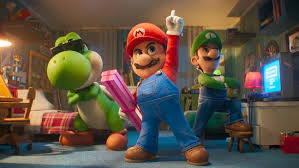

LOS ANGELES — The Super Mario Galaxy Movie has shattered 2026 box office records with a staggering $372.5 million global debut over the Easter weekend, cementing Nintendo’s animated franchise as one of the most dominant forces in modern cinema.
The animated sequel, produced by Illumination and Universal Pictures, earned $190 million domestically across its five-day Easter corridor from 4,252 theaters, with a traditional three-day weekend haul of approximately $131 million. Internationally, the film pulled in $182 million from 80 markets, underscoring the universal appeal of the mustachioed plumber’s cosmic adventure. While the numbers are nothing short of extraordinary, the sequel ever-so-slightly trails its 2023 predecessor, which opened to $204 million domestically in its first five days — a reminder of just how high the franchise has set its own bar.
The galactic debut also overshadowed A24’s much-anticipated drama starring Zendaya and Robert Pattinson, titled The Drama, which opened to a respectable but comparatively modest $14 million. In an era where franchise entertainment continues to dominate multiplex screens — much like how OpenAI Raises Record $122 Billion at $852 Billion Valuation demonstrated the sheer scale of investment flowing into dominant industry players — Nintendo’s cinematic universe appears virtually unstoppable.
| Parameter | Details |
|---|---|
| Film | The Super Mario Galaxy Movie |
| Global Opening Weekend | $372.5 million |
| Domestic 5-Day Gross | $190 million (4,252 theaters) |
| Domestic 3-Day Weekend | ~$131 million |
| International Gross | $182 million (80 markets) |
| 2023 Predecessor Opening (5-Day) | $204 million domestic |
| Nearest Competitor | The Drama (A24) — $14 million opening |
Situational Breakdown
The Super Mario Galaxy Movie’s opening weekend represents the largest global debut since Avatar: Fire and Ash launched over Christmas 2025, a remarkable achievement that places the animated sequel in rarefied commercial territory. The Easter corridor — traditionally one of the strongest family moviegoing periods of the year — provided the perfect launchpad for a film that appeals to children, nostalgic millennials, and gaming enthusiasts alike. With 4,252 domestic screens dedicated to the release, Universal Pictures left nothing to chance in ensuring maximum accessibility. — Deadline
Internationally, the film’s $182 million haul from 80 markets speaks to Nintendo’s extraordinary global brand recognition. Japan, the United Kingdom, Germany, France, and Australia were among the top-performing territories, with several markets reporting sold-out screenings throughout the holiday weekend. The franchise’s ability to transcend language barriers and cultural differences has made it a genuine worldwide phenomenon — a feat that few animated properties outside of Disney and Pixar have consistently achieved. — Variety
The slight gap between the sequel and its 2023 predecessor’s domestic opening — $190 million versus $204 million across the five-day frame — has prompted industry analysts to debate whether sequel fatigue is beginning to creep in, or whether the original film simply benefited from unprecedented novelty factor. Most box office trackers lean toward the latter explanation, noting that a $372.5 million global bow is by any standard a massive commercial triumph. — Hollywood Reporter
The Franchise Factor: Why Mario Keeps Winning
Nintendo’s decision to partner with Illumination Entertainment — the studio behind the Despicable Me and Minions franchises — has proven to be one of the most consequential deals in modern Hollywood. The 2023 original grossed over $1.3 billion worldwide, transforming a video game adaptation into a legitimate cinematic juggernaut and silencing decades of skepticism about whether game-to-film properties could work at the highest level.
The Galaxy sequel doubles down on what made the original successful: vibrant animation, accessible humor, and a deep well of gaming nostalgia that spans four decades. By setting the story in the beloved Super Mario Galaxy universe — one of the most critically acclaimed entries in the franchise’s gaming history — the filmmakers tapped into an especially passionate segment of the fanbase.
“The film posted the biggest global opening since Avatar: Fire and Ash launched over Christmas 2025.” — Deadline
Easter Weekend: The Box Office’s Hidden Powerhouse
The Easter corridor has emerged as an increasingly important window for major studio tentpoles, particularly those targeting family audiences. Unlike the summer blockbuster season, which spreads attention across dozens of competing releases, Easter offers a concentrated burst of moviegoing activity with relatively little competition. Universal’s decision to slot the Mario sequel into this window was a strategic masterstroke.
The five-day corridor — running from Wednesday through Sunday — gave the film an extended runway to build momentum through word of mouth, school holidays, and family outings. Industry analysts at Box Office Mojo noted that family films historically see stronger weekday-to-weekend ratios during Easter than during any other holiday period, a pattern that the Mario sequel exploited to near-perfection.
The Competition: A24’s Gamble and the State of Original Cinema
Perhaps the most telling subplot of the weekend was the fate of The Drama, A24’s star-studded original film featuring two of Hollywood’s most bankable young stars in Zendaya and Robert Pattinson. The film’s $14 million debut, while solid by A24’s standards, was dwarfed by the Mario juggernaut — illustrating the widening gulf between franchise blockbusters and even well-marketed original properties.
The disparity raises uncomfortable questions about the theatrical marketplace’s ability to sustain mid-budget original films alongside $200 million animated spectacles. A24 will likely find profitability through strong legs, awards consideration, and streaming deals, but the opening weekend contrast could not have been starker.
“The figures ever-so-slightly trail the franchise predecessor, which ignited to $146 million over the traditional weekend in 2023.” — Variety
Global Domination: What the International Numbers Reveal
The $182 million international haul is particularly significant when viewed through the lens of global distribution strategy. The simultaneous 80-market release — a logistical feat requiring coordinated dubbing, marketing, and theatrical partnerships across continents — reflects Universal’s confidence in the property and its willingness to invest heavily in day-and-date global releases to combat piracy and maximize opening weekend impact.
Markets across Asia, Europe, and Latin America showed robust performance, with reports from Reuters indicating that the Mario brand’s recognition among younger demographics in emerging markets has grown substantially since the first film’s theatrical and streaming runs. This global footprint bodes well for the franchise’s long-term commercial ceiling and all but guarantees a third installment.
BOLOTOSAI Assessment
The Super Mario Galaxy Movie’s $372.5 million global opening confirms what the industry has known since 2023: Nintendo’s cinematic universe is here to stay and it is building toward a multi-billion-dollar franchise ecosystem. Three outcomes warrant close attention in the coming weeks and months.
First, watch the film’s legs. The original Mario movie demonstrated exceptional holding power, ultimately crossing $1.3 billion worldwide. If the sequel follows a similar trajectory — and early audience scores suggest it will — a $1 billion global run is virtually assured, with $1.2 billion or more a realistic ceiling. Second, expect Universal and Nintendo to accelerate plans for a third film and potentially announce spin-off projects. The Donkey Kong and Princess Peach corners of the universe are ripe for standalone development. Third, the sequel’s slight domestic dip from its predecessor will fuel an industry-wide conversation about franchise sustainability — but a $190 million domestic opening is hardly cause for concern. It is, by any reasonable measure, a triumph.
The larger takeaway is structural: in a theatrical landscape increasingly defined by franchise dominance, Nintendo has positioned itself as a peer to Disney, Marvel, and the legacy studio systems. The plumber from the Mushroom Kingdom is no longer just a gaming icon — he is a box office institution. The question now is not whether the franchise will continue, but how far Nintendo is willing to expand its cinematic ambitions.


 By
By


 By
By