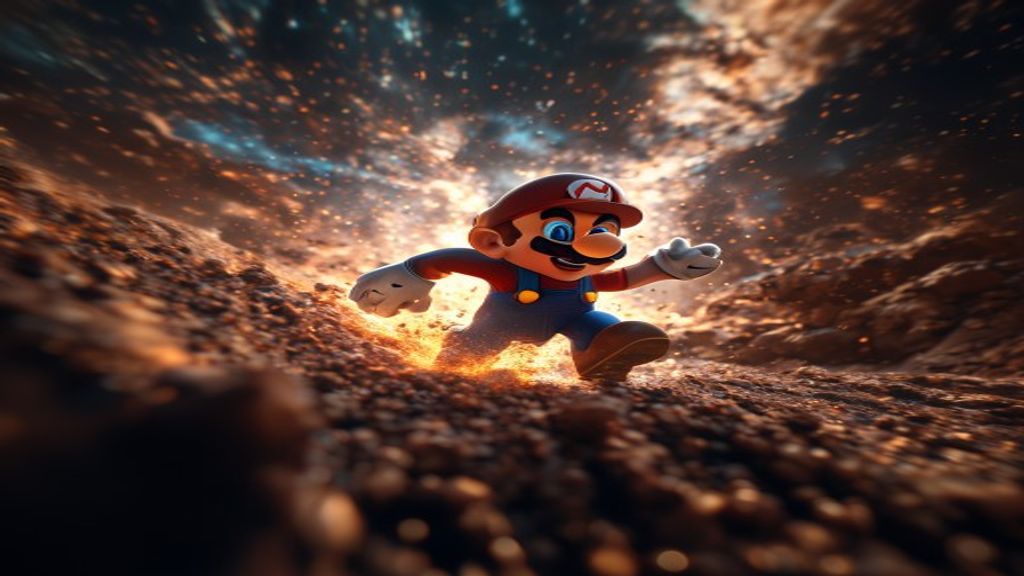

LOS ANGELES — The Super Mario Galaxy Movie has shattered box office expectations with a colossal $370.7 million global opening over Easter weekend, establishing itself as the biggest worldwide debut for a major studio release since Avatar: Fire & Ash and cementing Nintendo’s dominance in the animated film landscape.
The sequel to 2023’s massively successful Super Mario Bros. Movie, directed by Aaron Horvath and Michael Jelenic, pulled in approximately $188.5 million domestically across its five-day opening window from April 1 through April 6. The space-themed adventure, inspired by the beloved Nintendo Wii classic, features returning voice stars Chris Pratt as Mario, Anya Taylor-Joy as Princess Peach, Charlie Day as Luigi, and Jack Black reprising his scene-stealing role as Bowser. Audiences awarded the film an A CinemaScore, matching its predecessor and signaling the kind of robust word-of-mouth that could sustain its theatrical run for weeks. The film’s gargantuan haul has single-handedly pushed the 2026 domestic box office past the $2 billion cumulative mark, a milestone that underscores Hollywood’s continued reliance on franchise tentpoles to drive annual revenue.
| Parameter | Details |
|---|---|
| Global Opening Weekend | $370.7 million worldwide |
| Domestic 5-Day Opening | $188.5 million (April 1–6) |
| Directors | Aaron Horvath & Michael Jelenic |
| Lead Voice Cast | Chris Pratt, Anya Taylor-Joy, Charlie Day, Jack Black |
| CinemaScore | A (matching the original film) |
| Studio / IP Owner | Illumination / Nintendo |
| Nearest Competitor | A24 drama (Zendaya, Robert Pattinson) — $14 million |
A Galactic Debut for the Ages
The numbers paint a picture of near-total market domination. With $370.7 million in global receipts from its opening frame alone, Super Mario Galaxy has outperformed even the most optimistic industry tracking, which had pegged the film for a $130–$150 million domestic debut. The Easter holiday corridor proved to be the perfect launchpad, with families flooding multiplexes across North America, Europe, and Asia in numbers not seen since the post-pandemic recovery era. — Deadline
The competitive landscape was virtually nonexistent. The closest challenger at the domestic box office was an A24 drama starring Zendaya and Robert Pattinson, which managed a respectable but comparatively modest $14 million. That a prestige drama featuring two of Hollywood’s most bankable young stars could barely register in the same frame speaks to the overwhelming cultural gravity of the Mario franchise. No other wide release dared open against it, and for good reason. — Variety
International markets contributed roughly $182 million to the global total, with particularly strong performances across Japan, the United Kingdom, Germany, and Australia. Japan, where Nintendo is a national institution, delivered especially enthusiastic audiences, with early reports suggesting the film could challenge domestic animation records in several Asian territories over the coming weeks. — TheWrap
The Illumination-Nintendo Formula Perfected
The partnership between Illumination Entertainment and Nintendo, once viewed with skepticism by gaming purists, has now produced two of the most commercially successful animated films in history. The original Super Mario Bros. Movie grossed $1.36 billion worldwide in 2023, and if the sequel maintains similar legs — a reasonable assumption given its identical A CinemaScore — it could approach or exceed that figure.
“The film’s massive $370 million worldwide haul makes it the biggest global debut for an MPA studio release since Avatar: Fire & Ash.” — Deadline
What makes the Illumination-Nintendo model so potent is its dual appeal. For children, these films offer colorful, kinetic adventures with instantly recognizable characters. For millennial and Gen-X parents, they tap into deep wells of nostalgia — the original Super Mario Galaxy game, released in 2007, is widely regarded as one of the greatest video games ever made. The filmmakers wisely leaned into the source material’s cosmic wonder, delivering planetary set pieces and gravity-bending action sequences that critics have praised as a genuine step up from the first film’s more straightforward approach.
Hollywood’s Franchise Dependency Deepens
The film’s success arrives at a critical juncture for the theatrical exhibition business. With the 2026 domestic box office now past $2 billion, the industry is on pace for its strongest year since the pandemic, but the concentration of revenue in franchise tentpoles continues to intensify. Super Mario Galaxy’s opening weekend alone accounts for nearly 10 percent of the entire year’s domestic gross to date.
This dynamic raises familiar questions about the health of mid-budget and original filmmaking in the theatrical space. The A24 drama’s $14 million opening, while solid for its genre, illustrates the widening chasm between franchise spectacles and everything else. Studios are increasingly reluctant to greenlight films without built-in audiences, and results like this only reinforce that calculus.
“Audiences gave the sequel an A CinemaScore, matching the original and signaling strong word-of-mouth for weeks ahead.” — Variety
What This Means for Nintendo’s Entertainment Empire
For Nintendo, the implications extend far beyond box office receipts. The company has spent decades carefully guarding its intellectual property, and the Mario films have validated a broader entertainment strategy that now includes theme parks, merchandise expansions, and rumored adaptations of The Legend of Zelda. With two billion-dollar-caliber films under its belt, Nintendo has demonstrated that its characters possess the same cross-generational appeal in cinemas that they have enjoyed in living rooms for four decades.
The success also strengthens Nintendo’s negotiating position across the entertainment industry. Theme park expansions at Universal Studios parks worldwide are already underway, and the company’s stock has surged in Tokyo trading on the back of the film’s opening numbers. In an era where every major entertainment company is seeking to build interconnected universes and synergistic content ecosystems, Nintendo has proven that careful IP stewardship — rather than rapid exploitation — yields superior long-term results. While other studios have struggled to adapt video games successfully, as audiences across the world continue to embrace gaming culture alongside the ever-popular world of traditional sports entertainment, Nintendo has cracked the code.
🇵🇰 Pakistan Connection
The Super Mario Galaxy Movie is releasing across Pakistani cinemas this weekend, and exhibitors are expecting strong turnout. The first Mario film performed well in Pakistan’s rapidly expanding multiplex market, particularly in cities like Lahore, Karachi, and Islamabad, where family-oriented Hollywood animation consistently draws crowds. With Pakistan’s cinema infrastructure continuing to grow — the country has added dozens of new screens in recent years — the sequel represents another test case for major international releases in the market.
Pakistani audiences’ appetite for animated blockbusters has grown steadily, and the Mario franchise’s universal appeal transcends language and cultural barriers in ways that make it particularly well-suited for the South Asian market. Local distributors have scheduled extensive Urdu-dubbed screenings alongside the original English-language version, aiming to capture both urban multiplex audiences and viewers at smaller single-screen venues.
BOLOTOSAI Assessment
The Super Mario Galaxy Movie’s record-setting debut is not merely a box office story — it is a signal of where the entertainment industry is heading. Three outcomes are worth watching closely in the weeks and months ahead.
First, the film’s legs will determine whether it can challenge the original’s $1.36 billion lifetime gross. With an A CinemaScore and the Easter holiday corridor still generating family traffic, a $1.2–$1.5 billion final worldwide total is within reach, potentially making it the highest-grossing animated film of 2026. Second, Nintendo’s next move will be closely scrutinised. A Zelda film adaptation, long rumoured, now feels increasingly inevitable, and the company’s approach to that tonally different property will reveal whether the Illumination partnership model can flex beyond Mario’s family-friendly comedy. Third, the competitive dynamics of the 2026 summer season have now shifted. Studios with films opening in the coming weeks will need to contend with a Mario juggernaut that shows no signs of slowing down, potentially reshuffling release calendars as distributors scramble to avoid its gravitational pull.
For now, one thing is clear: the plumber from Brooklyn has conquered the galaxy — and the global box office with it.

 By
By


 By
By