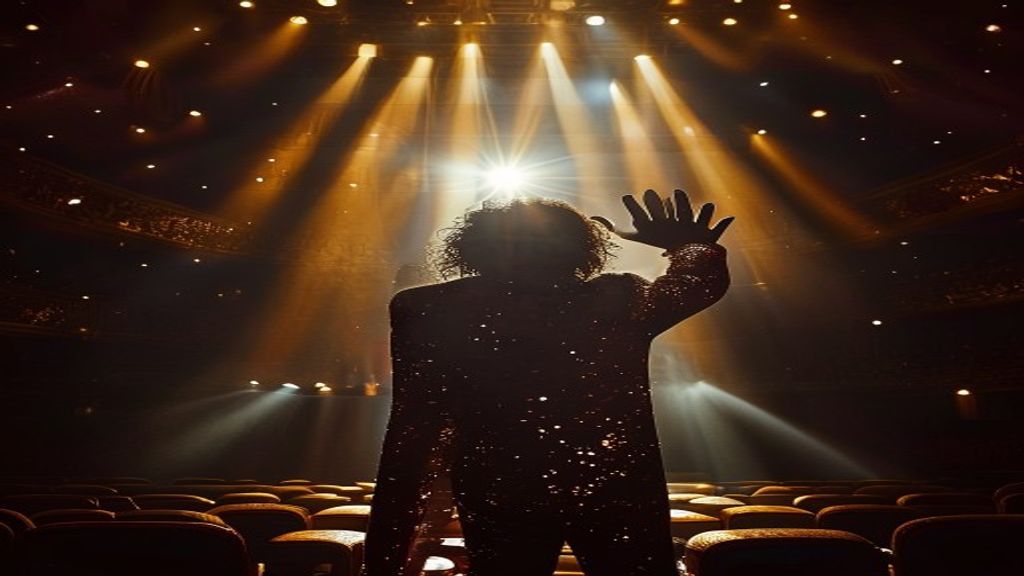

LOS ANGELES — The upcoming Michael Jackson biopic Michael underwent $15 million in reshoots funded by the Jackson estate to systematically remove all references to the 1993 child molestation allegations, scrapping approximately 22 days of filmed footage ahead of its global release on April 24.
The revelation has reignited fierce debate over the ethics of biographical filmmaking and the boundaries between legacy preservation and historical erasure. Directed by Antoine Fuqua and starring Jackson’s nephew Jaafar Jackson in his acting debut, the film was originally conceived as a warts-and-all portrait of the King of Pop’s life. Instead, following the estate’s financial intervention, the restructured film now concludes with Jackson preparing for his iconic Bad world tour, focusing squarely on his musical genius and family dynamics. The production is tracking for a $55 million-plus domestic opening weekend, which would make it the largest musical biopic debut in box office history.
| Parameter | Details |
|---|---|
| Film Title | Michael |
| Director | Antoine Fuqua |
| Lead Actor | Jaafar Jackson (nephew, acting debut) |
| Reshoot Cost | $15 million (funded by Jackson estate) |
| Footage Scrapped | ~22 days of filming, including Neverland investigation scenes |
| Global Release | April 24, 2025 (including IMAX) |
| Projected Opening | $55 million+ domestic (potential record for musical biopics) |
Situational Breakdown
The scale of the reshoots is staggering by any industry standard. Twenty-two days of scrapped footage represents a significant portion of any feature film’s production schedule, and the $15 million price tag rivals the entire budget of many independent productions. Among the deleted sequences were scenes depicting law enforcement officers investigating Jackson’s Neverland Ranch, material that would have directly addressed the most controversial chapter of the singer’s life. The estate’s decision to fund these changes gave it an equity stake in the production, effectively transforming the project from an independent biographical film into one with significant family oversight. — Consequence of Sound
The restructured third act now bypasses the 1993 allegations entirely, ending the narrative during Jackson’s ascent with the Bad tour rather than confronting the accusations that shadowed his later career. This creative pivot has drawn sharp criticism from documentary filmmakers and abuse survivors’ advocates, who argue that estate-funded sanitisation sets a dangerous precedent for how powerful estates can shape posthumous narratives. Supporters counter that Jackson was acquitted of all charges in his 2005 trial and that the film has every right to focus on his artistic contributions. — Deadline
For distributor Lionsgate, the commercial calculus appears sound regardless of the controversy. The film’s projected $55 million-plus opening would surpass the debut weekends of Bohemian Rhapsody and Rocketman, establishing a new benchmark for the musical biopic genre. Whether the sanitised approach ultimately helps or hurts long-term box office performance remains an open question that only audiences can answer. — ABC News
The $15 Million Question: Legacy or Erasure?
At the heart of this controversy lies a fundamental tension in biographical filmmaking: who owns a public figure’s story after death? The Jackson estate’s financial intervention is not without precedent — estates routinely exercise control over music rights, image licensing, and merchandise. But directly funding the removal of historically documented events from a major motion picture represents a qualitatively different kind of influence, one that blurs the line between protecting a legacy and rewriting history.
The 1993 allegations were not minor footnotes. They triggered a criminal investigation, a widely covered civil settlement reportedly worth over $20 million, and fundamentally altered public perception of one of music’s most celebrated figures. By excising these events, the film presents a version of Jackson’s life that many critics argue is incomplete at best and dishonest at worst. The estate, however, has consistently maintained Jackson’s innocence, pointing to his 2005 acquittal as definitive vindication.
“The estate secured an equity stake in the production after funding the costly reshoots that restructured the entire third act.” — Consequence of Sound
Jaafar Jackson and the Weight of Family
Casting Jaafar Jackson — Michael’s nephew and the son of Jermaine Jackson — adds another layer of complexity to the production. On one hand, the familial resemblance and intimate understanding of Jackson’s mannerisms lend the performance an authenticity that no outside actor could replicate. On the other, casting a family member in a film funded in part by the family estate raises unavoidable questions about objectivity and artistic independence.
Jaafar, making his acting debut with arguably the most scrutinised role in recent Hollywood memory, has spoken about his motivations with notable sincerity.
“I hope audiences will watch the film and gain a deeper understanding of the King of Pop beyond the headlines.” — Jaafar Jackson, ABC News
The irony, critics note, is that the film achieves understanding “beyond the headlines” precisely by removing the most significant headlines from its narrative. Whether Jaafar’s performance can transcend this structural contradiction will likely determine the film’s critical reception. Early tracking suggests audiences may be less concerned with what was omitted than with the spectacle of Jackson’s music brought to life on an IMAX screen.
The Biopic Precedent Problem
Hollywood has long struggled with the ethics of biographical storytelling. From the controversies surrounding Bohemian Rhapsody‘s treatment of Freddie Mercury’s personal life to debates over estate involvement in musical biopics, the genre sits at a perpetual crossroads between entertainment and accountability. What makes Michael different is the sheer financial magnitude of the intervention — $15 million is not a subtle note from a consultant, but a wholesale reconstruction of a film’s narrative architecture.
The broader entertainment industry is watching closely. In an era when artificial intelligence is transforming content production and deepfakes can resurrect performers digitally, the question of who controls a deceased artist’s story has never been more urgent. If estate-funded reshoots can remove documented historical events from a biographical film, what prevents similar interventions in future productions about other controversial figures?
The answer, increasingly, appears to be: nothing. As long as estates control the music rights essential to any musical biopic — and Jackson’s catalog alone is worth billions — they hold effective veto power over any production that wishes to use the artist’s songs. Without the music, there is no musical biopic. Without the estate’s cooperation, there is no music.
Box Office vs. Credibility
Commercially, the sanitised approach may prove to be shrewd calculation rather than cowardice. The projected $55 million opening weekend suggests that a significant portion of the moviegoing public is eager for a celebration of Jackson’s artistry, not a courtroom drama. The global appetite for Jackson’s music — his estate has earned over $2 billion since his death in 2009 — indicates that the commercial audience and the critical audience may be fundamentally different constituencies.
Yet credibility matters for longevity. Bohemian Rhapsody grossed over $900 million worldwide despite mixed reviews, but it has largely faded from cultural conversation. Films like Walk the Line and Ray, which confronted their subjects’ flaws more directly, have endured as definitive portraits. The question for Michael is whether a record-breaking opening weekend is worth the long-term cost of being remembered as the biopic that looked away.
🇵🇰 Pakistan Connection
Michael Jackson remains one of the most recognisable pop culture figures in Pakistan, where his music has transcended generational and linguistic barriers since the 1980s. The film’s global IMAX release on April 24 includes Pakistani cinemas, where it is expected to draw significant audiences in Karachi, Lahore, and Islamabad. For Pakistani moviegoers, the censorship controversy carries particular resonance in a country where film censorship boards routinely make editorial decisions about what audiences are permitted to see — though in this case, the cuts came not from a government body but from the subject’s own family.
The debate over sanitising Jackson’s legacy has found an engaged audience on Pakistani social media, where fans are divided between those who view the estate’s intervention as appropriate respect for an acquitted man and those who see it as an uncomfortable precedent for controlling historical narratives through financial power.
BolotoSAI Assessment
The Jackson biopic controversy will not derail its commercial prospects — the $55 million opening projection may even benefit from the publicity surrounding the reshoots. Controversy sells tickets, even when the controversy is about what the film chose not to show. Three outcomes merit close attention.
First, if Michael succeeds at the box office despite the sanitisation, expect other estates to adopt the same playbook. The Elvis Presley, Prince, and Whitney Houston estates are all navigating their own biographical film projects, and a proven template for estate-controlled storytelling would reshape the genre permanently.
Second, watch for a documentary counter-narrative. The success of Leaving Neverland in 2019 demonstrated that audiences have appetite for the unvarnished story. A well-timed documentary release could reframe the biopic’s omissions as the story itself.
Third, and most significantly, this episode crystallises a growing tension in entertainment between commercial interests and historical responsibility. As estates accumulate greater control over posthumous narratives — through music rights, image licensing, and now direct production funding — the biographical film may evolve from a genre of revelation into one of authorised mythology. The $15 million spent erasing 22 days of footage is not just a production cost. It is the price of a particular version of the truth.

 By
By

 By
By