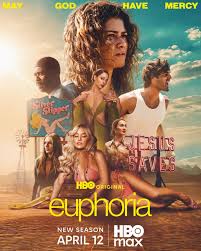

LOS ANGELES — HBO has announced that the premiere episode of Euphoria‘s third and final season will screen at the Coachella Valley Music and Arts Festival on Sunday, April 12, 2026, marking the first time in the iconic festival’s 27-year history that a television series has ever been given a dedicated screening at the event.
The announcement represents a bold convergence of two of America’s most influential cultural institutions — prestige television and live music — and signals a new frontier in how networks market flagship programming to younger, experience-driven audiences. With Zendaya’s star power anchoring both the show and the cultural moment, HBO appears to be betting that the desert spectacle can generate the kind of organic, social-media-fueled buzz that traditional premiere events no longer reliably deliver. The eight-episode final season will also debut on HBO the same evening from 9–10 PM ET/PT, with subsequent episodes airing weekly, meaning Coachella attendees will experience the premiere nearly two hours before the East Coast broadcast begins.
The move comes at a critical juncture for HBO, which has been aggressively repositioning its content strategy amid intensifying competition in the streaming wars. Euphoria, which became a cultural phenomenon during its first two seasons, faced years of production delays and cast scheduling conflicts that threatened to erode its once-fervent fanbase. This Coachella gambit is designed to reignite that conversation in the most public, most Instagrammable way possible.
| Parameter | Details |
|---|---|
| Event | Euphoria Season 3 Premiere Screening at Coachella |
| Date & Time | Sunday, April 12, 2026, at 11:59 PM PT |
| Location | Coachella Festival Campgrounds, Indio, California |
| Access | First-come, first-served; Coachella wristband required |
| Cast | Zendaya, Hunter Schafer, Jacob Elordi, Sydney Sweeney, Alexa Demie, Maude Apatow |
| Season Details | Eight episodes; final season; weekly release on HBO |
| HBO Broadcast | Same day, 9–10 PM ET/PT |
SITUATIONAL BREAKDOWN
The screening will take place in the festival campgrounds after the weekend’s final performances conclude, transforming the post-concert wind-down into a communal viewing experience under the California desert sky. The timing is deliberate — by scheduling the event at 11:59 PM, HBO avoids competing with Coachella’s headline musical acts while capitalizing on the captive, emotionally primed audience that lingers in the campgrounds after the main stages go dark. The first-come, first-served access model, requiring only a valid Coachella wristband, ensures the event feels democratic and spontaneous rather than corporate and exclusive. — Variety
The decision to pair the Coachella screening with a simultaneous traditional HBO broadcast reveals the network’s dual strategy: reach the festival’s young, trend-setting demographic in person while ensuring the broader subscriber base is not alienated by an exclusive debut. Industry observers note that this approach mirrors the increasingly blurred line between live events and streaming content, a trend accelerated by platforms like Netflix hosting live comedy specials and Amazon screening theatrical releases at cultural gatherings. For HBO, the stakes are particularly high given the investment required to bring Euphoria back after a multi-year hiatus that saw its principal cast members — particularly Zendaya and Sydney Sweeney — become significantly bigger stars. — Deadline
Festival organizers, for their part, appear to view the partnership as an evolution of Coachella’s brand rather than a departure from it. The festival has long positioned itself as a broader cultural event rather than a purely musical one, incorporating art installations, fashion activations, and brand experiences into its programming. A prestige television premiere is, in this context, a logical extension — and one that could open the door for similar collaborations with studios eager to reach Coachella’s affluent, culturally engaged audience of roughly 125,000 daily attendees. — The Hollywood Reporter
THE EUPHORIA EFFECT: WHY THIS SHOW, WHY NOW
Euphoria has always existed at the intersection of television and youth culture in a way that few other series have managed. Since its 2019 debut, the show’s aesthetic — neon-drenched cinematography, boundary-pushing fashion, and an emotionally raw portrayal of Gen-Z adolescence — has permeated social media, music, and fashion in ways that transcended its viewership numbers. Its influence on makeup trends alone generated billions of TikTok views, while its soundtrack selections routinely sent artists to the top of streaming charts overnight.
“This is a first-of-its-kind event that brings the world of ‘Euphoria’ to one of the most culturally significant gatherings in the world.” — HBO Max spokesperson
But the show’s cultural capital has been tested by an unusually long gap between seasons. Season 2 aired in early 2022, and the subsequent four-year wait — caused by a combination of the writers’ strike, creator Sam Levinson’s reported creative overhauls, and the increasingly packed schedules of its breakout stars — has left fans oscillating between anticipation and frustration. The Coachella screening is, in many ways, HBO’s attempt to convert that pent-up energy into a cultural event rather than let it dissipate into indifference.
COACHELLA’S EVOLUTION: FROM MUSIC FESTIVAL TO CULTURAL PLATFORM
Coachella’s willingness to host a television premiere reflects a broader transformation that has been reshaping the festival industry for years. What began in 1999 as an alternative music festival in the California desert has become a multi-billion-dollar cultural platform where fashion brands launch collections, tech companies debut products, and influencers generate more content in a single weekend than most create in a month. The addition of a prestige TV screening is less a departure than a formalization of what Coachella has already become — a place where cultural industries converge.
“The premiere will play under the California desert sky in the campgrounds of the festival.” — Variety report
This evolution has not been without criticism. Purists have long lamented that Coachella’s musical programming has taken a backseat to its function as a lifestyle brand, and a television screening in the campgrounds will likely intensify that debate. Yet for the festival’s organizers, the calculus is straightforward: anything that keeps attendees engaged, talking, and posting extends the festival’s cultural reach far beyond the polo fields of Indio.
THE STAR POWER EQUATION
The cast returning for the final season reads like a roll call of Hollywood’s most bankable young talent. Zendaya, who won an Emmy for her portrayal of Rue Bennett, has since headlined blockbuster franchises including Dune and Spider-Man. Sydney Sweeney has become one of the most sought-after actors of her generation. Jacob Elordi’s turn in Saltburn and Priscilla cemented his status as a leading man. Hunter Schafer, Alexa Demie, and Maude Apatow have each carved out significant careers in fashion, film, and television respectively.
The irony is that the very success that makes this cast so valuable is what made reuniting them so difficult — and what makes the final season feel like a genuine event rather than a routine renewal. In an era of endless content, scarcity has become Euphoria‘s most powerful marketing tool, and the Coachella screening exploits that scarcity brilliantly. Much like how major sporting events or unexpected franchise shake-ups — such as the Toronto Maple Leafs’ decision to fire GM Brad Treliving — generate intense public conversation precisely because they disrupt expectations, Euphoria‘s Coachella debut is designed to be a moment that demands attention.
THE STREAMING WARS: HBO’S EXPERIENTIAL GAMBIT
HBO’s decision must be understood within the context of an increasingly competitive streaming landscape where subscriber acquisition costs continue to rise and traditional marketing channels yield diminishing returns among younger demographics. Netflix, Disney+, and Amazon Prime Video have all experimented with immersive, real-world activations tied to their flagship properties, from Netflix’s interactive Squid Game experiences to Disney’s themed pop-ups.
What distinguishes the Euphoria-Coachella partnership is its scale and its authenticity. Rather than creating a branded side event, HBO is embedding its content directly into the festival’s organic programming — a move that feels less like advertising and more like cultural participation. If it works, expect every major streamer to be courting Coachella and similar festivals for similar partnerships by 2027.
🇵🇰 WHAT THIS MEANS FOR PAKISTAN
While Coachella may seem geographically and culturally distant from Pakistan, the convergence of streaming television and live events has direct implications for the country’s rapidly growing entertainment and digital media sectors. Pakistan’s streaming market has expanded significantly in recent years, with platforms like Tapmad, ARY ZAP, and international services competing for a young, increasingly connected population. The Euphoria-Coachella model offers a blueprint for how Pakistani content creators and platforms might leverage the country’s thriving music festival scene — from Lahore Music Meet to Islamabad’s emerging live event culture — to launch and promote original programming.
Moreover, Euphoria‘s massive popularity among Pakistani youth, particularly on social media platforms, underscores the cultural reach of HBO’s programming into South Asian markets. As Pakistani production houses increasingly target international audiences and streaming distribution, understanding how Western networks use experiential marketing to cut through content saturation is not merely academic — it is a competitive necessity. The fusion of live culture and premium content is a trend that Pakistan’s entertainment industry would be wise to study and adapt.
BOLOTOSAI ASSESSMENT
HBO’s Coachella gambit is likely to succeed on its own terms — generating massive social media engagement, dominating cultural conversation for at least 48 hours, and re-establishing Euphoria as appointment television in an era of algorithmic content discovery. The real question is whether this model is replicable or whether it works only because of the unique confluence of Euphoria‘s cultural cachet, Coachella’s platform, and a four-year anticipation gap that turned the premiere into a genuine event.
Three outcomes to watch: First, whether the Coachella screening measurably impacts HBO subscriber sign-ups in the days following the premiere, which would validate the experiential marketing thesis. Second, whether Coachella formalizes a programming track for film and television screenings in future editions, which would signal a permanent shift in the festival’s identity. Third, whether competing streamers accelerate their own festival partnerships — early reports suggest Netflix and Amazon are already in discussions with Glastonbury and Lollapalooza organizers for 2027 activations.
What is certain is that the boundary between television and live culture has been permanently blurred. Euphoria‘s final season will not merely be watched — it will be experienced. And in an attention economy where passive viewing is increasingly insufficient, that distinction may be the most valuable thing HBO has produced all year.

 By
By
 By
By