
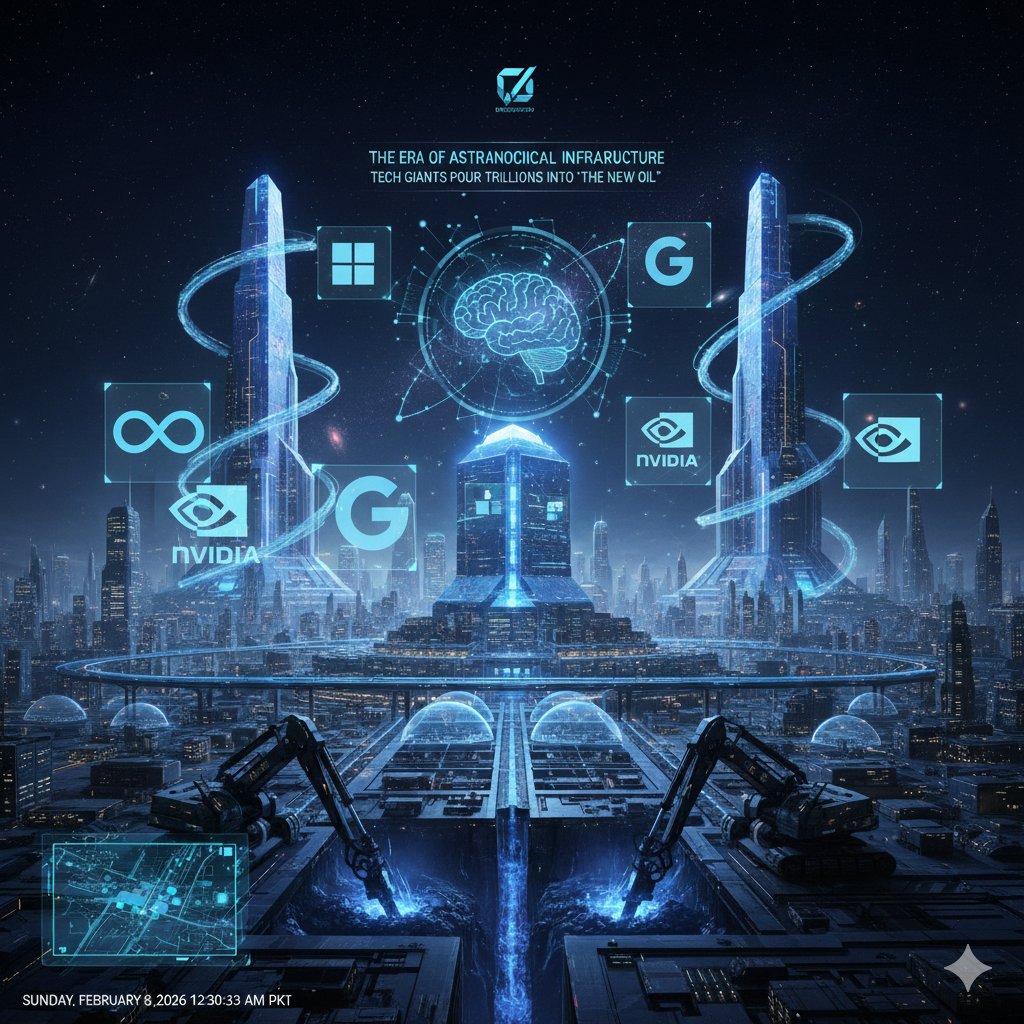

SAN FRANCISCO/SINGAPORE – A new industrial arms race is unfolding not on factory floors, but in the desert mega-data centers and semiconductor fab plants of the world. Driven by the generative AI explosion, the world’s largest technology firms are committing to capital expenditures of unprecedented scale, signaling the dawn of an era defined by astronomical AI Infrastructure Spending.
Fueled by the demand for models like GPT-5, Gemini Ultra, and an ecosystem of AI agents, companies are no longer just buying chips—they are building the entire industrial ecosystem to power the next decade of intelligence. Analysts at Gartner &
McKinsey project that cumulative global investment in AI infrastructure (encompassing data centers, semiconductors, and energy grids) will surpass $1.5 trillion by 2030, with the next five years seeing the most concentrated spend.
The Titans’ Ledger: Projected Spend
- Microsoft & OpenAI: The defining partnership of the era. Microsoft has signaled it may spend over $100 billion on a singular, next-generation AI supercomputer project dubbed “Stargate” for OpenAI, part of a multi-year plan potentially exceeding $500 billion in data center build-out.
- Google/Alphabet: Has accelerated its spending, with 2024 capital expenditure projected at over $50 billion, nearly all directed toward AI and digital infrastructure, a massive jump from previous years.
- Meta: Has been transparent about its aggressive build-out, forecasting 2024 capital expenditures of $35-40 billion, focused almost entirely on AI. Mark Zuckerberg stated the company aims to have ~600,000 of the latest Nvidia H100-equivalent GPUs by year’s end.
- Amazon (AWS): As the world’s largest cloud provider, its infrastructure is the backbone for countless AI startups. Its capex surged to support AI, with projections pointing to $60-70 billion annually in the near term to expand data center capacity and develop custom silicon (Trainium, Inferentia).
- NVIDIA, TSMC, & The Enablers: While not end-users, these suppliers are direct beneficiaries. NVIDIA’s data center revenue has become a barometer for the frenzy, while TSMC is racing to build advanced packaging (“CoWoS”) capacity to meet insatiable demand, with its own capex budgets in the tens of billions.
The “AI Bubble” Discussion: Prudent Bet or Reckless Speculation?
This tsunami of capital has ignited a fierce debate: Is this the necessary foundation for a transformative technological revolution, or a hyper-inflated bubble reminiscent of the dot-com era?
The Bull Case: Proponents argue this is the essential “picks and shovels” phase of a genuine paradigm shift. “You cannot have an AI-powered economy running on 2022’s cloud infrastructure,” argues Dr. Lena Kowalski, a tech economist at MIT. “This spending isn’t speculative; it’s a direct response to measurable, skyrocketing demand for compute. AI is becoming embedded in every product and service. This is the new critical infrastructure, akin to building the interstate highway system or the global fiber-optic network.”
The Bubble Warning: Skeptics see red flags in the sheer velocity and scale of investment, driven more by fear of missing out (FOMO) than near-term economic returns. “We are seeing capital allocation based on narratives of artificial general intelligence (AGI), not present-day cash flows,” warns Michael Hart of the Cautionary Capital Group. “When every CEO feels compelled to have an ‘AI strategy,’ capital discipline evaporates. A significant portion of this spend assumes demand that may not materialize as quickly as hoped, leading to potential overcapacity and a painful consolidation phase.”
The ultimate test may lie in the “Productivity Payoff.” For the spending to be validated, it must translate into measurable, massive gains in corporate profitability and economic growth within the next 3-5 years. If that payoff lags, the strain on tech balance sheets could be severe.
As the diggers break ground on yet another 500-megawatt data center campus, the industry holds its breath. The era of astronomical AI infrastructure spending is unequivocally here. Whether it will be remembered as the foundation of a new world or the zenith of a speculative mania is the trillion-dollar question hanging over Silicon Valley and the global economy.
Also Read: Japan’s Moon Ring: 2026-A Bold Proposal for Earth’s Energy Future

 By
By

 By
By