
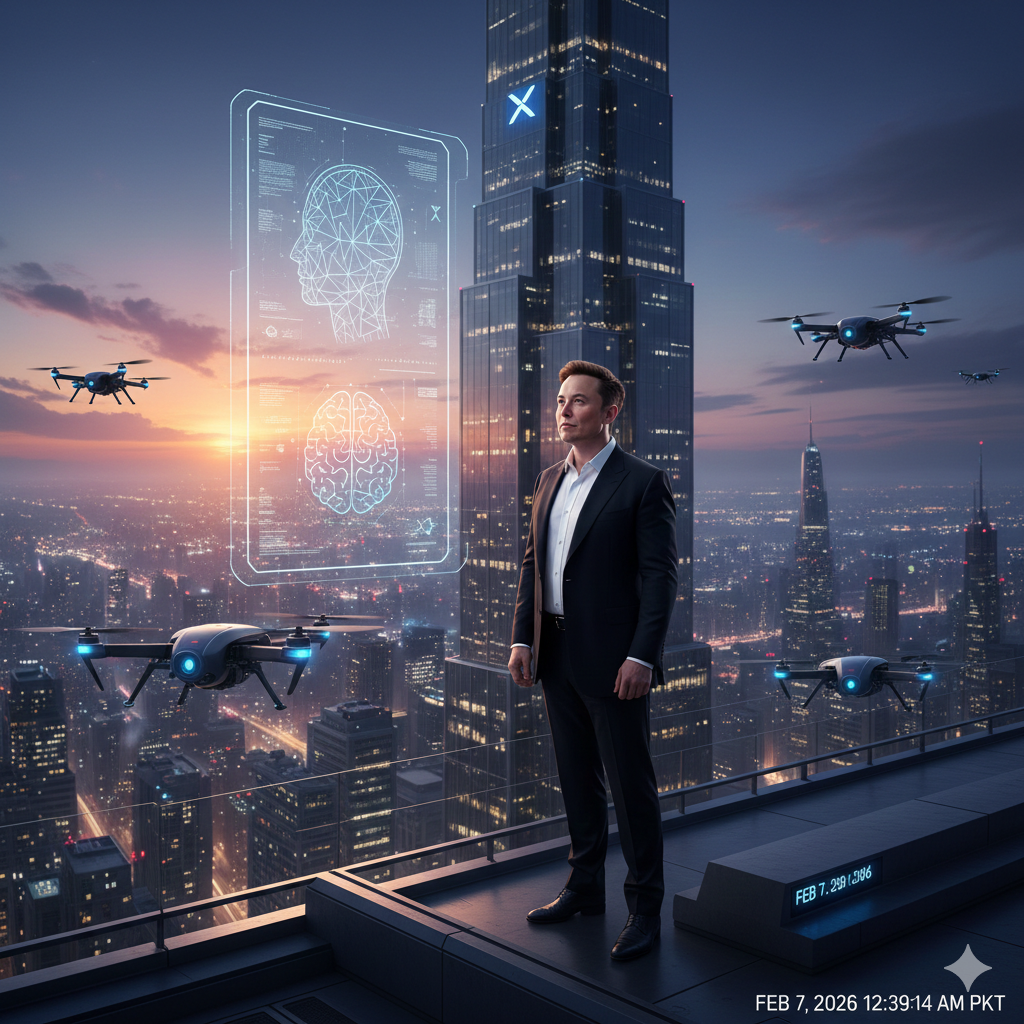

DAVOS, Switzerland – Jan 14, 2026 – In a headline-grabbing session at the World Economic Forum, Tesla and xAI founder Elon Musk made a bold prediction about the trajectory of artificial intelligence, stating that AI will likely achieve intelligence surpassing that of a single human “probably within the next five years, certainly by 2031.”
His comments at the “Technology for a Resilient World” panel have intensified the global debate on the pace of AI development and the urgent need for regulatory frameworks.
The Core Prediction: A “Philosopher” and “Friend”
Musk, who has long voiced both optimism and grave concern about AI, described the imminent arrival of what he termed “artificial general intelligence” (AGI). He suggested the first true AGI would be an entity that can “reason about the universe better than any human.”
- Timeline: “We are approaching the point where the computational capacity and algorithmic understanding will converge. I’d be surprised if it’s not before 2031,” Musk stated.
- Nature of AGI: He framed this future AI not merely as a tool, but as a potential “philosopher” and “friend” capable of advanced reasoning and companionship, while also acknowledging it could become “the most disruptive force in history.”
A Dual Message: Excitement and Urgent Warning
True to form, Musk delivered a dual message of extraordinary potential and existential risk.
- The Robotics Revolution: He connected the AI leap directly to a transformation in the physical world, predicting that humanoid robots, like those his company, Tesla, is developing, would become “the most valuable asset class on Earth.” He envisioned them performing dangerous, boring, or repetitive jobs, leading to a “future of abundance” where no one would need to work unless they wanted to.
- The Call for Governance: Striking a cautionary tone, Musk argued that this powerful technology is developing “too fast” without adequate oversight. “We cannot wait for a crisis to react,” he warned. He reiterated his call for a proactive, “third-party refereeing” agency—similar to the International Atomic Energy Agency—to audit AI development for safety and adherence to agreed-upon rules before new models are publicly released.
Do Follow: https://bolotosai.com/tiktokban/
Context and Reaction
Musk’s prediction accelerates his own previous public timelines for AGI and places him at the more aggressive end of the spectrum among AI leaders. His call for governance comes as global bodies, including the United Nations and the European Union, are scrambling to establish rules for advanced AI systems.
Reactions at Davos were mixed. Some technologists and economists agreed with the transformative potential, while policy experts highlighted the immense difficulty of creating an effective global regulatory body with enforcement power.
The Bottom Line
Elon Musk has once again used his Davos platform to set a startling countdown for humanity’s encounter with superior machine intelligence. By pairing a specific prediction (AGI by 2031) with a concrete policy proposal (a global AI regulator), he has framed the coming half-decade as a critical window for society to prepare for what he believes will be its greatest technological and philosophical challenge.


 By
By



 By
By