
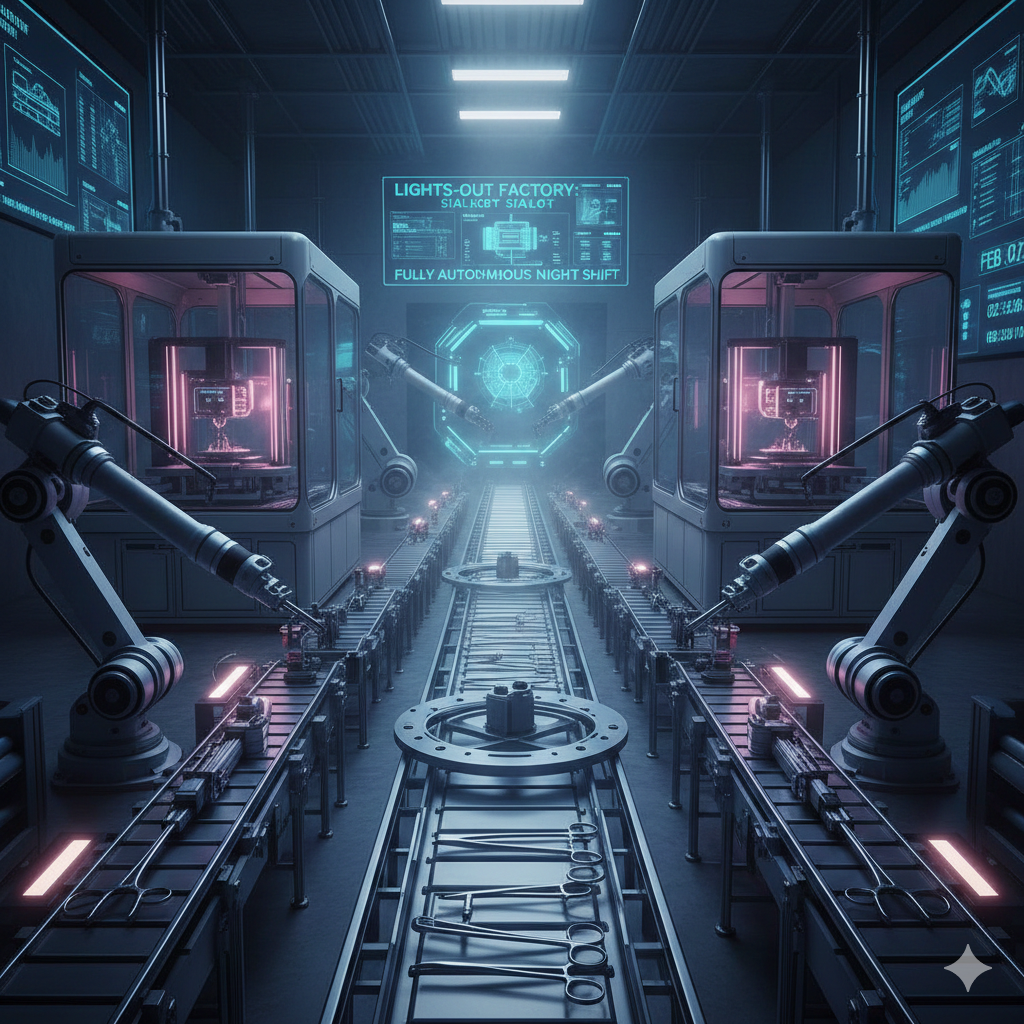

SIALKOT, Pakistan – In an industrial revolution quietly unfolding in the heart of Pakistan’s manufacturing powerhouse, a leading surgical instruments unit in Sialkot has successfully transitioned its night shift to full “lights-out” automation. For ten hours each night, the factory floor operates in near-total darkness, with robotic arms, CNC machines, and automated guided vehicles (AGVs) producing precision surgical tools without a single human worker present.
The facility, owned by PrecisionMed Solutions, has implemented a state-of-the-art Internet of Things (IoT) ecosystem. Every machine on the production line is equipped with sensors and connected to a central AI-powered control system. This “digital foreman” manages the entire workflow—from feeding raw stainless steel and titanium, through precision milling and polishing, to final quality checks and packaging.
“The decision wasn’t about replacing people, but about maximizing precision, consistency, and capacity,” explained CEO Ali Raza. “Surgical instruments require microscopic accuracy. Our autonomous night shift eliminates human fatigue variables, ensuring every scalpel and forceps produced between 10 PM and 8 AM meets identical, flawless specifications.”
The lights-out model has yielded staggering results. The company reports a 30% increase in overall production output, a near-zero defect rate on the night shift, and a 40% reduction in energy costs due to optimized machine operation and the obvious savings on lighting and climate control for human comfort.
While the factory hums autonomously, it is not unsupervised. A small remote monitoring team, including engineers and data analysts, oversees the operation from a control center and via smartphones, receiving real-time alerts on performance or any required maintenance.
This leap positions Sialkot, which already supplies over 70% of the world’s surgical instruments, at the forefront of Industry 4.0. It addresses critical challenges of scaling up production to meet global demand while adhering to the highest international quality standards.
“This is the future of manufacturing in Pakistan,” said Dr. Hina Khan, an industrial automation expert. “PrecisionMed is demonstrating that our specialized industries can not only adopt but also master advanced automation, boosting competitiveness on the global stage without compromising the craftsmanship Sialkot is known for.”
The successful implementation serves as a blueprint for the region’s numerous export-oriented units. As the lights go out each night in this Sialkot factory, the signal is clear: Pakistan’s manufacturing sector is entering a new, highly efficient, and technologically advanced era.
Good Read: From Lab to Market: 2026-NUST’s AI Cancer Detection Algorithm Now Powering European Clinics


 By
By


 By
By