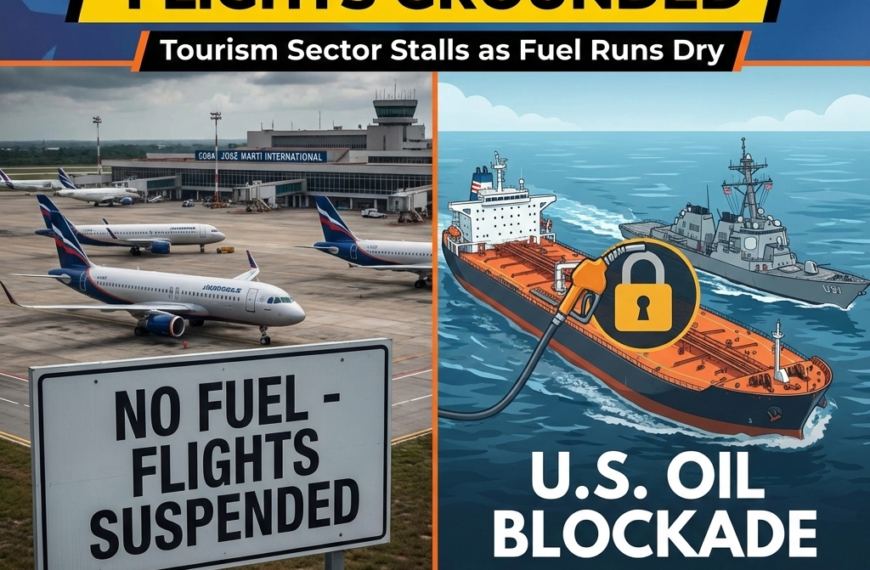
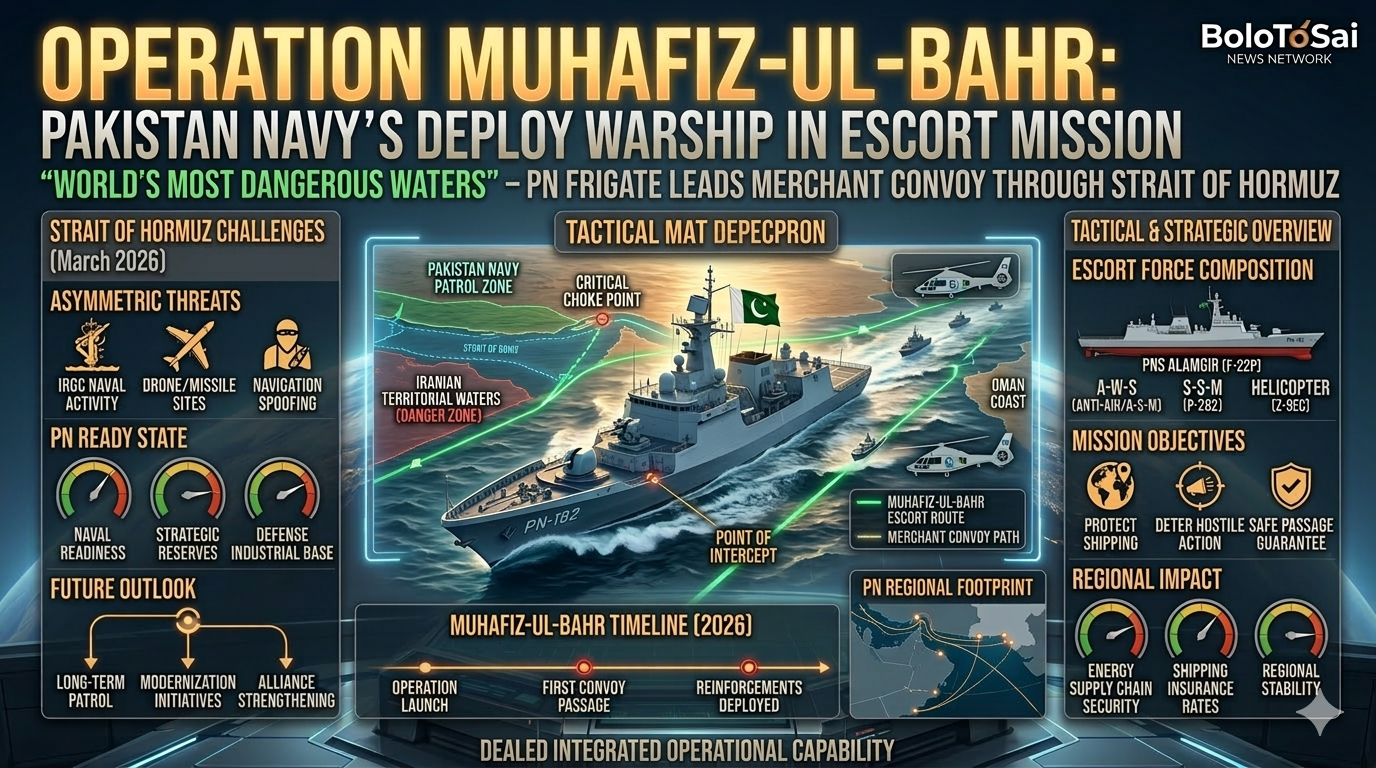

KARACHI/ISLAMABAD/STRAIT OF HORMUZ — In a bold and historic display of naval power, the Pakistan Navy has launched Operation Muhafiz-ul-Bahr — deploying warships into the Strait of Hormuz to escort Pakistani merchant vessels through the world’s most dangerous and strategically critical waterway. The operation, announced on March 9, 2026 by the Inter-Services Public Relations (ISPR), marks one of the most significant deployments in Pakistan Navy history — a direct response to the catastrophic disruption of global shipping caused by the Iran-Israel-USA war. Pakistan joins France, the United Kingdom and other nations in taking decisive naval action to protect its critical energy lifeline.
ANALYTICAL BRIEF — OPERATION MUHAFIZ-UL-BAHR (10 MARCH 2026)
| Parameter | Details |
|---|---|
| Operation Name | Muhafiz-ul-Bahr (Guardian of the Sea) |
| Launch Date | 9 March 2026 |
| Announced By | ISPR — Pakistan Navy |
| Objective | Escort Pakistani merchant vessels through Strait of Hormuz |
| Coordination | Pakistan National Shipping Corporation (PNSC) |
| Vessels Currently Escorted | 2 merchant vessels — 1 arrived Karachi on March 9 |
| Strait of Hormuz Status | Effectively closed — IRGC threatening all vessels |
| Oil Removed From Markets | 20 million barrels per day — largest disruption in history |
| Pakistan Oil Rerouting | Saudi Arabia rerouting via Yanbu Red Sea port |
| PM Emergency Measures | Schools closed 2 weeks — universities online |
| Pakistan Central Bank | Warning on inflation outlook due to energy crisis |
| International Deployments | France (10 warships), UK, Italy, Greece, Pakistan |
SITUATIONAL BREAKDOWN
Operation Muhafiz-ul-Bahr — Guardian of the Sea: The Pakistan Navy launched Operation Muhafiz-ul-Bahr to counter multidimensional threats to national shipping and maritime trade amid the ongoing Middle East crisis. PN escort operations are being conducted in close coordination with the Pakistan National Shipping Corporation. The Pakistan Navy is fully cognizant of the prevailing maritime situation and is actively monitoring and controlling the movement of merchant vessels to ensure their safe and secure transit.
According to ISPR, at the time of the announcement, Pakistan Navy warships were escorting two merchant vessels — one of which was scheduled to arrive in Karachi the same day. The operation comes as a direct response to Iran’s effective closure of the Strait of Hormuz following the joint US-Israeli strikes that began on February 28, 2026.
Why Pakistan Had No Choice: The conflict has already removed an estimated 20 million barrels per day of oil from global markets — creating what analysts describe as the largest oil supply disruption in modern history. Shipping companies have begun imposing war-risk surcharges while some vessels have altered routes amid fears of attacks or disruptions in the Gulf. For Pakistan — a country that imports the vast majority of its oil and gas through Gulf shipping lanes — the closure of the Strait of Hormuz is not just an economic problem. It is an existential energy security crisis.
Pakistan’s Emergency Response on Multiple Fronts: The Pakistan Navy’s deployment is just one part of a broader national emergency response. On March 4, Pakistan officially requested that Saudi Arabia reroute oil supplies through Yanbu’s Red Sea port — with Saudi Arabia providing assurances and arranging at least one crude shipment to bypass the closed strait. Prime Minister Shehbaz Sharif announced emergency austerity measures aimed at reducing fuel consumption and controlling government spending — schools will close for two weeks while universities will shift to online classes. Pakistan’s central bank warned earlier this week that rising global energy prices linked to the Middle East war had increased uncertainty about the country’s inflation outlook.
The Strait of Hormuz — Why It Matters So Much: The Strait of Hormuz, a vital maritime chokepoint for global energy trade, has experienced ongoing geopolitical and economic disruption since February 28, 2026, following the joint US-Israeli strikes on Iran. Iran’s IRGC issued warnings prohibiting vessel passage through the strait — leading to an effective halt in shipping traffic. Tanker traffic dropped by approximately 70% and over 150 ships anchored outside the strait to avoid risks — with traffic soon going to near zero. P rotection and indemnity insurance was removed on March 5, making the economic risk too high for ship owners to use the strait.
Pakistan Joins Global Naval Response: Pakistan is not alone in this deployment. France announced it would send 10 additional warships to the Middle East and dedicate two frigates to escort merchant ships through the Strait of Hormuz. In addition to France, the UK, Greece, Italy and Pakistan have all announced new deployments in response to the Iranian retaliation strikes. However, Pakistan’s deployment carries unique strategic significance — as a Muslim-majority nation navigating the extraordinarily delicate balance of protecting its own economic interests while maintaining relationships with both Iran and the Gulf Arab states.
The IRGC Threat — Real and Deadly: The waters Pakistan’s Navy is now sailing are genuinely dangerous. On March 2, a senior IRGC official confirmed the strait was closed and threatened any ship attempting to pass through it. The US-flagged Stena Imperative was struck twice at the port of Bahrain causing a fire — a port worker was killed and two others were hurt. The Athe Nova was struck by two drones after attempting to cross the strait, according to IRGC-linked Tasnim News Agency. Pakistan’s naval commanders are sailing their warships and the merchant vessels under their protection directly into these waters — a decision that reflects both extraordinary bravery and extraordinary necessity.
Pakistan’s Diplomatic Tightrope: The deployment places Pakistan in an extraordinarily delicate diplomatic position. Iran is Pakistan’s neighbour and a country with deep religious, cultural and economic ties to Islamabad. Yet Pakistan’s economy cannot survive without the oil and gas that flows through Iranian-controlled waters. The PN may need to sustain Operation Muhafiz-ul-Bahr for weeks or months — this will test the fleet’s operational readiness and logistical depth. Islamabad has so far carefully avoided taking sides in the Iran-Israel-USA conflict — but deploying warships into the Strait of Hormuz in defiance of Iran’s closure order inevitably draws Pakistan into the geopolitical vortex.
Pakistan Navy’s Growing Capability: The PN’s parallel investments in the Babur-class MILGEM corvettes and the forthcoming Jinnah-class frigates will further deepen the fleet’s capacity for sustained operations of this kind. O Wikipediaperation Muhafiz-ul-Bahr is the Pakistan Navy’s most high-profile operational deployment in decades — and a powerful demonstration to the world that Pakistan possesses the naval capability and the strategic will to protect its national interests in contested waters.
Qatar’s Warning — Global Economies at Risk: On March 6, Qatari Energy Minister Saad Sherida al-Kaabi warned that if the war continues, other Gulf energy producers may be forced to halt exports and declare force majeure — adding “this will bring down economies of the world.” K euronewsuwait has already declared force majeure and announced cuts to oil production. Qatar stopped gas production on March 2 and declared force majeure on gas contracts on March 4.
WHAT THIS MEANS FOR PAKISTAN
Energy Security: Operation Muhafiz-ul-Bahr is Pakistan’s most direct answer to the fuel crisis that has already forced a Rs.55 per litre petrol price hike this week. Every merchant vessel safely escorted to Karachi represents fuel in Pakistani homes, factories and vehicles.
National Pride: The Pakistan Navy’s decision to deploy warships into the world’s most contested waters — at a moment when global shipping has effectively collapsed — is a powerful statement of capability, sovereignty and resolve. Pakistan is not a passive victim of this crisis. It is taking active steps to protect its citizens.
Strategic Positioning: By deploying alongside France, UK and other Western nations in a defensive maritime escort mission, Pakistan has carefully positioned itself as a responsible regional actor focused purely on the protection of civilian shipping — rather than a combatant in the wider conflict.
Economic Relief: The operation was taken to ensure the uninterrupted flow of national energy supplies and the security of sea lines of communication. Eve Wikipediary successful escort mission directly reduces the pressure on Pakistan’s foreign exchange reserves, fuel prices and inflation outlook.
BOLOTSAI ASSESSMENT
Operation Muhafiz-ul-Bahr is one of the most significant decisions the Pakistan Navy has made in its history. Deploying warships into waters where oil tankers have been struck by drones and missiles — where insurance has been pulled, where the IRGC has explicitly threatened all vessels — requires both extraordinary capability and extraordinary courage.
Pakistan finds itself in the middle of a crisis it did not create — but one it cannot afford to ignore. With fuel reserves running low, schools shut for two weeks, oil prices at record highs and the Strait of Hormuz effectively closed, the Pakistan Navy has answered the call.
The operation comes in direct response to the effective closure of the Strait of Hormuz following the joint US-Israeli strikes on Iran that began on February 28, 2026. It Wikipediasignals to the world that Pakistan — simultaneously managing Operation Ghazab Lil Haq on its Afghan border and the worst energy crisis in its history — is a nation that will fight for its survival on every front.
The Pakistan Navy is on the water. BoloToSai will keep you updated on every development.
Sources: Express Tribune, Dawn, USNI News, Quwa Defence, Marine Insight, Gulf News, Wikipedia 2026 Strait of Hormuz Crisis | All figures verified at time of publishing — 10 March 2026
#OperationMuhafizulBahr #PakistanNavy #StraitOfHormuz #IranWar #BoloToSai #Pakistan #NavalOperation


 By
By

 By
By