
Summary: Regulators and enterprise customers are pressuring Microsoft Security to lock down the Windows kernel, sparking a high-stakes debate over security, competition, and stability in the post-outage era.
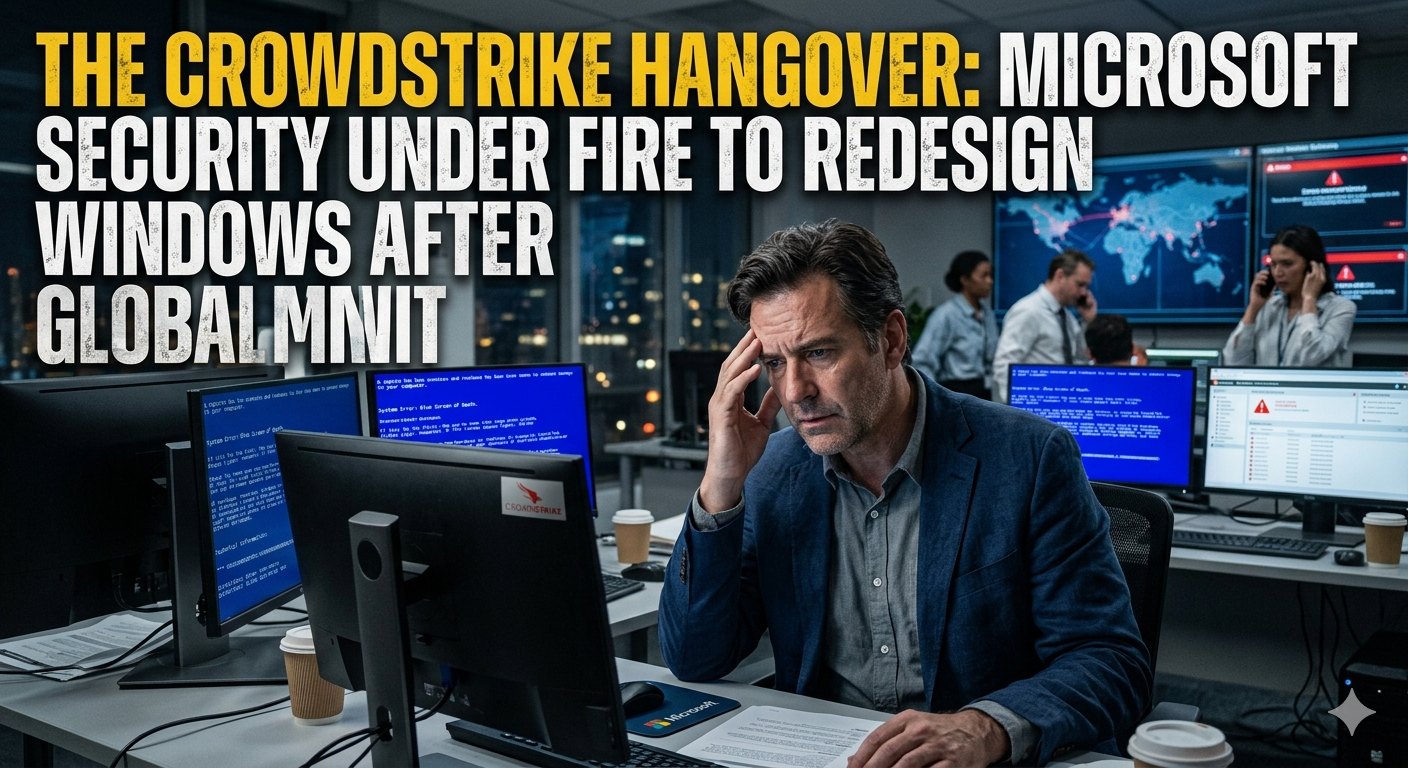
Redmond, Washington – In the wake of the catastrophic global IT outage caused by a faulty CrowdStrike update in July 2024, Microsoft security is facing intense pressure from regulators and corporate customers to fundamentally redesign the Windows operating system, sparking a high-stakes industry debate about whether the company must now lock down its kernel to prevent a similar disaster, even if it disrupts the cybersecurity industry’s long-standing access models.
The “CrowdStrike Hangover”: A Crisis of Trust
While the initial “blue screen of death” incident that grounded flights and halted financial services was technically the fault of a flawed content update from cybersecurity firm CrowdStrike, the controversy quickly shifted to Microsoft. The outage exposed a critical vulnerability in Windows’ architecture: the fact that a third-party security tool could cause a system-wide failure by accessing the core of the operating system—the kernel.
This event, now referred to by industry analysts as the “CrowdStrike Hangover,” has fundamentally altered the conversation around endpoint security. The question is no longer just “How do we vet updates?” but “Why can a third-party vendor crash the entire operating system in the first place?”
The Core Issue: Kernel Access
At the heart of the controversy is kernel access. For decades, security software like CrowdStrike, SentinelOne, and Defender has relied on deep access to the Windows kernel to monitor for threats like malware and rootkits. This access, however, carries inherent risk: if the security software crashes, the entire operating system crashes.
Microsoft security has previously attempted to lock down the kernel, most notably with the release of Windows Vista, but faced massive pushback from security firms and enterprise customers who argued that kernel access was essential for effective threat detection and performance.
The Current Situation: Pressure Mounts
Today, the regulatory and market pressure on Microsoft security is reaching a boiling point. According to sources familiar with the matter, the UK’s Competition and Markets Authority (CMA) and the European Commission are scrutinizing Microsoft’s security ecosystem, while major financial institutions and airlines—still tallying the losses from the July outage—are demanding systemic change.
The Cybersecurity and Infrastructure Security Agency (CISA) has also weighed in, urging a industry-wide conversation on “secure by design” principles. Microsoft is now caught between two impossible demands: make Windows impenetrable to failure, and do it without breaking the security tools that enterprises rely on.
The Proposed Solution: Building a “Red Line”
Microsoft security is reportedly exploring a major architectural shift that would mirror Apple’s approach with macOS. Apple has progressively locked down its kernel, requiring security vendors to use high-level APIs rather than installing kernel extensions.
For Microsoft, this would mean creating a modern, well-documented set of APIs (Application Programming Interfaces) that are powerful enough for security vendors to do their jobs without ever touching the kernel. This “red line” would theoretically ensure that if a security tool crashes, it crashes in user space—taking down the app, perhaps, but not the entire machine or server.
The Stakes: Microsoft Security vs. Stability
The debate is now framed as “security vs. stability,” though experts argue the reality is more nuanced.
The Argument for Change:
Critics, including many in the open-source and cloud-native communities, argue that the July outage proved the current model is a house of cards. “The CrowdStrike incident was a near-miss that turned into a direct hit,” said a cloud infrastructure architect who advises Fortune 500 companies. “If we want a resilient digital economy, the operating system cannot be a single point of failure. Microsoft must build a fence around the kernel.”
The Argument Against:
However, cybersecurity firms are pushing back. They warn that forcing security products to operate outside the kernel would create a “telemetry gap,” making it harder to detect sophisticated nation-state attacks that operate at the lowest levels of the system. They argue that Microsoft’s push to lock down the OS is a convenient way to push its own security products (Microsoft Defender for Endpoint), which would still have privileged access.
The Road Ahead
As Microsoft security navigates this complex landscape, the industry is watching closely. The company has hinted at upcoming changes to its “VBS enclaves” and virtualization-based security features, but has not yet committed to a full kernel lockdown.
The “CrowdStrike Hangover” has left the industry with a sobering realization: the very architecture that allowed Windows to dominate the enterprise market by being open and flexible may now be its greatest liability. The decision Microsoft makes in the coming months will not only define the future of Windows security but could also reshape the multi-billion-dollar endpoint protection market for years to come.
Frequently Asked Questions (FAQ): Microsoft and the CrowdStrike Outage
Q: What was the CrowdStrike outage?
A: In July 2024, a faulty software update from cybersecurity firm CrowdStrike caused millions of Windows computers and servers worldwide to crash, displaying the “Blue Screen of Death.” It disrupted airlines, banks, and hospitals globally.
Q: Why is Microsoft being blamed if it was CrowdStrike’s fault?
A: The controversy shifted to Microsoft because the outage exposed a fundamental design flaw: Windows allows third-party security software to run at the “kernel” level—the most privileged part of the operating system. This means a failure in the security tool can crash the entire OS.
Q: What is the “kernel” and why is it important?
A: The kernel is the core of an operating system. It has complete control over everything in the system. Security software likes to operate here to catch malware early, but it is risky because any crash at this level is catastrophic.
Q: What does Microsoft want to change?
A: Microsoft is under pressure to lock down the kernel, preventing third-party tools from accessing it directly. Instead, security vendors would use external APIs (Application Programming Interfaces) to monitor for threats, similar to how Apple’s macOS works.
Q: What are the risks of locking the kernel?
A: Security vendors argue that operating outside the kernel would blind them to sophisticated cyberattacks, making computers less secure. They also accuse Microsoft of using this as an opportunity to gain an unfair advantage for its own security products.

 By
By





 By
By