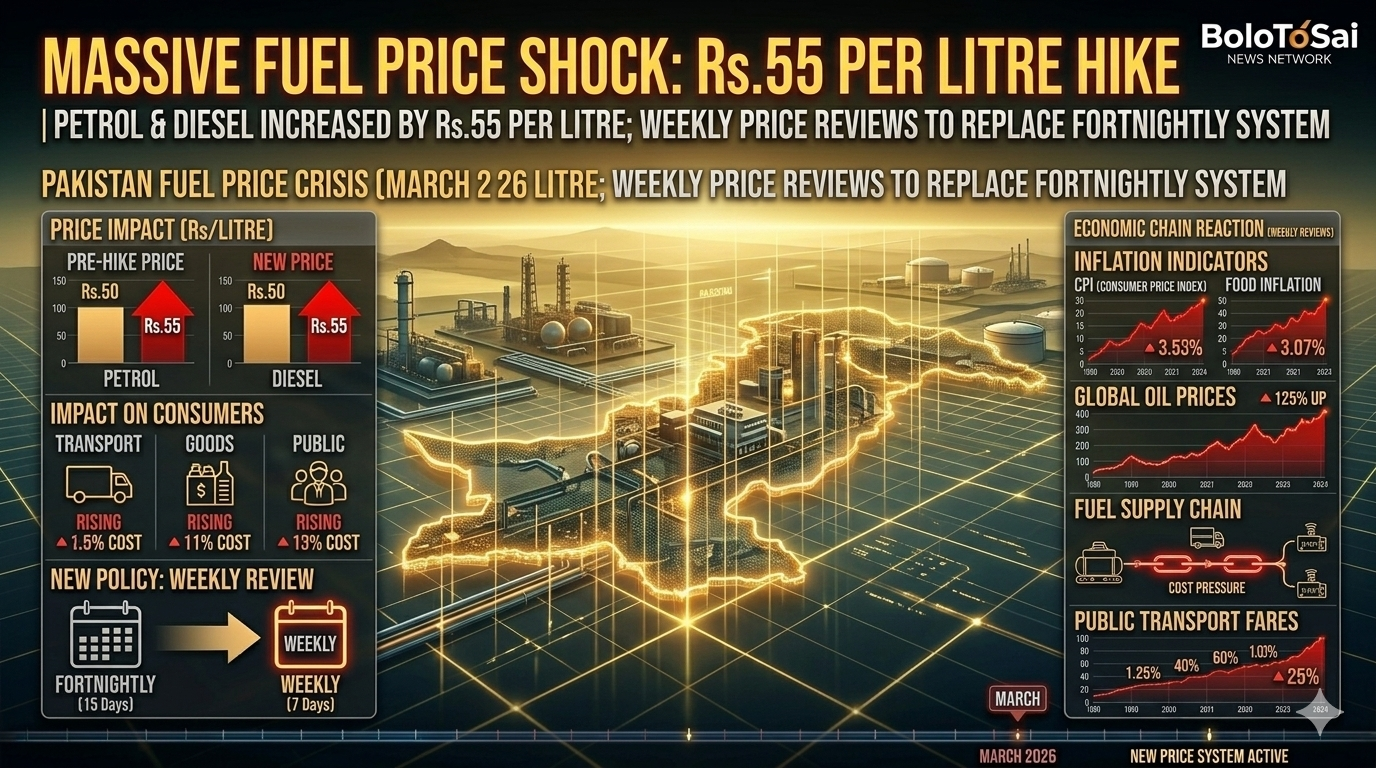

ISLAMABAD — In one of the steepest single fuel price increases in Pakistan’s recent history, the federal government has announced a massive hike of Rs.55 per litre on both petrol and high-speed diesel — effective immediately. The announcement, made on Friday March 6, 2026, comes as global oil markets reel from the ongoing Iran-USA-Israel war and the closure of the Strait of Hormuz. In an even more significant structural shift, the government is simultaneously moving towards a weekly fuel price review mechanism — replacing the existing fortnightly system — meaning Pakistani consumers could now face price changes every single week.
ANALYTICAL BRIEF — FUEL PRICE UPDATE (6 MARCH 2026)
| Fuel Type | Previous Price | New Price | Increase |
|---|---|---|---|
| Petrol (Motor Spirit) | Rs. 266.17/litre | Rs. 321.17/litre | ▲ Rs. 55.00 |
| High-Speed Diesel (HSD) | Rs. 280.86/litre | Rs. 335.86/litre | ▲ Rs. 55.00 |
| Review Mechanism | Fortnightly | Weekly | Major Change |
| Global Crude Oil | $85–$92/barrel | Surging | ▲ Ongoing |
| Projected Crude (War Scenario) | Up to $108/barrel | — | ▲ Risk |
SITUATIONAL BREAKDOWN
The Biggest Hike in Recent Memory: The federal government has sharply increased petroleum prices, raising the rates of petrol and high-speed diesel by Rs.55 per litre amid rising global oil prices and growing regional uncertainty — marking one of the steepest increases in recent months. Wikipedia The announcement sent shockwaves through Pakistani markets, with transport associations, agricultural groups and consumer rights organizations immediately raising alarm about the cascading economic impact.
Weekly Reviews — A New Era of Fuel Pricing: According to government sources, the increase comes as Islamabad moves towards a weekly review mechanism for petroleum prices, replacing the existing fortnightly system. WikipediaThis is a fundamental structural change in how Pakistan manages fuel pricing. Under the new system, prices could change every 7 days — meaning Pakistani households, businesses and transport operators will face far greater price volatility going forward. Critics argue this weekly mechanism will make financial planning nearly impossible for low and middle income families already stretched to their limits.
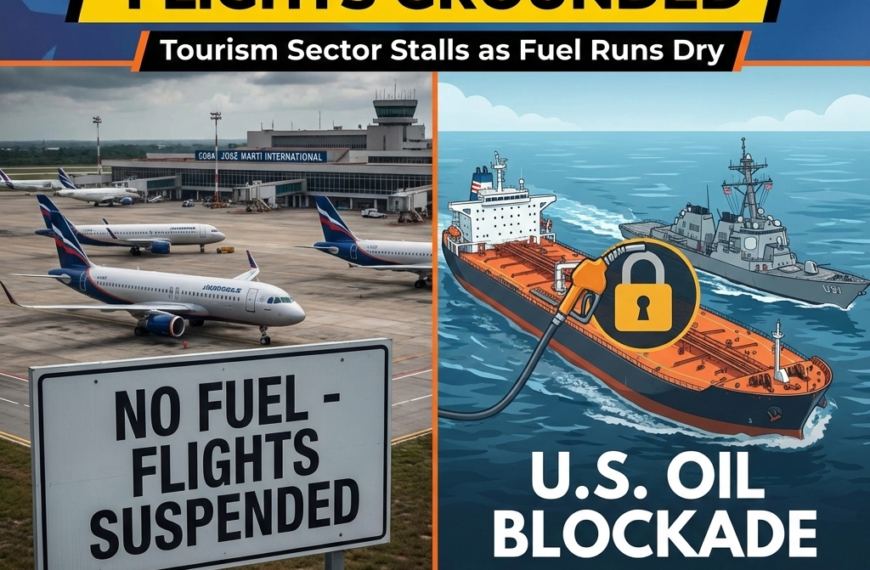
The Iran-USA War Connection: The timing of this dramatic hike is directly linked to the catastrophic conflict now engulfing Pakistan’s western neighbourhood. Global crude oil prices have surged sharply in recent weeks driven by the Iran-USA-Israel war. With Iran having closed the Strait of Hormuz — through which 20% of the world’s daily oil supply passes — and with QatarEnergy having halted LNG production due to Iranian missile strikes on Gulf infrastructure, Pakistan’s fuel import costs have skyrocketed. According to Bloomberg, ongoing geopolitical tensions and the recent conflict have pushed crude oil prices higher, with projections suggesting oil could surge to $108 per barrel if the situation escalates further. euronewsAt $108 per barrel, analysts warn the next weekly review could bring yet another significant hike.
Impact on Transport: The Rs.55 hike is expected to trigger immediate fare increases across Pakistan’s transport sector. Bus, rickshaw and taxi operators in Karachi, Lahore, Islamabad and other major cities are expected to revise fares upward within days. For millions of daily commuters — particularly low income workers dependent on public transport — this represents a devastating blow to already stretched household budgets.
Impact on Agriculture: High-Speed Diesel powers Pakistan’s agricultural backbone — tractors, tube wells, threshers and transport of produce from farms to markets. A Rs.55 per litre increase in diesel directly increases the cost of growing food in Pakistan. Farmers’ associations are expected to demand immediate government intervention in the form of subsidies or relief packages. Without relief, food prices across Pakistan’s markets are expected to rise sharply in the coming weeks.
Impact on Supply Chain & Inflation: Every rupee increase in diesel translates directly into higher freight charges for goods moving across the country — from raw materials to finished products. With diesel now at approximately Rs.335 per litre, Pakistan’s entire supply chain faces a dramatic cost shock. Economists warn that headline inflation — already elevated — could spike significantly in the coming weeks as fuel costs ripple through every sector of the economy.
The Weekly Review Threat: Perhaps more alarming than the Rs.55 hike itself is the shift to weekly reviews. Global petroleum prices have surged sharply in recent weeks — a trend that has begun to directly affect Pakistan’s domestic market. WikipediaWith the Iran-USA war showing no signs of ending — and with US Secretary of State Rubio warning that “the hardest hits on Iran are yet to come” — weekly reviews mean Pakistani consumers could face additional hikes in as little as 7 days from today.
WHAT THIS MEANS FOR EVERYDAY PAKISTANIS
The Rs.55 hike will hit every layer of Pakistani society:
Motorcycle riders: Pakistan has tens of millions of motorcycle users — predominantly low and middle income workers. A Rs.55 per litre increase means a full 10-litre tank now costs Rs.550 more than last week.
Small business owners: Generators, delivery vehicles and small commercial operations running on petrol or diesel face an immediate and severe cost increase.
Farmers: With Rabi harvest season underway, the diesel hike strikes at the worst possible time for Pakistan’s agricultural sector.
Household budgets: Higher transport and food costs will squeeze household budgets across the board — with the poorest families bearing the heaviest burden.
BOLOTSAI ASSESSMENT
The Rs.55 per litre fuel hike of March 6, 2026 is not just an economic story — it is the direct cost Pakistan is paying for a war it did not start. The Iran-USA-Israel conflict, raging on Pakistan’s doorstep, has sent global oil markets into freefall and forced Islamabad’s hand on fuel pricing. The shift to weekly reviews adds a new layer of uncertainty that will make life even harder for ordinary Pakistanis already grappling with inflation, a weak rupee and economic instability.
The pump price has crossed a painful new threshold today. And with the war still raging and global oil markets still surging — it may not stop here.
BoloToSai will keep you updated on every fuel price change as it happens.
Sources: Aaj TV, INCPak, PakWheels, Flare.pk, Bloomberg | All figures verified at time of publishing — 6 March 2026
#FuelPriceHike #PetrolPrice #PakistanEconomy #OGRAUpdate #BoloToSai #Pakistan #PetrolBomba

 By
By


 By
By